



May 14, 2026
By Mohamed Nwishy
Middle East, Business Development Manager, Ciena
Ciena’s Mohamed Nwishy explores why the Gulf is emerging as a strategic foundation for neoscalers, where AI ambition, sovereignty, and network-ready infrastructure are converging to turn compute capacity into scalable AI services.
The Gulf’s AI story is changing
A new class of AI builders is emerging. Ciena describes them as neoscalers: AI infrastructure and solution providers building around large language models, GPUs, and data center resources to meet AI-driven demand.
The Gulf’s first AI phase was defined by ambition. Governments set national priorities, cloud regions expanded, and large infrastructure projects made headlines. The next phase is more practical. It is about turning AI capacity into usable services.
For neoscalers, the question is no longer only where GPUs can be deployed. It is where AI infrastructure can scale efficiently, perform predictably, and support real customer demand. That is one reason the Gulf is drawing more attention. Saudi Arabia is adding large-scale AI capacity through projects such as the planned DataVolt campus in Oxagon, Groq’s inference expansion in Dammam, and HUMAIN’s development of a full-stack AI ecosystem spanning sovereign data centers, cloud infrastructure, models, and applications. The UAE is also building momentum through Khazna’s AI factory collaboration with NVIDIA and Core42’s positioning around sovereign cloud and AI infrastructure.
Why the region is attracting attention
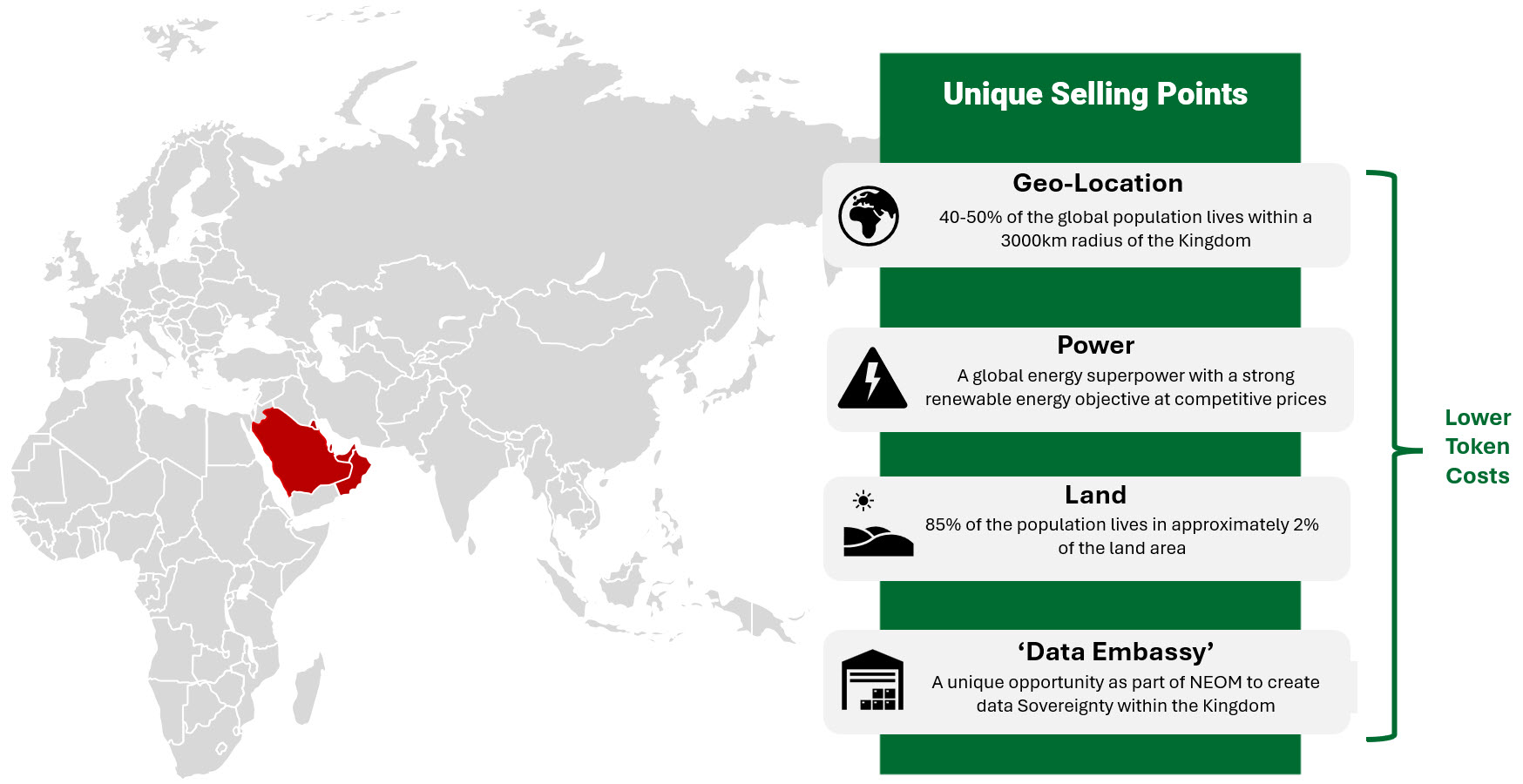
The Gulf is becoming more relevant to neoscalers because it combines strategic geo-location, power availability, land readiness, and sovereignty-led digital infrastructure.
I see four reasons the Gulf is becoming more relevant to neoscalers:
- Geo-location
The Gulf’s geographic position is becoming a bigger strategic advantage in the AI era. It sits between major growth markets and major infrastructure routes, making it increasingly relevant for providers that need regional reach, not just isolated capacity. For neoscalers, that means a stronger base for serving demand across adjacent markets while supporting cross-regional data flows and distributed AI services. - Power
Power remains one of the region’s most important advantages. Long-term energy investment, growing sustainable power ambitions, and large-scale digital infrastructure plans are helping create conditions that matter for high-density AI workloads. For neoscalers, the key issue is not only whether power is available, but whether dense compute environments can access reliable power at a commercially sustainable cost over time. Training and inference infrastructure are energy-intensive, and their economics depend heavily on long-term power availability, cooling, and operational resilience. This makes power availability and energy economics central to the Gulf’s relevance as a potential base for next-generation compute and inference infrastructure. - Land
Land and deployment readiness matter more than many headlines suggest. For neoscalers, readiness means whether large-scale AI campuses can be planned, connected, supplied, and expanded in a coordinated way. In the Gulf, large-scale campuses can often be planned alongside wider national infrastructure programs and connectivity investment. That includes access to suitable land, utilities, fiber routes, logistics, cloud ecosystems, and national digital infrastructure planning. That can help make phased infrastructure scaling more practical and coordinated, rather than treating each data center or compute site as an isolated build. - Data embassy
The Gulf is also becoming more relevant for sovereignty-led digital infrastructure. In Saudi Arabia and the UAE, cloud and AI platforms are evolving in ways that support local jurisdiction, regulatory alignment, and trusted operations for regulated sectors. That matters because AI infrastructure becomes more valuable when it can support real workloads in government, healthcare, finance, energy, and other data-sensitive environments.
Why networks matter more than headlines
This is where the story shifts from capacity to execution. Neoscalers in the Gulf are building AI platforms in a more difficult global environment. Inflation is raising the cost of power, construction, equipment, and skilled labor. Geopolitical tensions, tariffs, and export controls are also making advanced hardware harder to access. At the same time, governments are placing greater emphasis on local ownership, data control, and security. In that environment, the network becomes a way to manage risk, improve efficiency, and stay competitive.
Scalable networks help neoscalers avoid oversizing isolated data centers for peak demand. By connecting multiple sites, they can share resources across locations, use GPUs and power more efficiently, and scale in stages. That lowers the cost per AI workload and allows capacity to be added where it makes the most operational and economic sense.
The same logic matters when deployment is uneven. Hardware may arrive in phases or be spread across different sites, cities, or jurisdictions. With the right network in place, those distributed assets can still operate as one logical AI platform. That reduces dependence on any single site and improves resilience.
That point matters in the Gulf because many AI environments in the region will not stay inside one building. They will span campuses, metros, cloud zones, enterprise environments, and sovereign boundaries. As those environments expand, the transport question changes. It is no longer only where traffic moves. It is also how connectivity is sourced, controlled, and scaled. Governments want infrastructure that supports national priorities and keeps sensitive data under local control. Networks make that possible through local routing, isolation, and monitoring. In that kind of environment, the network becomes part of the AI service itself.
Many neoscalers start with leased capacity and then move toward hybrid or dedicated approaches as bandwidth demand, control requirements, and costs become more complex.
| Decision criteria | Lease | Hybrid | Build |
|---|---|---|---|
| Barrier to entry | Low | Medium | High |
| Control | Low | Medium | High |
| Deployment timeline | Fast | Medium | Slow |
| Cost profile | OPEX-heavy | Balanced | CAPEX-efficient |
As AI environments extend across campuses, cloud zones, and sovereign boundaries, many neoscalers evolve from leased connectivity toward more hybrid or dedicated transport models.
This shift also matters because AI workloads place different demands on the network. Training requires high, predictable throughput between GPUs, while inference depends more on low latency close to users. That allows training to be concentrated in larger campuses, while inference can sit closer to demand across the region. Networks can also support regulatory requirements through local routing, monitoring, and data control from the outset.
For neoscalers, AI performance is not determined only by the amount of compute available, but by how efficiently that compute can be connected across sites. Scale across architectures are sensitive to packet loss, congestion, and latency variation over distance. As AI infrastructure in the Gulf becomes more distributed across campuses, cloud zones, and sovereign environments, predictable inter-site connectivity becomes increasingly important. In this context, the network is not just a transport layer; it becomes part of how AI capacity is pooled, scaled, and delivered as a service.
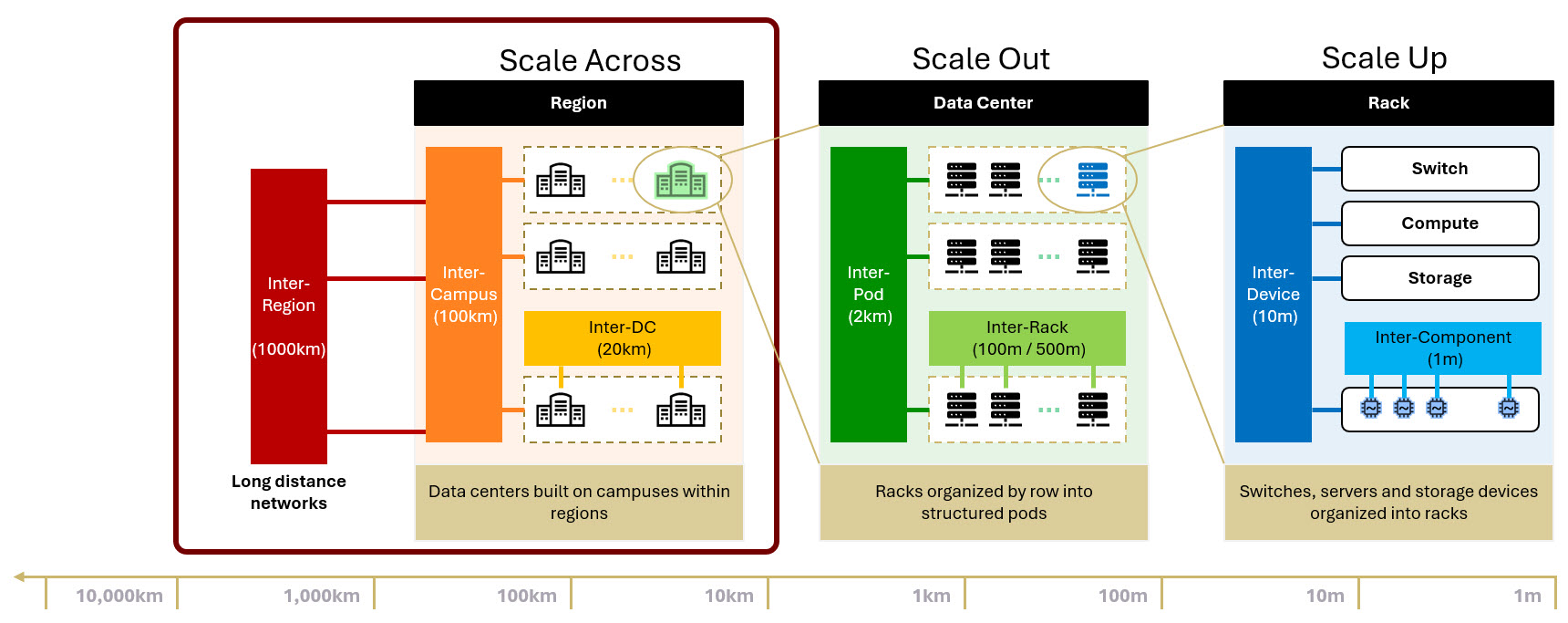
AI-ready connectivity spans scale-up, scale-out, and scale-across domains, from inside the rack to inter-data-center and inter-region transport.
What this means for neoscalers
For neoscalers, the Gulf opportunity is not simply to host AI. It is to build AI platforms that can scale, connect, and serve customers effectively in a region where infrastructure, sovereignty, and demand are increasingly moving in the same direction. The advantage is not just access to compute. It is the ability to combine compute strategy with the right network architecture, the right operating model, and regional footprint.
Neoscalers need to decide where capacity should sit, how workloads should be distributed, when leased connectivity is sufficient, and when hybrid or dedicated transport becomes necessary. They also need to think beyond a single site. As AI environments spread across campuses, cloud zones, enterprise environments, and sovereign boundaries, the network starts shaping performance, resilience, compliance, and the economics of the service itself.
That is why the Gulf is becoming more relevant. The region is beginning to offer the ingredients for a new class of AI platform: sovereign where needed, regionally relevant, enterprise-ready, and increasingly connected in the right ways. For neoscalers that align compute strategy with transport strategy early, that is a stronger position than raw capacity alone.