






January 26, 2026
CTO of the Americas, VP of Sales Engineering and Strategic Solution Sales
AI and blockchain are transforming competitive advantage — but only for those who can move data faster, safer, and smarter. From accelerating model training to securing global ledgers, infrastructure decisions about how you connect sites, systems, and partners can make or break performance. That’s why more leaders are asking: Should we build or buy our network core? Kevin Sheehan, Ciena’s Chief Technology Officer of the Americas dives in.
In the worlds of AI and blockchain, there’s no shortage of talk about compute power, GPU clusters, edge nodes, and large language models. But here’s the part that often gets overlooked: none of it delivers value without a rock-solid network underneath.
Your infrastructure is only as good as your ability to move data — quickly, reliably, and at scale. For AI workloads, a long time to move datasets hinders training efficiency and slows project execution. For blockchain, latency can lead to delayed consensus, missed validation windows, or degraded performance across distributed nodes. And potentially loss of Proof of Work.
These systems don’t just need high bandwidth — they need the kind of uptime, low latency, and high security you can bet your reputation on.
So, here’s the question I keep hearing from founders, engineers, and CTOs across the Americas: Do we build our own fiber network, lease a lit service, or combine the two in a hybrid approach?
Truth is, there’s no single right answer. But each path comes with its own advantages — and risks. Let’s walk through them, plain and simple.
Option 1: Dedicated fiber: Full control, but you own ALL the risk
Building your own fiber network gives you unmatched control, scalability, and flexibility. You decide how it’s lit, what equipment to use, and when it gets upgraded. However, if you are new to running a network, you will have to locate, recruit, and hire talent to run this infrastructure.
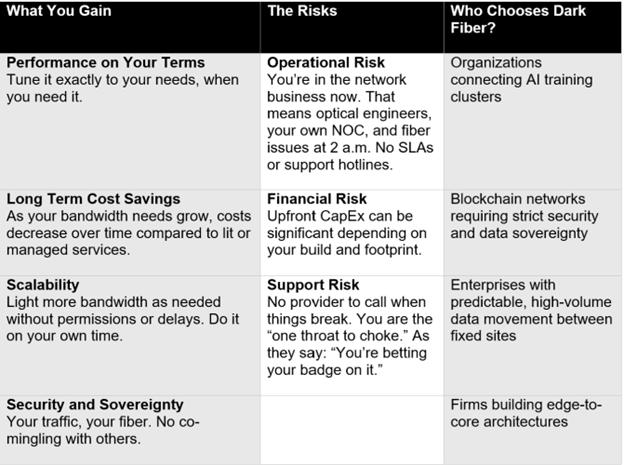 Who chooses to “build their own” and why?
- Organizations connecting AI training clusters: When you're moving massive datasets between data centers or across compute environments, latency and throughput aren’t just performance metrics — they’re productivity bottlenecks. AI workloads, especially during training, require high-speed, low-latency, and predictable network performance. Dedicated fiber provides full control of the high-capacity, high-performance transport needed to keep training cycles running efficiently and without interruption.
- Blockchain networks with strict security and data sovereignty requirements: For blockchain infrastructure — particularly when operating validation nodes, consensus mechanisms, or custody services — data security and network isolation are critical. Dedicated fiber enables organizations to physically separate their traffic from the public internet and multi-tenant service providers, reducing exposure and delivering a higher level of sovereignty and compliance.
- Enterprises with predictable, high-volume data movement between fixed sites: When traffic patterns are stable, and volumes are consistently high—like between data centers or regional hubs—dedicated fiber offers long-term economic benefits. But even in more dynamic environments, some enterprises choose to build fiber to rapidly scale bandwidth on demand without waiting on a provider. Whether the priority is cost efficiency or control, dedicated fiber gives operators flexibility to adapt as needs evolve.
- Teams that require full control over performance, upgrades, and future capacity: Dedicated fiber gives you ownership of the optical layer. That means you can control everything from how it’s lit to when and how it’s scaled. For teams that need fine-tuned performance or expect significant growth, this level of control can be a strategic advantage — especially when paired with the correct network expertise.
- Firms building edge-to-core architectures: As both AI and blockchain ecosystems extend into the edge — with micro data centers, localized inference, or distributed validators — having a consistent, high-performance backbone from edge to core is key. Owning the fiber can be the foundation for this architecture, allowing organizations to maintain performance and control across geographies and network domains.
Option 2: Lit services: Simplicity, reliability, and availability, but with dependence
With lit services, you’re riding on someone else’s fiber network. Think high-speed, fully managed, state-of-the-art connectivity — without the headaches of managing your own fiber and equipment.
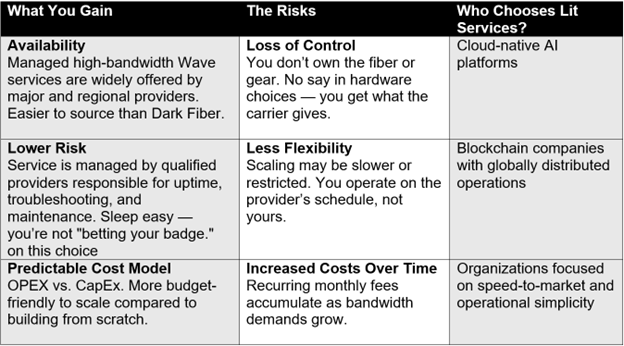 Who chooses lit services, and why?
- Cloud-native AI platforms and startups: Teams that are building entirely in the cloud — or consuming compute and storage as-a-service — often don’t need to manage physical infrastructure. For them, lit services offer a fast, low-friction way to connect to hyperscalers, data centers, and peering exchanges without the burden of owning and maintaining fiber and or optical equipment.
- Blockchain companies with globally distributed operations: When your infrastructure spans multiple regions or continents, building and maintaining your own dark fiber network simply isn’t practical. Lit services provide the reach and redundancy needed to connect nodes, exchanges, and endpoints across diverse geographies while maintaining performance and uptime guarantees through SLAs.
- Organizations focused on speed-to-market and operational simplicity: If time-to-value is a priority, lit services eliminate the complexity of network deployment and management. Teams can quickly turn up capacity, avoid hiring specialized staff, and rely on service-level agreements to ensure performance and reliability.
- Businesses managing variable workloads and changing network needs: For use cases with seasonal or unpredictable traffic patterns, lit services provide flexible bandwidth options that can scale up or down based on demand. This allows businesses to align cost with usage, rather than overbuilding infrastructure that sits idle for part of the year.
- Teams prioritizing focus on product and innovation over infrastructure: Not every company wants to become a network operator — and that's okay. Lit services are ideal for teams that want to stay focused on what they’re building, not how it’s delivered. Outsourcing transport allows them to allocate more time and talent toward software, AI model development, or blockchain innovation.
Option 3: Hybrid: More options, but not without complexity
Most modern teams don’t pick just one network design — they blend dedicated fiber, wavelength services, and lit managed services as required to match mission-critical needs, workloads, and service availability. Private Dedicated Networks (PDNs) or Managed Optical Fiber Networks (MOFNs) offer a pathway to dedicated, lit fiber networks as managed services. Hybrid architectures combine leased and owned networks and services where it makes sense for a more complete and flexible networking strategy.
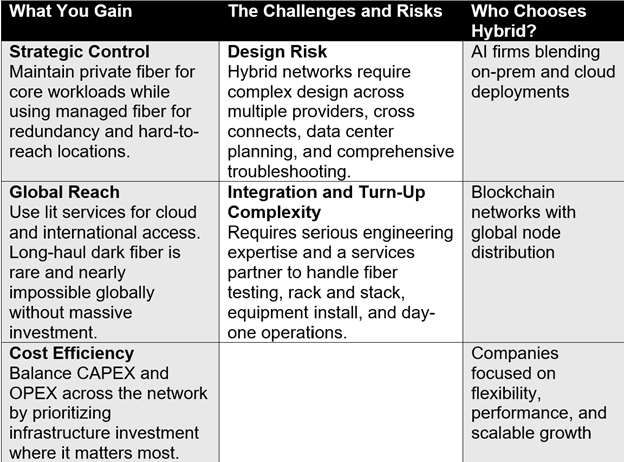 Who Chooses Hybrid and why?
Blockchain Networks with Global Node Requirements
Blockchain operators often maintain a mix of core validator nodes and edge nodes distributed across geographies. With hybrid networking, they can:
- Own the core routes supporting latency-sensitive operations and transaction finality.
- Lease managed connections to public or partner infrastructure in regions where dark fiber isn't viable or cost-effective.
- Improve sync speed and resiliency through a blend of redundancy strategies.
Why hybrid? It supports decentralization goals while ensuring fast, reliable connectivity across global sites. And sometimes you just cannot build or procure dark fiber on all of the routes that are required.
Companies prioritizing flexibility, performance, and growth
For teams scaling rapidly—or unsure of future workloads—hybrid models allow for:
- CapEx and OpEx balance: Invest in dedicated fiber where ROI is clear, and leverage lit services where time-to-market is more critical.
- Geographic customization: Use different approaches based on local availability, regulatory needs, or vendor ecosystems.
- Future-proofing: Start with managed services and gradually migrate to dark fiber as volumes and internal capabilities grow.
Why hybrid? It provides a flexible foundation that evolves with the business, without forcing an early, permanent commitment.
It’s not just about picking a product — it’s about choosing the right partner to build the right strategy
Every path — dedicated fiber, lit services, or hybrid — comes with its own trade-offs. The difference between success and setbacks often comes down to having the right partner by your side.
At the end of the day, it’s not just about choosing a technology. It’s about building a network strategy that fits your unique challenges, growth plans, and performance expectations — and working with a team that knows how to get you there.
Ciena brings the expertise, the portfolio, and the practical know-how to help you map the best path forward. Whether you need fully private connectivity, managed services, or a combination of both, we help you design with confidence, avoid costly missteps, and scale smarter.
Choosing the right partner doesn’t mean giving up control — it means gaining clarity, accelerating execution, and setting your infrastructure up to support everything you’re building. Whether you’re standing up a GPU cluster, moving petabytes of training data, or launching decentralized services around the globe — your network should accelerate your roadmap, not slow it down.