



Once often associated primarily with metro networks, data center interconnect (DCI) spans a wide spectrum of use cases—from campus and backbone to submarine connectivity and now scale-across AI clusters. In this blog, Ciena’s Helen Xenos explores the requirements behind each DCI deployment and how the right technology helps make them work.
When someone says data center interconnect (DCI), what’s the first thing that comes to mind?
If you’re like most people in the industry, you probably picture a simple, regional link connecting two nearby data centers—a classic Metro DCI deployment. And you wouldn’t be wrong. But that view captures only a small part of a much larger story.
The reality is that DCI has always been about more than metro. Data centers have long been interconnected across campuses, regions, backbones, and even continents. What’s new—and driving much of today’s conversation—is scale across. Fueled by AI and distributed compute, scale across introduces a new set of requirements that are reshaping how people think about interconnecting data centers.
So, let’s take a tour. What are the key DCI use cases today? What unique performance, reach, and operational requirements does each one demand—and how does Ciena help customers address them with the right technology for the job?
Metro DCI: Simple, fast, and space-conscious
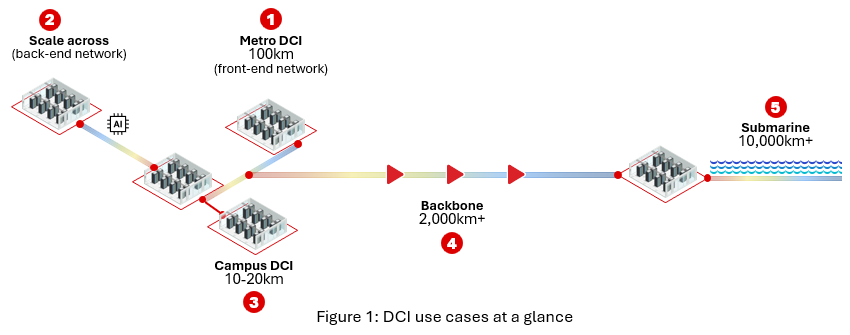
Metro DCI is where most conversations begin—and for good reason. Part of the front-end network in data center architectures, this use case typically involves point-to-point connectivity over 80–100 km, linking data centers within a metro or regional area.
What matters most here? Low power consumption. Space efficiency. Simple, fast deployment.
Metro DCI is all about efficiency. Cloud providers want to scale bandwidth quickly without filling racks or exceeding power budgets. As a result, coherent pluggables have become the preferred approach, enabling high-capacity links directly from router ports. With WaveLogic™ Nano 400ZR and 800ZR coherent pluggables, Ciena enables dense, interoperable Metro DCI deployments, paired with simple-to-deploy RLS photonic line systems that provide the required optical amplification and wavelength management.
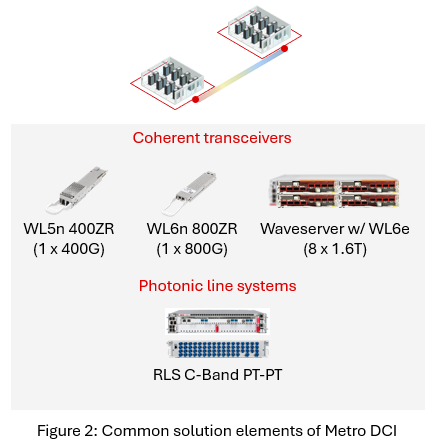 A key reason RLS is so popular for this application is that it delivers more than high-density DWDM interconnect. RLS automatically equalizes wavelength power levels—resulting in less troubleshooting and manual tuning, faster rollouts, and stable, optimized performance from day one. With open northbound APIs, RLS also supports rapid integration into cloud provider management systems.
And even within metro environments, DCI solutions are not a one-size-fits-all. For cloud providers constrained by limited fiber availability, Ciena also offers WaveLogic 6 Extreme (WL6e) 1.6 Tb/s solutions, delivering 50% more capacity per fiber compared to coherent pluggables—maximizing existing fiber assets while keeping the architecture simple. For security-conscious customers, WL6e also supports ultra-low-latency, AES-256-GCM encryption, enabling always-on, quantum-safe data protection at the optical layer to securely connect locations.
And as metro capacity demands continue to grow, Ciena’s roadmap extends beyond 800G, with 1600ZR coherent pluggables already in development—ensuring Metro DCI architectures remain future-ready.
Scale-across DCI: When two data centers must act like one
What if the challenge isn’t simply connecting data centers—but making them behave like a single logical AI training cluster?
That’s the promise behind scale-across architectures. Instead of keeping an AI training cluster inside one facility, scale across allows a single xPU cluster to span geographically separated data center campuses, each built where power is available. The result: the performance of one massive AI cluster—while unlocking access to new power pools and enabling geographic resiliency.
But it comes with a catch. Scale across introduces an entirely new class of requirements: the inter-data-center network can’t behave like a traditional transport link. It has to function as an ultra-scalable, lossless, deterministic extension of the intra-data-center fabric—with massive bandwidth, ultra-high availability, and minimal latency.
And there’s another shift happening here: delivering that kind of capacity over distance requires coherent optics and photonic line systems, bringing these technologies into the AI cluster for the first time. As the global leader in DCI, Ciena is uniquely positioned to help customers bring this next-generation architecture to life—at scale, and with the performance and reliability AI demands.
With deployments that can involve hundreds of fiber pairs, customers need an architecture that delivers extreme bandwidth and reliability—without driving disproportionate cost, footprint, or operational complexity. And unlike many network upgrades, scale across isn’t something you turn up gradually—capacity, fibers, and infrastructure all need to scale at the same time. That drives fast, high-volume deployment requirements across both coherent optical transceivers and the supporting photonic line systems, making purpose-built infrastructure essential for massive inter-data-center connectivity.
Ciena addresses this with the RLS C&L-band DCI system, paired with interoperable high-performance WaveLogic 6 Nano (WL6n) 800Gb/s coherent pluggables. Together, they enable ultra-reliable, deterministic DCI links optimized for the distances and scale required to support distributed AI training.
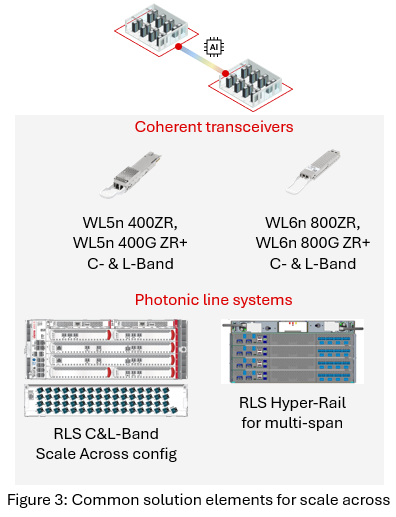 As scale-across deployments extend beyond a single span, another challenge becomes unavoidable: densification in intermediate amplifier sites. These locations must accommodate dramatically higher fiber counts and capacity—often 10+ times more—within the same physical footprint, with power availability frequently becoming the more acute constraint than space, all while maintaining operational simplicity. Meeting these requirements is a prerequisite for multi-span scale across to become practical at scale—which is why Ciena is developing RLS Hyper-Rail amplification configurations to enable the next phase of scale-across deployments.
And when you’re turning up massive capacity on day one, it raises another question: why light only part of the spectrum? Ciena has a clear vision for how full-spectrum transponders can help customers accelerate time-to-capacity by enabling efficient, end-to-end turn-up of the full optical band from the start.


Which is why Ciena is developing RLS Hyper-Rail amplification configurations to enable the next phase of scale-across deployments
Campus DCI: Rethinking short-range connectivity
But before we jump across cities—or continents—let’s zoom in to the campus, where rising interface speeds are quietly reshaping what “short” links really mean.
Campus DCI might sound straightforward—after all, we’re often talking about just a few kilometers, right? Historically, these links have relied on IMDD technology. But here’s the challenge: as line rates climb, IMDD can’t always deliver the reach customers need to connect distributed facilities across the campus.
So, what’s the alternative?
Ciena’s Coherent-Lite pluggables offer a practical path forward. They extend campus connectivity up to 20 km (or an equivalent loss budget) using coherent modulation, while maintaining a cost, power, and latency profile comparable to IMDD—making it easier to upgrade speeds without changing how the network is built and operated.
The big win? Customers gain the reach they need to scale campus connectivity with confidence—without unnecessary complexity or over-engineering. It’s a smarter way to future-proof campus DCI as speeds continue to rise.
Backbone and submarine DCI: Going the distance
Now let’s zoom back out—because backbone and submarine DCI take connectivity to the extreme.
What happens when data centers need to connect across continents…or across oceans? In these environments, every dB, every Hz, and getting the most out of every fiber pair matters. Networks must deliver long-distance performance, high availability, and relentless capacity growth—often on infrastructure that’s too valuable (or too difficult) to replace.
This is where coherent performance and photonic line system design become critical.
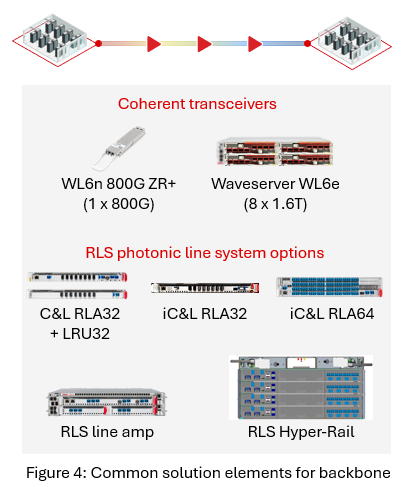 For backbone networks, Ciena offers a full range of C- and C&L-band photonic line systems engineered to support multiple generations of coherent technology without requiring additional hardware—helping customers scale capacity over time while protecting their original investment and avoiding costly, time-consuming network upgrades for missing-critical AI infrastructure. And as backbone networks densify, RLS Hyper-Rail enables higher-density line amplification configurations—supporting more fibers and more capacity in the same physical space, without adding operational complexity.
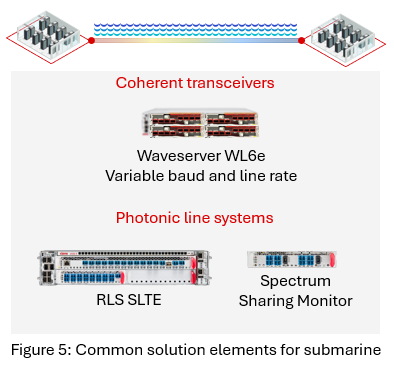 For submarine deployments, Ciena provides compact 2RU RLS SLTE configurations, minimizing space and power consumption in cable landing stations where footprint is at a premium. Ciena also offers SLTE configurations optimized for secure spectrum sharing, enabling multiple parties to safely share wet-plant capacity while maintaining strong performance isolation and operational control.
On the optics side, WL6e 1.6 Tb/s transponders deliver industry-leading fiber capacity for long-haul and submarine applications, including quantum-safe encrypted data communications that supports Post Quantum Cryptography (PQC) algorithms. WL6e also supports specialized transmission modes for both D++ and compensated cables, enabling customers to upgrade precious cable assets and extend usable cable life as demand continues to rise.
And for cases where footprint and power are paramount, high-performance transmission modes in WL6n 800G pluggables are expanding deployment options. With Ciena’s PKT-MAX transmission mode, 800G pluggables can now be extended to more applications—simplifying architectures while maintaining the performance required for demanding long-haul connectivity.
One DCI strategy, many use cases
So, what’s the takeaway?
DCI isn’t a single use case anymore. It’s a continuum—from campus to metro, from scale-across to submarine. Each segment has its own requirements, but customers don’t want a patchwork of disconnected solutions.
You want simplicity.
You want scalability.
And you want a clear path forward.
By offering the industry’s broadest coherent portfolio—from pluggables to line systems, from short-reach to transoceanic—Ciena enables customers to build DCI architectures that adapt as applications evolve and bandwidth demands grow.
And maybe the most important question of all: Is your DCI strategy ready for what comes next?