






April 28, 2026
By Chris Bayly
Managing Director, KSA, Ciena
Saudi Arabia’s next AI advantage will depend not only on compute, but also on the sovereign network fabric that helps AI perform at scale. Ciena’s Chris Bayly explains below.
In the global AI discussion, it is tempting to focus on models, chips, and data centers. But in Saudi Arabia, the more strategic question is this: what infrastructure will allow AI to operate securely, reliably, and at a national scale?
That is why Saudi Arabia’s AI infrastructure moment is not only about AI capacity. It is also about building the right foundation for sovereign execution.
The Kingdom is emerging as one of the region’s most strategically coordinated digital markets. What matters is not only the policy direction, but also how Saudi Arabia’s digital sovereignty is increasingly being expressed through cloud-first government policy, state-backed AI infrastructure, and stronger control over the connectivity routes that link digital assets within the Kingdom and beyond it.
From data centres to national AI fabric
At LEAP25, Saudi Arabia announced more than $14.9 billion in AI-sector investments and projects, reinforcing the Kingdom’s position as a regional and global AI hub. But the long-term significance of these announcements lies not only in added capacity. It also lies in what they require next: a national AI fabric that can connect data centers, cloud environments, enterprises, and inference locations with resilience and scale.
Ciena’s recent work on AI networking makes this shift clear. Data center interconnect (DCI) is no longer limited to metro connectivity. It now spans campus DCI, metro DCI, backbone networks, submarine connectivity, and scale-across architectures that connect distributed GPU environments across multiple facilities.
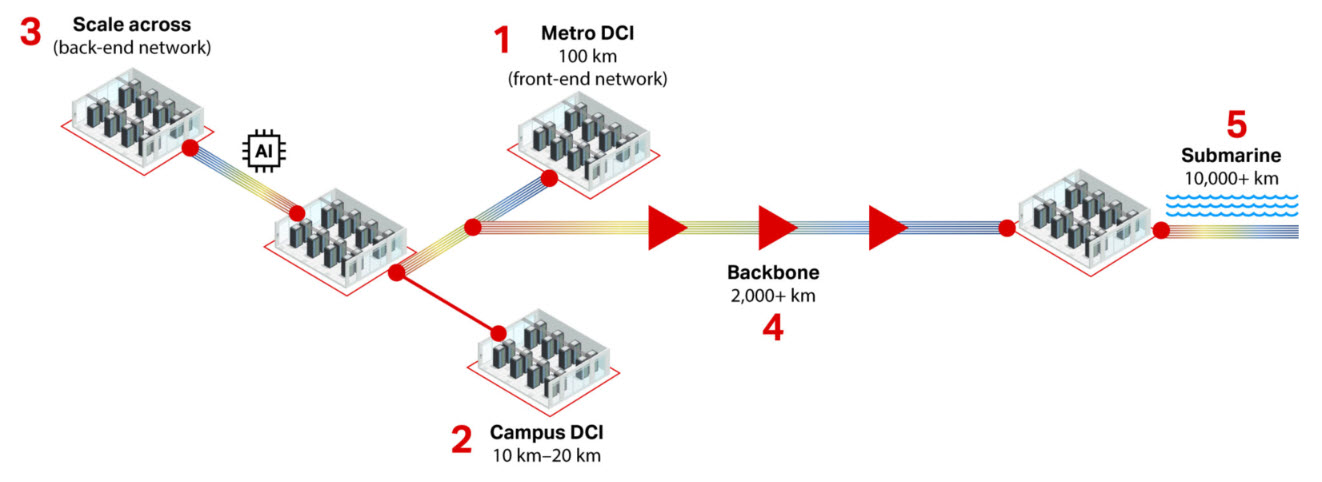 AI changes the infrastructure challenge from single-site compute to multi-site performance, making scale-across connectivity increasingly strategic.
For Saudi Arabia, that point matters. The opportunity is not only to host AI workloads inside individual facilities, but also to connect them through a broader sovereign digital fabric.
Why the network layer has become strategic
Saudi sovereignty is increasingly being supported through platforms such as HUMAIN and the infrastructure ecosystems around them. HUMAIN has underscored the importance of connectivity through its framework with center3, stating that connectivity is fundamental to Saudi Arabia’s AI ecosystem.
At the same time, center3’s role in strengthening the Kingdom’s position in international data connectivity reflects a broader reality: Saudi Arabia’s opportunity is not only to host AI, but also to connect it across the Kingdom, across the Gulf, and between continents. This broader connectivity buildout is not limited to one operator. Mobily, for example, has highlighted investments in subsea systems including SMW6 and Africa 1, as well as its Red Sea Crossing route connecting Duba in Saudi Arabia to Sharm El Sheikh in Egypt, adding a new diverse path across the Red Sea. Together with data centre expansion, these investments are strengthening Saudi Arabia’s links to Asia, Europe, and Africa and supporting the Kingdom’s wider digital infrastructure ambitions.
A new generation of AI-native infrastructure providers, known as neoscalers, does not compete on GPUs alone. High-capacity connectivity, low latency, simplified operations, and speed to market are also critical. That is why the network has become strategic to AI economics, not merely supportive of them.
Why route diversity and regional interconnection matter
Saudi Arabia’s emerging regional connectivity architecture is increasingly focused on route diversity, resilient terrestrial links, and stronger east-west interconnection between landing stations, data centres, and cross-border infrastructure. Recent Saudi-Oman terrestrial initiatives point to growing interest in building redundant regional paths that can improve continuity, flexibility, and long-haul resilience.
For sovereign AI, that matters because resilient and diverse connectivity helps reduce dependence on single paths while improving availability, control, and scalability across a distributed infrastructure footprint.
This also explains why the dark, lit, or hybrid decision is becoming more strategic. The choice is no longer only commercial. It also shapes how network operators balance control, speed, flexibility, and scale as AI traffic grows. In sovereign environments, that balance becomes even more important.
What this will enable in practice
The infrastructure layer around AI investment will determine what the Kingdom can enable in practice.
It can support distributed training and scale-across architectures. It can enable higher-capacity data movement between sites. It can support the shift from training-focused environments toward more inference-heavy ones as AI adoption and new use cases evolve. And it can help sovereign platforms operate with the security, resilience, and route control that national priorities require.
Saudi Arabia’s next move
Saudi Arabia already has the scale, policy direction, and investment momentum to shape the next phase of AI infrastructure. The question now is not whether the Kingdom will participate in that future, but how decisively it will define the standards, corridors, and digital foundations that support it.
If the infrastructure layer is built with the same clarity of purpose now visible across the market, Saudi Arabia will be well-positioned not only to lead in sovereign AI but also to help shape the regional model for how it is built and operated.