






June 24, 2026
By Pete Hall
Regional Managing Director, MEA
AI will do more than just add more traffic to operator networks. Ciena’s Pete Hall explains why it will change who operators sell to, where demand appears first, and how connectivity is monetized.
The first AI shift is commercial, not just technical
When operators hear “AI infrastructure,” the instinct is often to think about future traffic growth. However, the near-term shift is more commercial than statistical. While AI workloads initially concentrate demand inside and between data centers, the first operator opportunity is not a broad consumer or enterprise traffic surge. It is the interconnection layer around AI infrastructure itself, especially high-capacity data center interconnect (DCI), cloud adjacency, and transport layers that connect new AI sites to one another and to the wider digital economy.
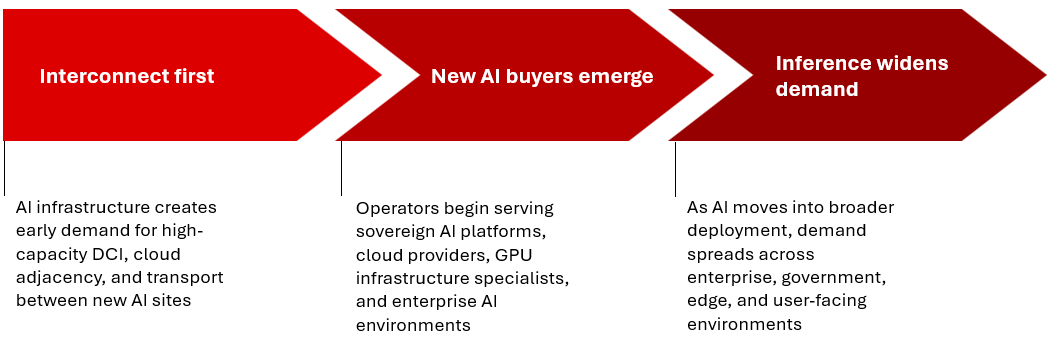
Figure 1: The AI opportunity for operators is likely to emerge in phases, from interconnect to new customer demand to distributed inference.
That distinction matters across the Middle East. The region is moving from AI ambition into AI buildout, with cloud expansion, sovereign AI programs, and new digital infrastructure investment creating demand for more resilient, higher-capacity interconnection. For operators, the first AI opportunity is not waiting for AI traffic to appear everywhere. It is deciding how to position around the interconnect layer that AI infrastructure needs now.
Recent public announcements help make that shift more tangible. Saudi Arabia’s MCIT announced more than US$14.9 billion in AI-related investments at LEAP 2025, an official signal that AI is moving from national ambition into infrastructure deployment. For operators, the significance is not simply the investment figure; it is the likelihood that compute, cloud, data residency, and sovereign AI platforms will need to be joined through reliable, high-capacity transport rather than treated as isolated data center builds.
DCI is becoming a strategic layer
This is why DCI is no longer just a metro story. In the AI era, it spans campus interconnect, metro links, backbone transport, and, increasingly, regional and international routes that help distributed AI environments operate as an integrated system.For operators, that change is where value sits in the network. It raises the importance of the links between facilities, cloud zones, carrier hotels, data centers, and regional corridors that connect digital infrastructure across the region. That shifts the opportunity from selling bandwidth to helping build and operate an AI-ready transport fabric across multiple layers.
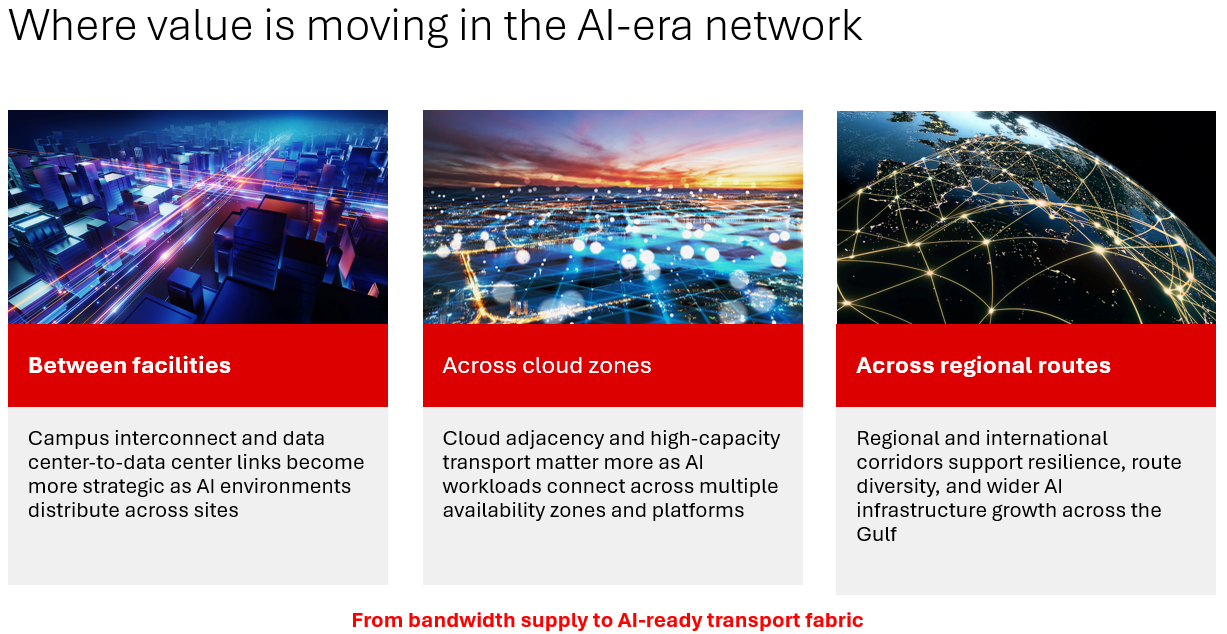
Figure 2: In the AI era, operator value increasingly sits in the interconnection layer between facilities, cloud zones, and regional routes.
Regional proof points are already emerging. In the UAE, e& deployed WaveLogic™ 6 Extreme (WL6e) on its optical network, linking the move to the traffic sensitivity of AI data center hubs. In Oman, Omantel launched a managed optical fiber network (MOFN) designed to support hyperscalers, cloud providers, and large enterprises as AI and cloud infrastructure requirements grow. In Bahrain, Batelco by Beyon has expanded white-space and edge data center infrastructure positioned around low-latency, sovereign, and AI-ready services. Taken together, these are early signs of a broader regional shift: operators are beginning to align transport strategy more closely with AI infrastructure demand.
Route diversity is another dimension of that DCI story. Batelco and BNET’s landing-infrastructure agreement for the SMW6 and Al Khaleej submarine cable systems points to a wider regional requirement: AI and cloud growth will depend not only on local data center capacity, but on resilient cross-border paths that can support distributed workloads and wholesale traffic between Gulf markets.
AI is widening the customer base
A second shift is that the AI connectivity market is broadening beyond hyperscalers alone. A wider class of AI-native buyers is emerging, including sovereign and digital platform providers, cloud and neocloud operators, GPU infrastructure specialists, and enterprise AI environments that need high-capacity, lower-latency, and more flexible connectivity models.
This is one reason the Gulf matters so much in the regional picture. It is not only building hyperscale-adjacent infrastructure. It is also building sovereign AI environments, regulated-industry AI capacity, and national-scale digital platforms. That makes the operator opportunity broader and more durable. Operators are no longer serving only a narrow set of global cloud buyers. They are entering a market where AI connectivity demand is becoming a category in its own right.
Across the region, AI infrastructure is being shaped through a mix of sovereign platforms, large-scale compute investment, managed connectivity, and lower-latency digital infrastructure. The precise pace and model will differ by market, but the wider direction is increasingly clear.
Inference will widen the opportunity again
If interconnect is the first AI opportunity, inference is likely to be the next major network stress point. Training tends to concentrate demand around major AI facilities, but inference pushes demand outward into enterprise, government, developer, and user-facing environments.
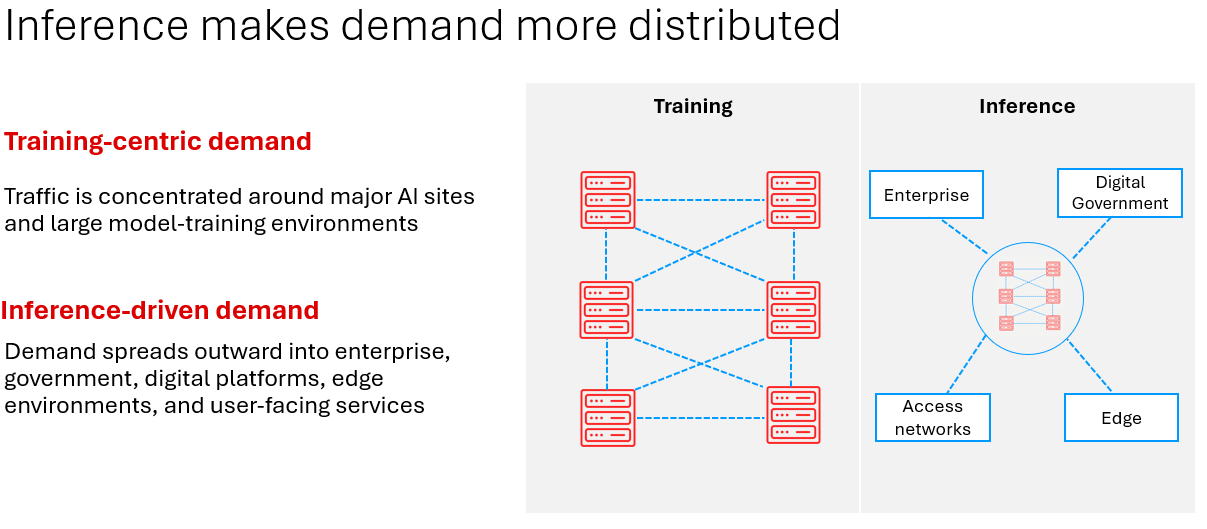
Figure 3: As AI shifts from training to inference, network demand spreads outward into more distributed and service-sensitive environments.
That matters in the Middle East because the region is not building AI only for model training. It is also building for regulated sectors, digital government, finance, healthcare, logistics, and national platforms where performance, sovereignty, and service quality matter. In that environment, inference will not remain confined to one campus. It will spread across cloud regions, enterprise environments, edge locations, and national digital systems.
The commercial implication is important. Operators might find that AI monetization first appears beyond generalized bandwidth growth, in premium interconnection, cloud adjacency, route diversity, latency-sensitive transport, and service models designed for AI infrastructure customers.
The operator playbook is changing now
The practical takeaway is straightforward. AI will reshape the Middle East’s operator opportunity in three phases. The first phase is interconnect around AI infrastructure, the second is serving a broader ecosystem of AI-native and sovereignty-sensitive customers, and the third is supporting more distributed inference at scale.
This is becoming a near-term commercial question for operators across the region, not a distant architecture debate. The ingredients are already visible in different ways across the Gulf: cloud geography, sovereign AI investment, new AI campuses, transport upgrades, managed optical infrastructure, and edge and co-location expansion built with digital infrastructure growth in mind.
Operators that recognize that sequence early will be better placed to capture near-term AI connectivity demand while building the network fabric required for what comes next. That is why this matters now. In the Middle East, AI is no longer a technology trend to monitor. It is becoming a network cycle to prepare for and a defining growth opportunity.