




What happens when the data center connectivity technologies we rely on today start running up against the limits of physics? Brodie Gage explores how rising interconnect speeds are shifting the boundaries between copper and optical—and opening the door to new approaches.
AI is changing almost every dimension of the data center: how much compute we deploy, how we power and cool it, how we package it—and increasingly, how we connect it.
I've spent a lot of time over the past few years talking with the world's largest cloud providers and service providers about what AI means for their networks. One thing has become increasingly clear: as AI infrastructure scales, high-speed connectivity is facing a physics problem.
And that's creating some interesting engineering challenges.
AI switch ASICs continue to advance rapidly. Electrical I/O lane speeds have progressed from 50G to 100G and 200G, with 400G on the horizon. With eight electrical lanes typically used per interface, that translates to interconnect speeds moving from 800G and 1.6T today towards 3.2T and beyond.
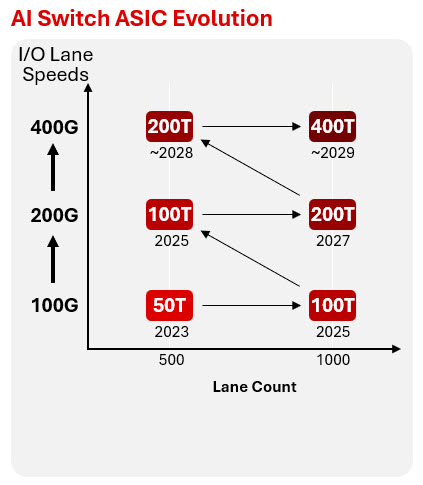
Figure 1: AI switch I/O lane speeds are rapidly increasing, with 400G on the horizon
But as speeds increase, the connectivity assumptions that have worked for previous generations begin to change.
More speed, less reach.
The faster electrical signals run, the harder it becomes to move them very far. As lane rates increase, passive copper reach shrinks and increasingly sophisticated processing is needed to preserve signal integrity.
This matters enormously in an AI data center.
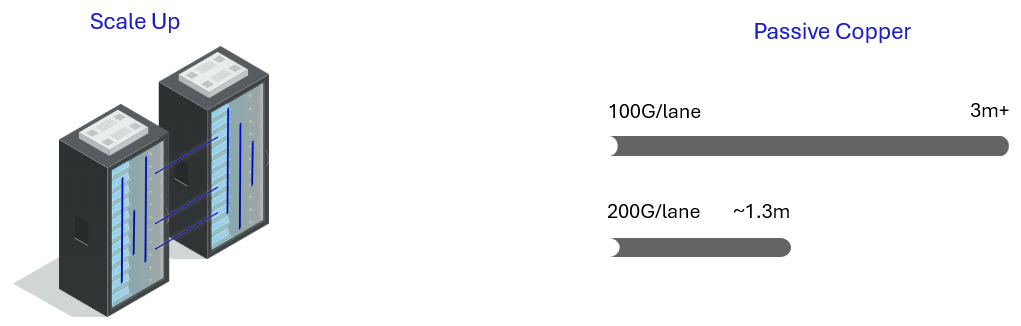
Figure 2: Scale up is reaching farther as passive copper reach gets shorter
AI clusters depend on massive numbers of high-speed connections between XPUs and switches and between switches themselves. At lower speeds, the industry has been able to rely extensively on inexpensive, low-power copper connectivity for many of those short-reach links.
But what happens when the copper cable that worked at one generation no longer reaches far enough at the next? How do we keep copper viable as speeds increase?
We can improve signal integrity and compensate for loss with active electronics, extending copper connectivity farther than passive cables can reach. But eventually, the physics and economics favor a transition to optics.
Copper will continue to be extremely valuable wherever its reach, power, cost, and latency make sense. But the boundary between copper and optical is moving closer to the compute as speeds increase.
Optical connectivity faces its own physics challenge
Moving from copper to fiber solves one propagation problem. But as capacities continue to increase and connections extend farther across the data center and campus, another emerges.
Today's intra-data-center optical ecosystem has been built largely around intensity modulation direct detection, or IMDD. It has been enormously successful. It is relatively simple, cost-effective, and supported by a broad ecosystem that has enabled optics to scale to tremendous volumes.
But IMDD optics doesn't get a free pass from physics.
As data rates rise, achieving the required reach becomes increasingly difficult. And reach isn’t the only challenge. New architectures incorporating optical circuit switches (OCS) introduce additional loss into the optical path, requiring optics to support higher link-loss budgets. The challenge becomes particularly interesting as we look at connectivity extending across OCS fabrics, beyond racks and buildings and across larger AI campuses.
At some point, traditional IMDD reaches its limits: it can no longer reliably support the required reach or loss budget. That’s where coherent optics comes into play.
This creates the second major technology transition we see: IMDD » Coherent optics
And just like the transition from copper to optics, the transition from IMDD to coherent optics won't happen everywhere at once.
There isn't one answer—and there doesn’t need to be
One of the most interesting things about this evolution is that the right connectivity technology depends increasingly on the combination of speed, distance and loss budget.
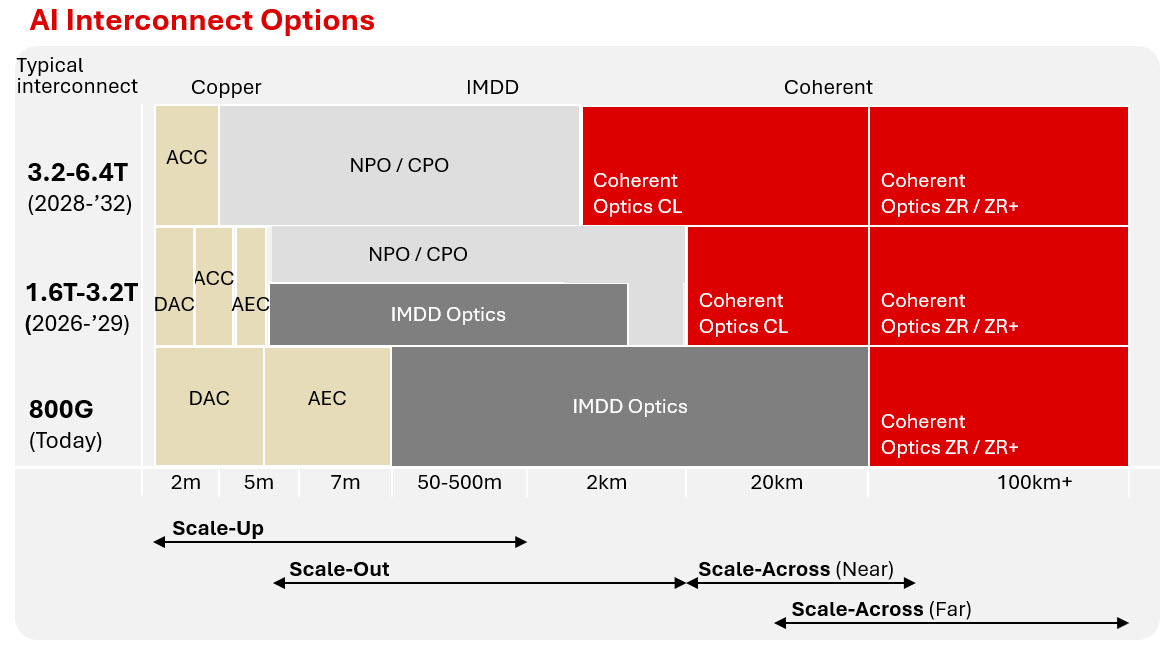
Figure 3: No single interconnect technology fits every speed and distance
At the shortest reaches, the objective is to preserve the advantages of copper for as long as possible. As electrical speeds increase and copper reach contracts, optics move closer to the switch ASIC, creating new opportunities for co-packaged and near-package optics. Farther still, traditional IMDD optics remain extremely effective. And eventually, as speed, reach, and link-loss requirements continue to climb, coherent optical technology starts to make sense in places where we wouldn't have seriously considered it before.
That means the next generation of AI infrastructure won't be built around a single interconnect technology. It will require a continuum of technologies optimized for different combinations of speed, distance, power, density, latency, reliability, and cost.
This is one of the reasons I find what's happening inside the data center so exciting.
A mature market meets a new set of problems
The data center interconnect ecosystem inside the building has historically been exceptionally well served. A broad set of silicon, cable, optics, connector, and system suppliers has created an efficient, high-volume ecosystem optimized around well-understood architectures and technology boundaries.
AI is now pushing against those boundaries.
It isn't because those technologies suddenly stopped working. It's because we're asking them to do something new.
We're asking electrical signals to travel at dramatically higher speeds. We're asking optics to deliver more bandwidth in less space and with less power. We're pushing optical technology closer to the switch ASIC. And we're asking familiar optical architectures to operate at speeds and distances where the trade-offs start to change.
When the operating point changes, the optimal technology can change with it. That's opening the door to a new wave of innovation.
This problem looks very familiar to us
For Ciena, many of the engineering challenges emerging in and around the data center are familiar ones.
For decades, we've worked with the world's largest cloud providers and service providers to solve some of the hardest signal-propagation problems in networking. We've pushed electrical and optical signals closer to their physical limits, combining expertise across high-speed analog electronics, silicon photonics, DSP, packaging, optics and systems and link engineering.
Historically, much of that innovation has been applied to moving enormous amounts of data over increasingly long distances – including between data centers and across cities, countries and continents.
Now, many of those same fundamental engineering disciplines are becoming increasingly important inside and around the data center.
The distances may be shorter, and the economics and architectures are different. But the underlying question is remarkably familiar:
How do you move more data, faster and farther, while minimizing power, space, latency, and cost?
That's a problem we know well.
And importantly, we're not approaching it with one technology and trying to make that technology fit every application. We're applying different pieces of our technology portfolio and expertise to different points along the connectivity continuum.
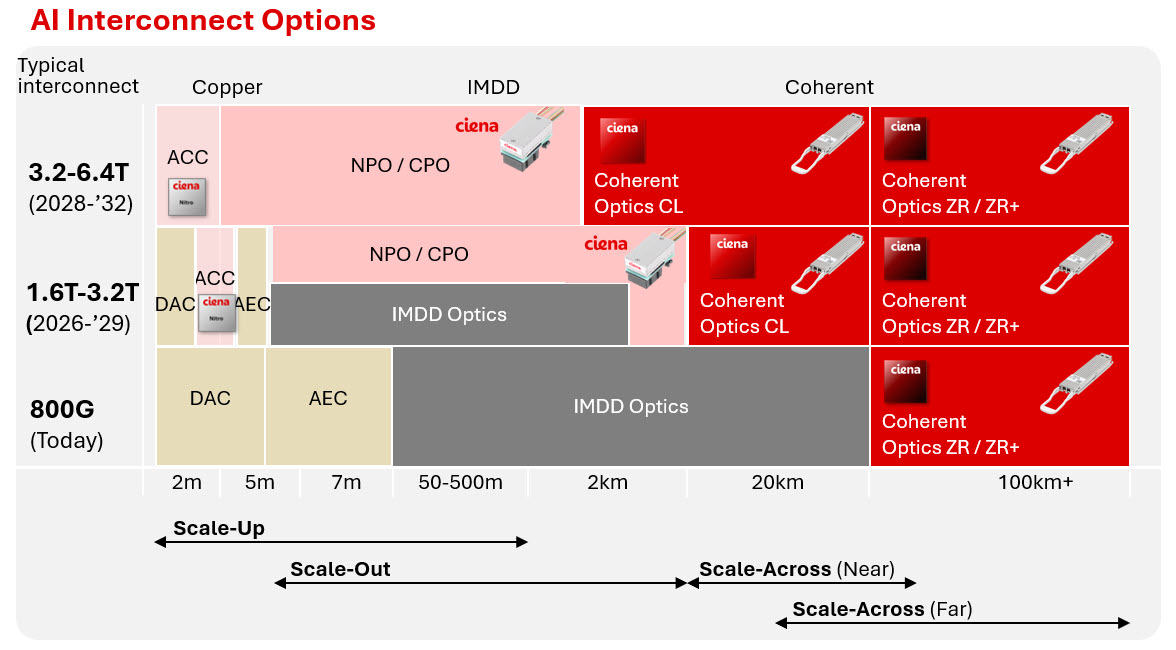
Figure 4: Ciena’s portfolio spans the AI interconnect continuum
Different challenges call for different approaches
Over the next three blogs, I'll dig into three areas where Ciena teams are working closely with customers and the broader ecosystem to address these emerging challenges:
- Scale up: how our Nitro linear redriver technology can extend the useful life and reach of copper as electrical lane speeds increase.
- Next-generation scale up and scale out: how our Vesta optical engines enable new NPO and CPO architectures as optical connectivity moves closer to the ASIC.
- Campus connectivity: how we're applying decades of WaveLogic coherent optical expertise to develop Coherent-Lite, a new class of coherent optics technology optimized for the power, cost, latency, and reach requirements of shorter-distance AI connectivity.
These are very different applications. But they're being driven by the same underlying trend: AI is driving interconnect speeds beyond the practical limits of traditional connectivity technologies. That is moving the boundaries between copper and optical, and between IMDD and coherent optics.
We've seen technology boundaries move before. In fact, much of Ciena's history has been about figuring out what comes next when the physics of high-speed connectivity changes.
Now, AI is bringing many of those same challenges in and around the data center.
And that's where the fun starts.