






As AI shifts from model training to widespread inference, enterprise traffic is becoming more distributed, dynamic, and unpredictable. Ciena’s Paulina Gomez explores how service providers can respond with more agile, on-demand connectivity to turn the evolving needs of AI into a new growth opportunity.
Artificial intelligence is entering a new phase. For the past few years, much of the industry's attention has focused on building AI infrastructure for training ever-larger models capable of delivering better and more insightful outputs. Hyperscalers have invested billions in AI training infrastructure, driving unprecedented demand for high-capacity optical connectivity into and in between massive GPU clusters. Now the momentum is shifting toward inference—the phase where AI models are actively used by employees, customers, applications, and increasingly autonomous AI agents to make decisions and complete tasks.
As AI adoption moves beyond model development and into production, a new networking opportunity is emerging. Unlike model training, which involves a few companies, inference touches every person on the planet and happens everywhere—across industries, enterprises, and geographies. Although inference workloads may be comparatively lighter on a per-job basis, their growth is ubiquitous, more distributed, and increasingly significant.
For service providers, this represents more than another wave of bandwidth growth. It creates an opportunity to play a much larger role in enterprise AI digital transformation and rethink how enterprise connectivity is delivered. In a recent survey of service providers, 47% of the respondents expect enterprises moving large datasets between cloud environments for AI processing to drive demand for high-capacity, flexible cloud connectivity. By delivering dynamic, high-bandwidth optical services that make data flow more seamless across distributed environments, service providers can help enterprises put more of their data to work for AI and accelerate their AI initiatives.
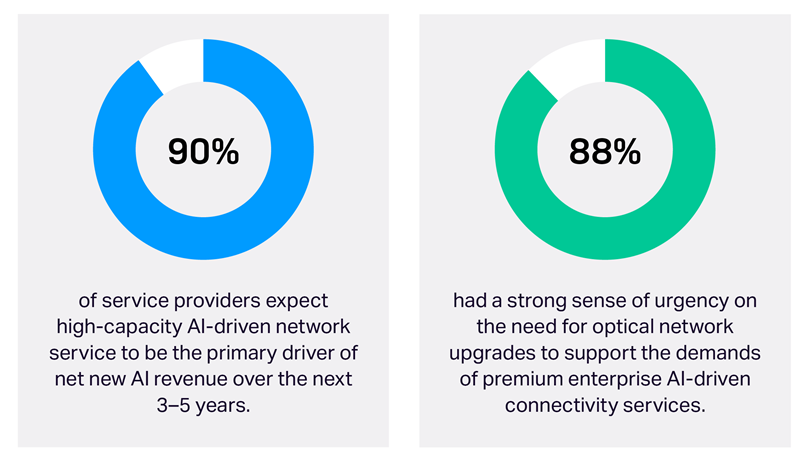
A recent Ciena survey of service providers underscores the revenue potential of AI-driven networking. The survey, conducted in collaboration with Censuswide questioned more than 1,200 telecom, wholesale, and regional service provider experts across 12 countries. Read the full results in our press release.
Enterprise AI is reshaping traffic patterns
Enterprise AI workloads behave differently from traditional enterprise applications. As organizations adopt agentic AI, they are no longer deploying a single application in one cloud. They are building and continuously refining specialized AI agents that can rely on different AI models, cloud providers, data sources, and compute platforms throughout their lifecycle.
Developing, customizing, and operating these agents requires moving large volumes of data between storage environments, AI development platforms, training and fine-tuning environments, and production inference infrastructure. These transfers can be episodic but bandwidth-intensive, creating bursts of traffic that need to move quickly so organizations can use AI for their enterprise requirements.
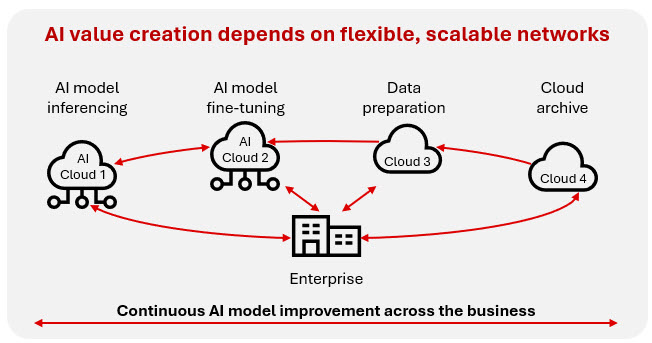
At the same time, AI infrastructure itself is becoming more distributed. New AI data centers are being built, while different sites increasingly offer specialized compute capabilities, accelerators, and AI services. This means enterprises will increasingly need more than a connection to “the cloud.” They will need access to specific locations where the right AI resources are deployed, with the performance, latency, and availability their applications require. Workloads can shift between clouds, AI data centers, and enterprise sites according to business priorities, resource availability, and application requirements. This fundamentally changes enterprise traffic patterns.
As inference scales, network agility matters more
As organizations move from AI pilots to production, inference requirements will continue to grow. More AI applications mean more distributed inference infrastructure—and more data moving between AI data centers to distribute updated models, synchronize information, and support increasingly sophisticated AI workflows. At the same time, more users interacting with AI applications will drive additional traffic between enterprises and AI cloud environments. But bandwidth growth is only part of the story. The real challenge is that AI traffic is becoming more dynamic in nature.
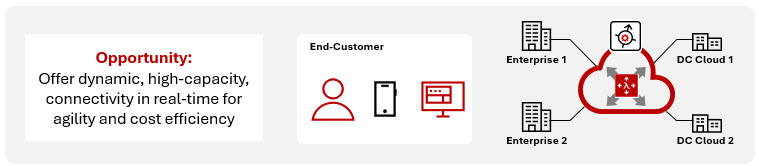 Traditional connectivity models were designed around relatively predictable traffic patterns, with services provisioned and left largely unchanged for months or years. AI operates differently. Projects evolve quickly. Compute resources shift between locations. New agents are deployed. Waiting days—or even weeks—to provision additional connectivity does not match that pace. Increasingly, enterprises expect networking to behave more like the cloud infrastructure they already consume: available when needed, scalable on demand, and used for as long as required.
Making connectivity behave more like the cloud
Meeting these AI-era expectations requires more than simply adding optical capacity. It requires a different way of delivering connectivity—one that reduces the friction created by manual processes, fixed provisioning cycles, and services that cannot easily adapt as requirements change. The concept is simple: make connectivity behave more like cloud infrastructure.
With on-demand optical bandwidth allocation, service providers can enable customers to scale optical capacity up or down as requirements change—activating and consuming connectivity when they need it, rather than waiting through traditional provisioning cycles. Programmable optical infrastructure, intelligent network control software, and open APIs can help automate that process, enabling near real-time provisioning, monitoring, and management of high-capacity services.


This cloud-like service consumption model delivers benefits for everyone involved.
This cloud-like service consumption model delivers benefits for everyone involved. Enterprises gain the flexibility to scale connectivity alongside AI workloads and pay for the capacity they need when they need it. AI projects can move faster when networking is not the limiting factor. Neoscalers can benefit from the same model as they connect distributed AI infrastructure and respond to changing customer demand. For service providers, this flexibility creates a new revenue opportunity. Instead of selling connectivity primarily as rigid capacity, they can introduce differentiated, consumption-based services aligned with how customers increasingly consume cloud and AI infrastructure.
Dynamic connectivity services are already becoming reality
And this is not just a vision for where enterprise connectivity is heading. It is already happening. Cirion Technologies recently announced the initial phase of its Network-as-a-Service offering across Latin America, combining Ciena's networking platforms, multi-layer network control software, and open APIs with Carma's orchestration capabilities to deliver on-demand enterprise connectivity services. By automating service provisioning and enabling customer self-service, Cirion is demonstrating how providers can simplify operations while giving customers much faster access to the connectivity they need. This is an important example of how service providers can evolve connectivity from treating bandwidth as a static resource to a dynamic connectivity service that can adapt as business requirements change.
Delivering this type of service requires a flexible optically switched infrastructure that enables any-to-any secure connectivity for dedicated high-speed multi-cloud access.
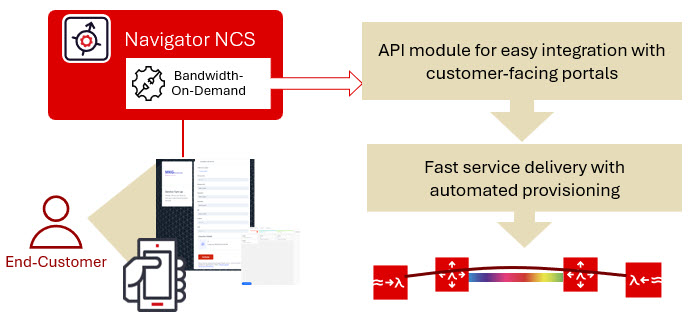
Ciena combines industry-leading WaveLogicTM coherent optics, programmable photonics, and Navigator Network Control Suite equipped with an open Bandwidth-on-Demand API to help service providers automate service delivery and dynamically scale capacity. This foundation can support new differentiated services around consumption-based bandwidth and dedicated, high-speed, multi-cloud connectivity, with enhanced Service Level Agreement (SLA) options.
Connectivity that moves at the speed of AI
As AI enterprise initiatives move from experimentation to large-scale production, enterprise connectivity is evolving from static capacity to dynamic, programmable optical services that can flex with changing workloads, locations, and business needs. For service providers, the opportunity extends beyond moving more traffic—it’s about delivering connectivity with the speed, flexibility, and responsiveness AI demands while creating new revenue opportunities and pathways for growth. As a trusted partner to service providers, we're ready to help turn the promise of AI into business value through insights and experience delivering networks that offer the agility, scale, and intelligence this new AI era demands. Interested in diving deeper into this topic? Join us in this upcoming webinar: The next phase of AI connectivity: How CSPs can capitalize on emerging demand with NTT, Omdia, and Ciena.