






March 26, 2026
By Gabriel Girard
Senior Manager, Custom Solutions Delivery, Ciena
Ciena’s Gabriel Girard explains how advisory expertise, engineered processes, and advanced analytics help operators accelerate growth and reduce operational risk.
Networks now sit at the center of nearly every growth initiative - from market expansion and acquisitions to service acceleration, network resilience, and capital efficiency. For communication service providers and large-scale digital infrastructure operators, the network is no longer just infrastructure; it is a business platform.
Yet many organizations still struggle to translate network complexity into measurable business outcomes. Initiatives such as network growth, migration, automation, and consolidation are often approached as isolated technical programs, making it difficult to align technical execution with business priorities.
The impact of solving this challenge can be significant. In one recent multi-vendor migration program spanning more than 14,000 circuits and multiple planning systems, integrating network data and automating validation increased migration throughput from roughly 10 circuits per week to more than 100 while reducing planning fallout and minimizing customer disruption.
Achieving results like this requires more than tools. It demands domain expertise, engineered processes, and advanced analytics operating together as a unified advisory capability.
Network initiatives must begin with business outcomes
Every major network initiative ultimately serves a small set of business imperatives:
- Accelerate time-to-revenue
- Improve return on invested capital
- Reduce operational risk
- Optimize asset utilization
- Strengthen customer experience
Delivering these outcomes requires clarity—clear visibility into what assets exist, how they are used, where capacity constraints lie, where inefficiencies persist, and how operational processes perform under real-world conditions.
In practice, achieving that clarity is difficult. Fragmented OSS/BSS environments, disconnected operational systems, inconsistent data models, legacy workflows, and spreadsheet-based planning obscure insight. Decisions slow, capital is deployed cautiously rather than confidently, and programs overrun.
Establishing a reliable, continuously refreshed “master” data layer that integrates disparate systems into a unified analytical environment is not straightforward. It requires specialized expertise, purpose-built tools, and disciplined process engineering - precisely where an experienced advisory partner can deliver value.
With that foundation in place, strategy shifts from assumption-driven to evidence-based, enabling faster decisions, sharper prioritization, and measurable business impact.
Bridging strategy and execution requires deep domain expertise
Technology investments succeed when strategy, planning, engineering, and operations work from a shared understanding of how the network is actually built and operated.
This is where domain expertise matters.
Ciena’s advisory teams bring together network engineers, data scientists, software architects, and program leaders within a purpose-built migration center of excellence. This multidisciplinary approach enables teams to interpret complex multi-layer networks while industrializing insights into scalable tools and repeatable methods.
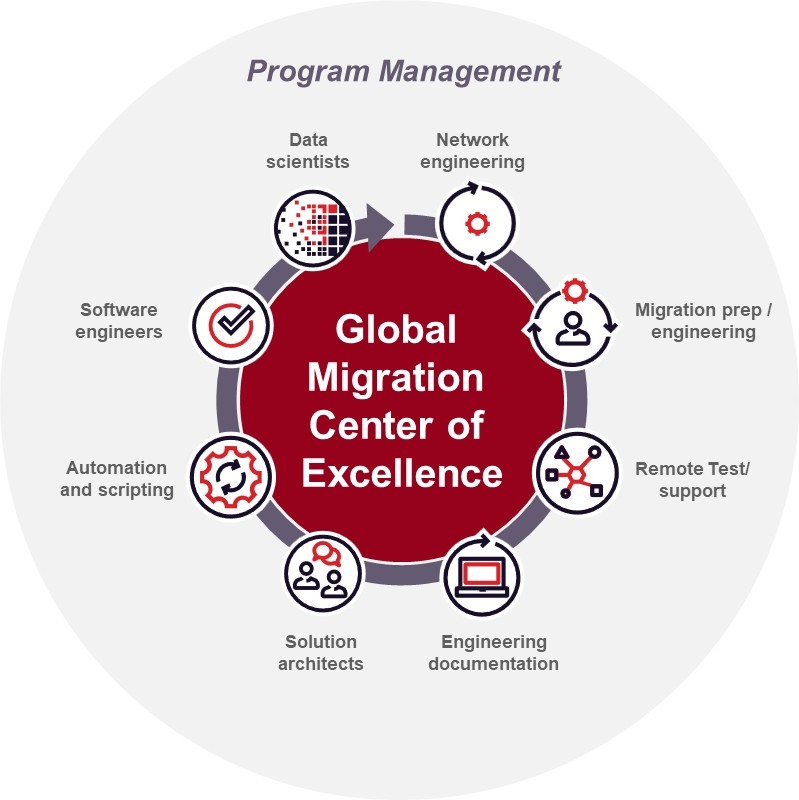
The impact can be tangible. Following a major acquisition, one Tier 1 operator struggled to reconcile fiber usage data and topology files across multiple formats. Limited visibility hindered consolidation planning and capital allocation.
By consolidating and visualizing those datasets in a centralized platform, the organization rapidly gained clarity on utilization, customer patterns, and optimization opportunities - reshaping its strategic roadmap in the process.
The value was not simply better reporting. Technical teams and executives quickly aligned around investment priorities, and sales teams were able to use the unified perspective provided by the visualization as a sales tool to highlight incremental customer opportunities.
But expertise and visibility alone are not enough. Turning insight into measurable outcomes requires the ability to operationalize those insights at scale. That is where engineered processes and automation become critical.
Process engineering is essential for scale
Even the most sophisticated analytics will underdeliver if underlying processes are fragmented.
In many large-scale programs - whether site exits, technology upgrades, network consolidation and migration, or broad network expansion - planning and scheduling remain heavily manual. Dependencies are discovered late. Maintenance windows are wasted. Field teams are underutilized or mis-sequenced.
These programs require process re-engineering alongside data integration. By combining analytics with process automation, critical tasks can be decoupled, capacity validated in advance, and workflows optimized for throughput rather than linear execution.
The results can be transformative. In the multi-vendor migration program mentioned earlier, throughput increased from approximately 10 circuits per week to over 100 per week after integrating data, automating validation, and streamlining scheduling.
Planning fallout was eliminated. Labor requirements dropped. And customer impact was minimized.
This is what operational leverage looks like—not incremental efficiency, but structural acceleration.
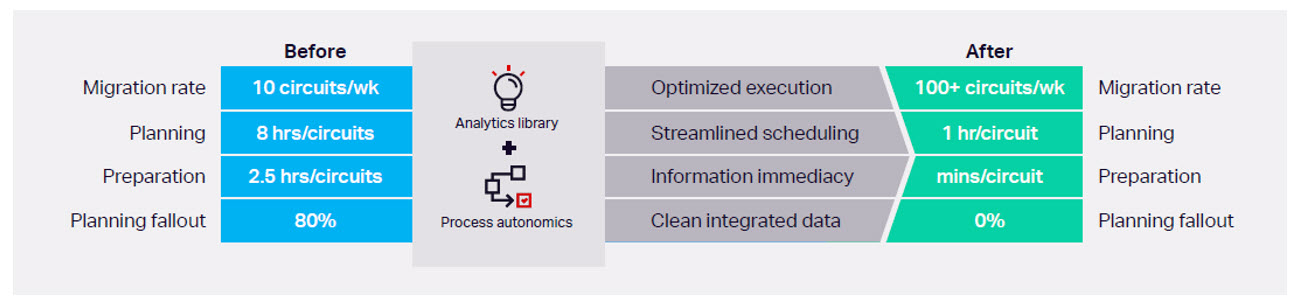
Achieving that level of operational leverage depends on analytics designed specifically for the realities of multi-layer network infrastructure.
Network decisions require purpose-built analytics
Generic BI platforms are not designed for the realities of optical, IP, and multi-layer infrastructure environments. Effective advisory requires tools customized for network topology, service traceability, and capacity modeling, combined with the specialized domain knowledge needed to interpret those insights.
Ciena’s Network Transformation Suite includes capabilities such as:
- Exploration for scenario modeling and baseline analysis
- Relationship exploration across logical and physical topologies
- Resource tracing to understand service-to-facility dependencies
These tools convert complex, siloed datasets into intuitive, role-based visualizations - far beyond the constraints of spreadsheets.
On the operations side, vendor-agnostic optical performance analytics provide proactive anomaly detection, risk evaluation, and historical correlation to prevent service degradation.
Meanwhile, predictive planning engines model utilization trends and forecast when capacity thresholds will be exceeded, enabling capital prioritization aligned to real growth trajectories.
The value is not the feature set. It is the ability to move from reactive troubleshooting to predictive, data-driven decision-making.
From initiative to enduring capability
Network growth, consolidation, automation, and modernization will continue as traffic patterns evolve, technologies advance, and market conditions shift.
Building the capability to navigate these changes—combining multi-vendor engineering expertise, data science, process re-engineering, automation, and large-scale program execution—requires sustained investment and experience gained through repeated execution in complex environments.
Ciena has built that capability so it can be applied where it creates measurable business value.
Some initiatives begin with large-scale transformation. In many cases, however, progress starts with a focused operational question:
- Where is data difficult to reconcile?
- Which network decisions require excessive manual validation?
- Where are planning cycles slowed by uncertainty?
- What operational question would you answer first if you fully trusted the data?
From there, engagements focus on a clearly defined objective—capacity visibility in high-growth markets, migration workflow bottlenecks, multi-layer service traceability, optical performance variance, or asset utilization clarity. Analytics, domain expertise, and engineered processes are applied to that challenge to deliver a measurable outcome.
As priorities evolve, capability expands. Each engagement strengthens the data foundation, improves planning confidence, and enables more effective execution. Over time, this creates a reinforcing cycle: better data improves planning, better planning improves execution, and execution continuously strengthens the data foundation.
When that discipline is in place, the network becomes more transparent, predictable, and ultimately more capable of supporting the business outcomes it was built to enable.
To learn more about how Ciena’s Advisory and Enablement Service help operators translate network complexity into measurable outcomes, read the Advisory and Enablement Infobrief.
If you would like to discuss a specific initiative or operational challenge, contact your Ciena account manager to start the conversation.