






April 22, 2026
By Phil Corey
Senior Director, Services Product Line Management, Ciena
In this blog, Phil Corey explores how staging in factory is helping meet rising deployment demands with a faster, more predictable, and higher-quality approach to network rollouts.
In today’s digital landscape, you are under constant pressure to deploy networking infrastructure that balances speed, efficiency, and resilience. To stay ahead, you must prioritize more than performance and cost. Deployment velocity, predictability, and risk mitigation are critical to delivering capacity on tight timelines while maintaining a competitive advantage.
At the same time, the operating environment is getting more complex. Bandwidth demand continues to surge, SLAs are tightening, and networks must interoperate across multi-vendor ecosystems. Add geopolitical volatility and related market uncertainty, and the traditional model of procuring, assembling, and deploying infrastructure in the field is increasingly strained.
Network operators and infrastructure owners are adapting by transitioning from individualized, site-specific builds to standardized, repeatable deployment models.
Adopting standard configurations
Standardization is the foundation of scalable network deployment. Instead of ordering individual components and assembling them in the field, network operators and infrastructure owners are adopting pre-validated shelves and racks aligned to specific network designs.
This approach simplifies procurement, improves forecast accuracy, and minimizes variability during installation. Procurement teams can approve complete, validated configurations rather than managing fragmented component lists. Engineering intent is preserved from design through deployment, and field teams spend less time interpreting and reconciling build requirements.
The result is faster and more accurate deployment timelines while maintaining quality.
Staging in factory: Shifting complexity upstream
Staging in factory (staging) delivers this model by moving integration, validation, and provisioning out of the field and into a controlled factory environment.
This is not simply about pre-racking equipment and powering it up. A robust staging approach applies augmented reality and object recognition, digital workflows, and advanced validation techniques to ensure that each system arrives on-site fully prepared for deployment.
Ciena’s staging in factory Implementation Service encompasses key activities including:
- Validating the bill of materials against the detailed network design
- Aligning hardware and software with network requirements
- Installing circuit packs, mechanical components, and structured cabling
- Integrating third-party components
- Upgrading and commissioning software
- Provisioning systems according to the target network design
Additional controls, such as asset tagging, custom packaging, secure tracking, and optional tamper-evident measures, ensure systems maintain their integrity from factory to site.
By completing these steps upstream, a significant source of variability and risk is removed from field operations.
Transforming on-site deployment
The impact of staging becomes most visible at the point of deployment. Instead of assembling systems from dozens of individual boxes, field teams receive integrated, pre-validated configurations that are ready to install.
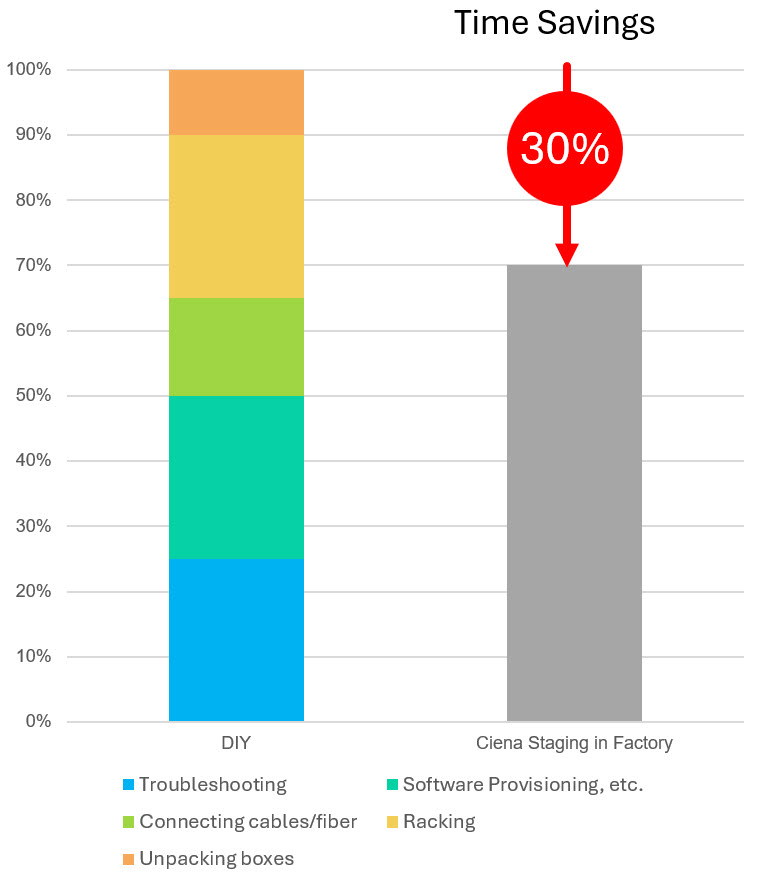 On-site activities are limited to positioning, powering, and connecting the system, as labor-intensive tasks like unpackaging, racking, cabling, software upgrades, and troubleshooting are completed beforehand.
This shift delivers several immediate benefits:
- Faster, more predictable installation timelines
- Reduced exposure to missing components or integration issues
- Simplified logistics through consolidated shipments
- Significantly reduced packaging waste, minimizing on-site unpacking and disposal, freeing up space, improving safety, and streamlining workflow efficiency
- Lower costs associated with packaging disposal and warehousing
In practice, the benefits of staging help with approximately 30% reduction in on-site installation time.
At scale, these efficiencies compound. Large, multi-site deployments see meaningful reductions in labor hours, travel requirements, and site access durations, directly accelerating service turn-up and revenue realization. In addition to reducing OPEX costs, it means reclassifying certain deployment-related costs from OPEX to CAPEX.
From operational efficiency to strategic advantage
What began as an operational optimization is now a strategic lever.
Staging in factory aligns procurement, engineering, and operations around standardized designs and repeatable processes. It reduces dependency on scarce field resources, mitigates deployment risk, and creates a more resilient supply and delivery model.
Equally important, it supports capital efficiency. By improving predictability and reducing rework, you can better manage investment cycles and respond more effectively to demand volatility.
In an environment defined by speed, scale, and uncertainty, the ability to deploy infrastructure quickly while ensuring it is done correctly the first time is a decisive advantage.
Staging in factory delivers that advantage by transforming deployment from a variable, labor-intensive process into a controlled, repeatable capability. This allows you to accelerate growth while maintaining operational discipline.