






April 8, 2026
By Stan Hawthorne
Director, Services PLM, Ciena
Ciena’s Stan Hawthorne explains why effective network optimization starts with network audit, which reveals hidden inefficiencies and creates a stronger foundation for growth. This is the first in a series of three thought leadership blogs exploring network optimization.
Operators like you are navigating stark choices. Service demand is increasing exponentially but everything around that demand has tightened: leaner engineering teams, constrained budgets, compressed timelines, and near-zero risk tolerance.
Growth under constraint
Historically, service growth has meant network expansion—lighting new fiber, deploying platforms, and building ahead of demand. Today, every capital decision faces higher financial hurdles, every operational initiative competes for limited resources, and every network change must avoid disruption. Meanwhile, service velocity has become a key competitive differentiator. Maybe the differentiator.
This creates tension across the organization because:
- Commercial teams see revenue opportunities.
- Engineering teams see congestion and limited capacity to execute.
- Finance teams see cost and risk exposure.
So the question becomes: how do you accelerate time to revenue while minimizing spend or operational strain? Expansion can’t always be the default first move. There’s a better, simpler starting point:
Are you extracting maximum value from the assets you already own?
Over time, networks accumulate inefficiencies—unknown inventory, mismatched configurations, degraded fiber spans, fragmented spectrum, and manual processes that slow execution. Even high-performing networks can operate well below their design potential when these issues go undetected. By introducing greater visibility and control, you can improve and sustain performance, accelerate service delivery, and unlock existing capacity—without immediate expansion.
A smarter operating model: optimize before expanding
This isn’t about bypassing infrastructure build-out—it’s about sequencing it intelligently. Network optimization enables more targeted, higher-impact modernization decisions. It also aligns stakeholders: faster fulfillment for commercial teams, better visibility for engineering, and measurable returns for finance.
Discover, analyze, and automate: Recalibrating your network for peak performance
It helps to talk about network optimization in terms of “discover, analyze, and automate.” If you can gain visibility to discover the true state of your network, analyze and optimize its performance, and automate workflows for sustained efficiency, you can cost-effectively achieve and maintain peak network performance while minimizing risk—day in and day out. It’s about driving competitive advantage through extracting more of what your network is designed to do.
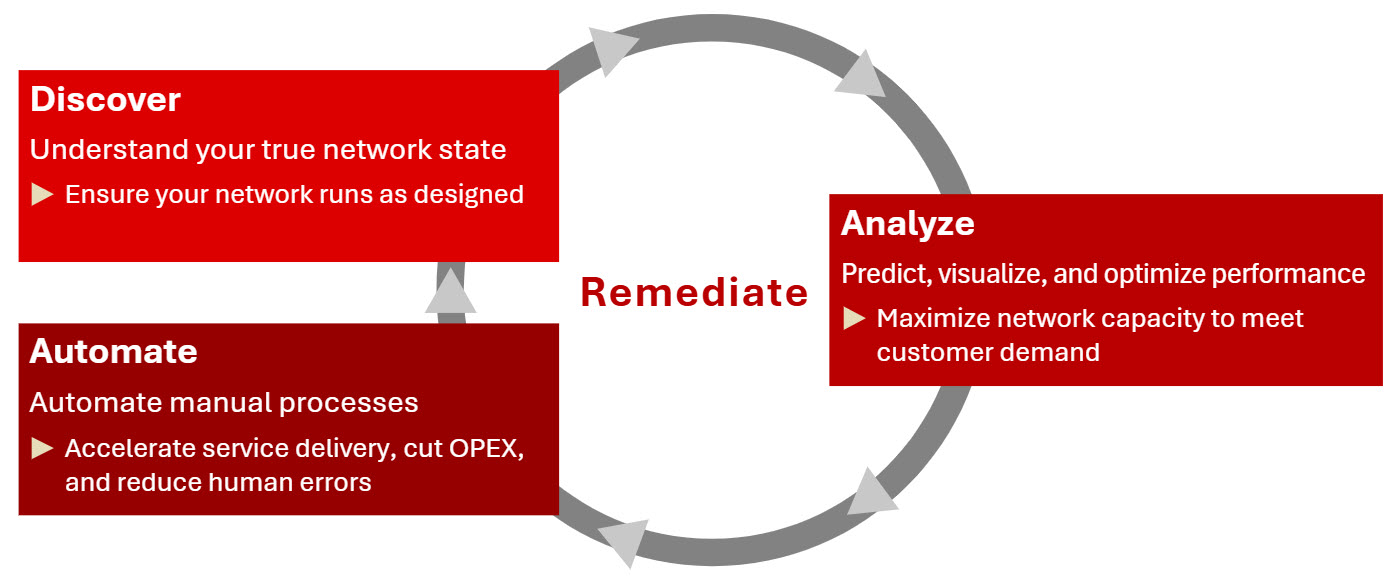
We’ll talk about analyze and automate in detail in two future blogs. For the remainder of this one, let’s explore how discovering the true state of your network through network audit is the first step to realizing your network’s true operational potential.
Network audit creates the clean foundation needed for further optimization
When you engage us to deliver the cost and operational benefits of the “analyze” aspects of optimization, such as SNR tuning and spectrum defragmentation, preliminary assessment often—even usually—reveals that we must first run an audit to create an error-free environment for them to work effectively in. The same applies to infrastructure buildouts: You must first know what’s actually going on in the network, and correct for errors, to ensure a productive and smooth expansion.
We come across this straightforward challenge everyday:
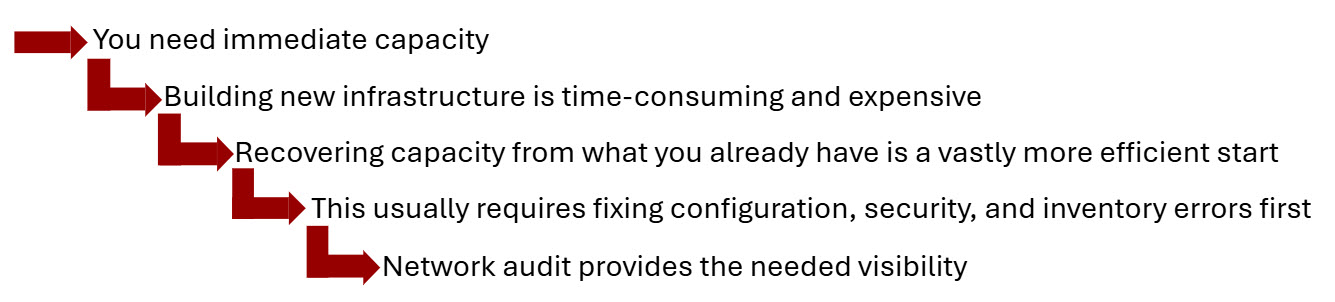
Now, with audit having resolved issues and created real insight into hidden network issues, you can confidently move forward with restoring optical margin and freeing spectrum to gain new capacity. Performance improvements follow by prioritizing and addressing issues based on a clear understanding of what’s in your network and how it’s configured.
Why network audit works
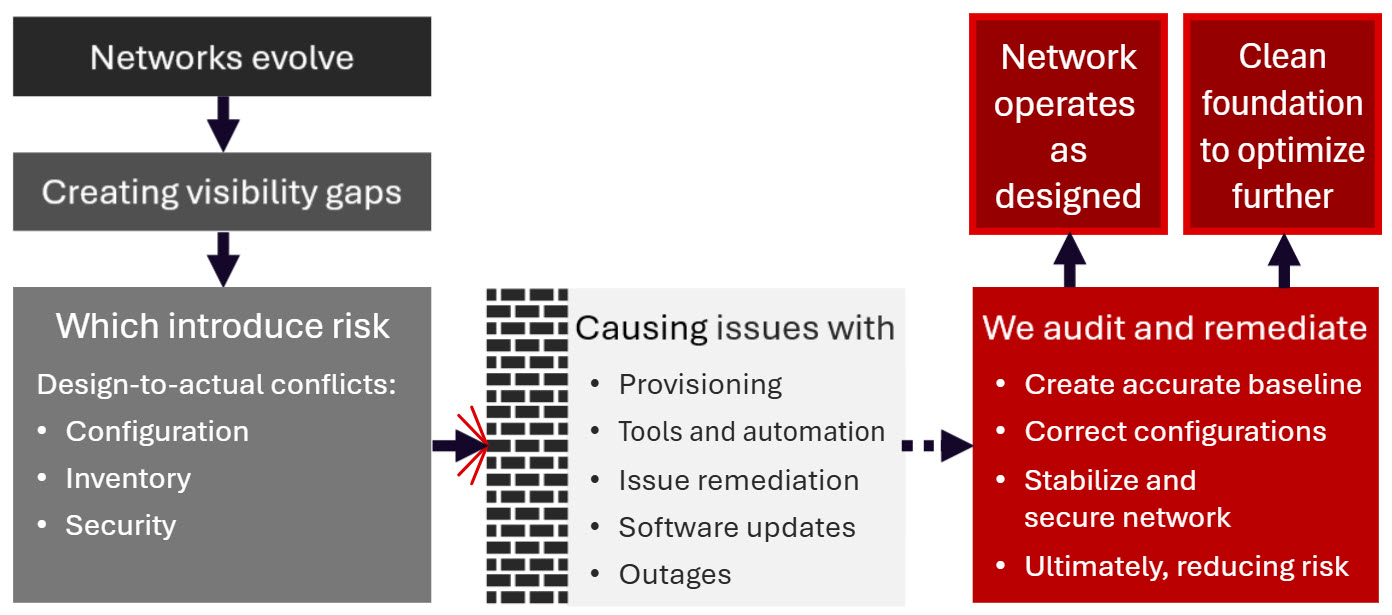
As you know from experience, networks don’t stand still. They evolve over years—often decades—shaped by growth, technology shifts, IT leadership preferences, and changing operational priorities. Through this evolution, gaps in visibility emerge. Inventory insight becomes incomplete. Configurations drift. Security inconsistencies appear. These design-to-actual conflicts create inefficiencies that impact provisioning, automation, troubleshooting, routine upgrades, and even introduce outage risk.
Through comprehensive assessments for photonic, OTN, and Ethernet/IP layers, as well as for inventory, and DCN and security, network audit delivers visibility into these hard-to-detect areas. Systematically validating your network’s as-built state against its intended design uncovers hidden constraints—obsolete or unknown devices, configuration errors, and security vulnerabilities—that quietly hobble service velocity, increase operational friction, and elevate risk. Remediating foundational L0-L2, inventory, and DCN/security anomalies helps assure stable operations and creates a baseline for further optimization.
Crucially, adopting a best-practice approach of routine audits every 12 to 24 months secures peak performance while maintaining a clean, reliable foundation for growth. The result is a secure environment aligned to design intent—one that supports consistent provisioning, reliable automation, and safe, predictable operations.
Summary—Audit first, optimize next
Network optimization starts with visibility. By auditing and validating the true state of your network, you uncover hidden inefficiencies, correct misalignments, and establish a stable foundation for growth. This positions you to unlock existing capacity, improve performance, and make smarter, lower-risk expansion decisions—maximizing value from current assets before investing in new infrastructure.