






October 8, 2026
By Jahanzeb Baqai
Director, Product Line Management
As network operators face AI-driven traffic growth, stricter SLAs, and pressure to scale efficiently, Flex-Algo is emerging as a practical way to deliver differentiated network services. Ciena’s Jahanzeb Baqai explains how this can be accomplished without requiring rip-and-replace of existing infrastructure or adding complexity through external controllers.
Today, a service provider’s transport network is no longer just about carrying traffic between endpoints. It is the foundational platform on which end-user experience, service differentiation, operational efficiency, and business growth depend. As AI models scale, cloud compute becomes more distributed and ubiquitous, enterprise SLAs tighten, and customer expectations increase. But it is the same underlying infrastructure that must support a wider range of demands and constraints than ever before.
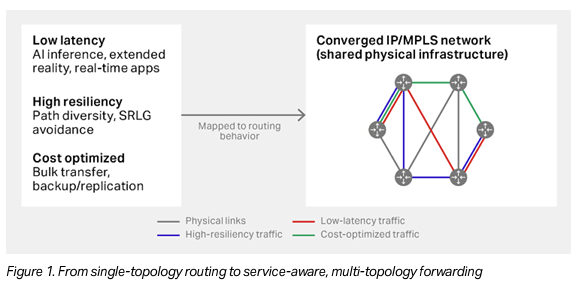
The business challenge is clear: how can network operators deliver more differentiated outcomes without adding operational complexity or capital expenditure to their IP transport network? For AI-era networks, it goes a step further: how can operators introduce latency-sensitive, resilient, and AI-ready connectivity services without the inherent complexity and operational burden of legacy IP architectures?
The answer is Flex-Algo
Traditional models, such as RSVP-TE, often depend on explicit path computation, tunnel inventories, and external centralized controllers to deliver differentiated services that meet SLAs and constraints. While these methods are, and will continue to be, relevant, they often require a team of highly specialized IP engineers because configuration changes or optimizations can generate unexpected outcomes due to their complexity. This is not always feasible, especially in smaller networks, stand-alone domains, or environments where service requirements can change quickly.
Flex-Algo, short for Flexible Algorithm, is a Segment Routing traffic engineering capability that lets operators define routing behavior based on intent, such as latency, resiliency, or cost, and distribute those policies through the IGP. For AI-era networks carrying multiple classes of traffic with different latency, resiliency, bandwidth, and scale requirements, this reduces the need for large-scale manual tunnel lifecycle management and helps transport networks adapt more quickly to changing service objectives.
Rather than building separate transport overlays for every new service class, operators can use Flex-Algo to create multiple intent-driven forwarding topologies across a common infrastructure. This allows AI-based, traditional enterprise, cloud, and best-effort traffic to follow paths that reflect their specific service requirements while keeping overall network operations simple and predictable.
How Flex-Algo changes the equation
At its core, Flex-Algo changes the economics of traffic engineering (TE) inside the network domain. Flex-Algo creates value in three areas that matter to network operators:
- Operational simplicity: minimizes label requirements— often to a single label— while reducing overlays and dependence on external controllers
- Service agility and monetization: enables differentiated services with varied latency, resiliency, and cost objectives across shared infrastructure
- Architectural sustainability: supports incremental traffic engineering adoption without requiring a full network redesign
To start with, Flex-Algo moves much of the intelligence required for TE into the routing system itself. It can compute diverse service paths based on constraints that reflect service intent. This allows operators to deliver more predictable and differentiated services without the need for new, complex external controllers or expensive hardware upgrades.
Another source of value is service agility. Operators increasingly need to support low-latency services, resilient enterprise offers, AI-related interconnect, and lower-cost transport on the same network. Flex-Algo helps by letting those services follow routing behaviors that match their business objectives, without requiring a separate overlay or per-service tunnel state for each one. This creates a clear path for network monetization by offering value-added services aligned with customer needs.
It also brings a resilience advantage. Operators do not just need fast recovery; they need recovery behavior that still aligns with the original service intent. Because Flex-Algo can compute primary and backup paths from the same constrained topology, it helps keep recovery behavior aligned with the intended service characteristics during failure events.
This is especially relevant for latency-sensitive AI workloads, where network behavior can directly affect application performance and infrastructure efficiency. Flex-Algo enables operators to define latency-optimized routing behaviors with recovery aligned to service intent. This helps maintain predictable service performance while improving utilization of high-value compute resources such as GPUs and transport capacity.
The third area is architectural sustainability. Flex-Algo gives operators an incremental path to more intelligent traffic engineering without forcing a full redesign. They can apply it where needed first while preserving existing infrastructure, operational processes, and domain-level flexibility. Because it works in mixed infrastructure environments, Flex-Algo helps operators evolve toward more service-aware and scalable transport.
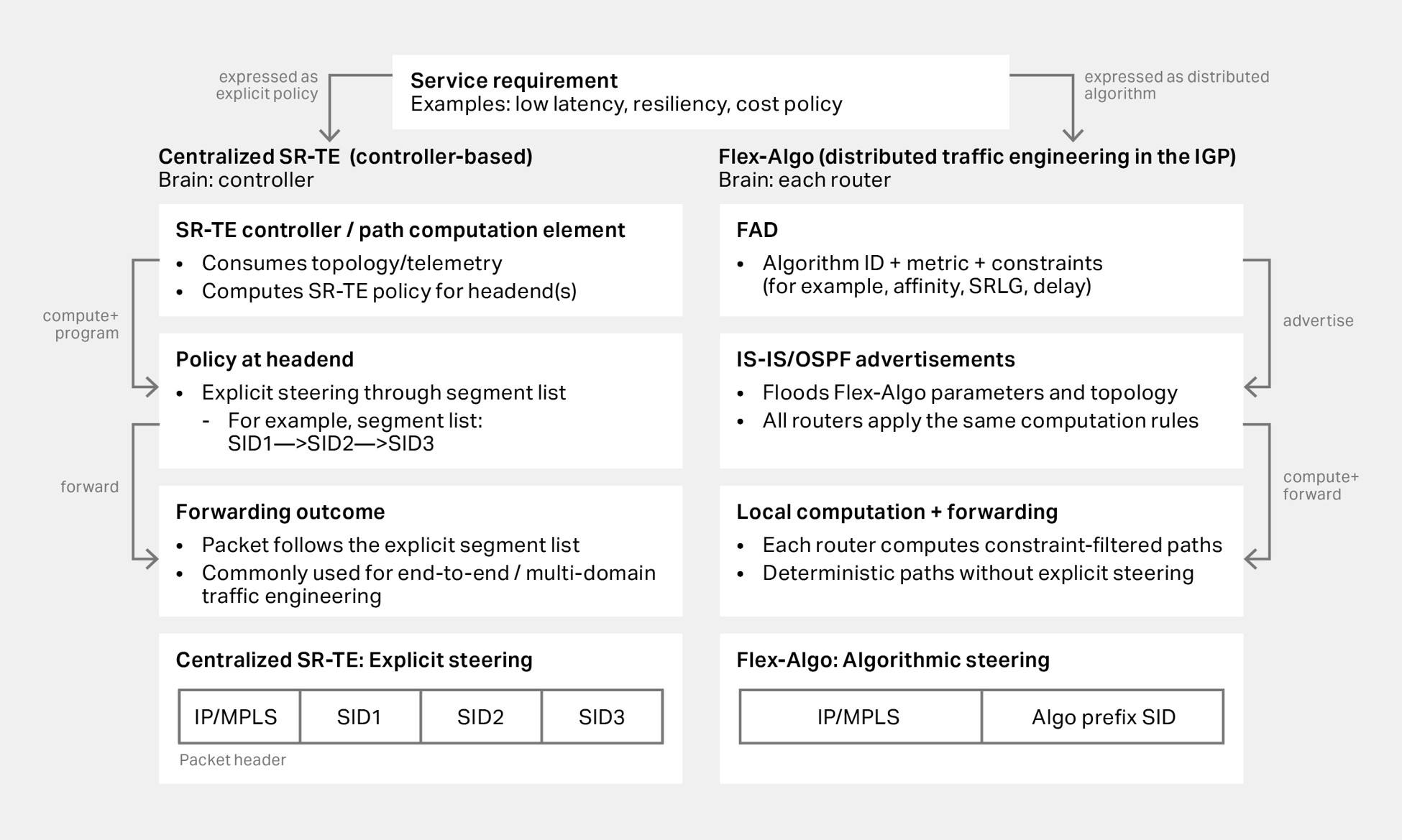
For AI environments, the implication is significant: distributed compute and high-value resources depend on predictable transport behavior across mixed infrastructure. By reducing complexity, including dependence on deep SID stacks, Flex-Algo helps operators scale traffic engineering without making the network a bottleneck to AI infrastructure investments.
Fitting Flex-Algo into real-world networks
None of this means Flex-Algo replaces centralized traffic engineering. Operators can still use centralized control where global optimization is needed, distributed intent-based routing with Flex-Algo where operational autonomy and lower complexity matter more, and hybrid models in multi-domain environments that require end-to-end TE without controllers in every domain.
That flexibility matters in AI-era networks, where traffic patterns, service constraints, and domain requirements can vary widely. Flex-Algo helps operators extend traffic engineering selectively without forcing a single control model across the infrastructure.
The business value of Flex-Algo becomes clearer when it is connected to the underlying architecture. Our recent white paper explores those foundations in detail and explains where Flex-Algo fits. For strategy, architecture, and operations teams, it is a useful next step in evaluating how Flex-Algo can provide operational and commercial advantages.
How Ciena can help
Ciena brings deep experience working with global network operators and a strong focus on Segment Routing, Flex-Algo, and related technologies. Our standards-based approach, with SAOS (Service-Aware Operating System) as a common operational foundation, supports Flex-Algo across SR-MPLS and SRv6, helping operators align TE with their network architecture. Our work helping operators move toward Segment Routing without rip-and-replace disruption positions us to support that shift with confidence.
As service requirements change, demand grows, and new constraints emerge, the IP transport network must become a more adaptable platform for service differentiation, operational efficiency, and long-term business growth. For AI-driven applications and distributed compute, Flex-Algo provides a practical foundation for AI-ready transport by aligning routing behavior with service intent while preserving the investment protection, simplicity, and architectural flexibility operators need as their networks evolve.