




September 28, 2026
By Chuck Harris
Portfolio Marketing Advisor, Ciena
AI is entering a new phase, and it is changing what service providers need from their networks. Ciena’s Chuck Harris explores how AI is driving new requirements across IP transport networks, accelerating the need for modernization, and highlights three practical approaches for building a more scalable, automated, and AI-ready IP transport network.
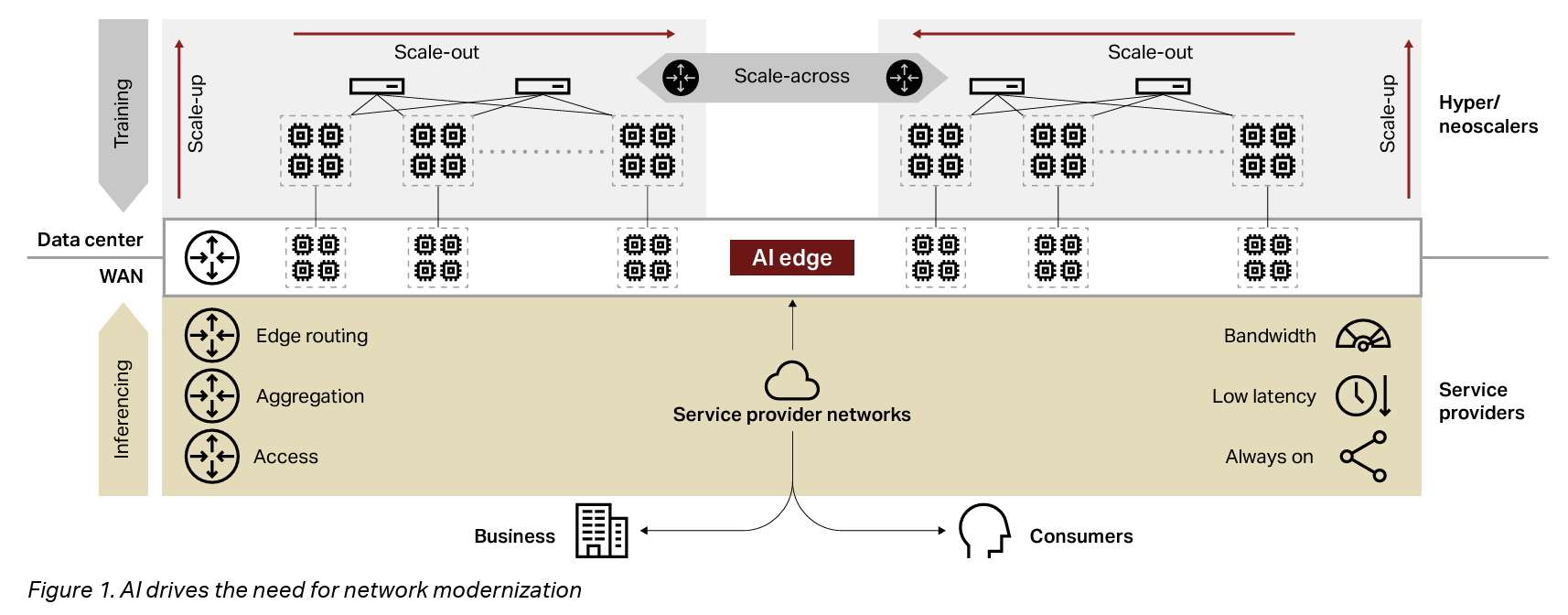
The industry has spent years building massive data center clusters to train AI models. Now those models are moving into production, bringing inference closer to enterprises and users. As AI becomes more distributed, the access, aggregation, and metro networks connecting users, clouds, and data centers become increasingly important to application performance and the customer experience.
For service providers, this creates both a network challenge and a business opportunity. The question is no longer simply whether the network can carry more traffic; it’s whether the network can support new AI-driven services while improving economics, protecting existing investments, and accelerating growth. (see figure #1)
Why IP transport modernization matters now
Many access and aggregation networks were designed for more predictable traffic patterns. While they continue to support critical broadband, enterprise, and mobile services, AI is increasing demands for scale, predictable performance, traffic optimization, security, and operational agility.
AI inference is already extending into regional data centers, enterprise campuses, and edge locations, creating more distributed traffic patterns and placing greater importance on the networks connecting those locations
Network modernization can help operators turn those requirements into business outcomes:
- Growing capacity and supporting emerging AI services without creating another service-specific network.
- Improving infrastructure utilization and operational efficiency through a common IP transport foundation.
- Delivering more predictable application performance with greater control over how traffic uses network resources.
- Reducing transformation risk by evolving incrementally instead of relying on disruptive network replacement.
- Accelerating service introduction and geographic expansion with repeatable architectures and greater automation.
A common foundation for growth
Operators are moving toward more scalable, service-aware, and automated IP transport architectures. Segment Routing and EVPN provide a common foundation for converging multiple services, complemented by Flex-Algo, SR-TE, MACsec, telemetry, and multi-layer automation for greater traffic optimization, security, visibility, and operational control.
For business leaders, the value is less about any individual protocol and more about what the architecture enables: a network that can support existing revenue-generating services and new AI-driven opportunities on a shared infrastructure, while becoming simpler to scale and operate.
Modernize without starting over
Operators approach network modernization from different starting points. Some are evolving Layer 2 networks, others are introducing newer IP capabilities into existing MPLS environments, and still others are building greenfield access networks to enter new markets.
Each path leads to a scalable, service-aware, and automated IP transport foundation that supports existing services and emerging AI-driven opportunities. To help operators evaluate these options, we developed an eBook that explores three modernization scenarios in greater detail and outlines approaches for evolving transport networks to support AI-driven growth.
Three principles are especially important for decision makers:
- Protect existing investments. New capabilities should coexist with current infrastructure and services, allowing modernization to proceed where and when the business case makes sense.
- Simplify while you transform. A common architecture can reduce the fragmentation created by separate service networks and help lower operational complexity over time.
- Build for repeatable growth. Standardized architectures can make it easier to expand into new markets, onboard services, and add capacity without redesigning the network for every new opportunity.
Turning network modernization into business advantage
AI is accelerating a network transition already underway. Traffic is becoming more distributed, service expectations are rising, and operators face continued pressure to improve both network performance and economics.
This creates an opportunity to modernize IP transport around a common foundation that supports today’s services and emerging AI-driven opportunities. Modernization is not simply a technology refresh. It is a practical way to protect revenue, improve efficiency, reduce operational risk, and position the network for growth as AI moves closer to users.
Ciena helps operators modernize incrementally, introducing new IP transport capabilities while preserving existing investments and aligning transformation with business priorities.
Prepare your network for AI-driven growth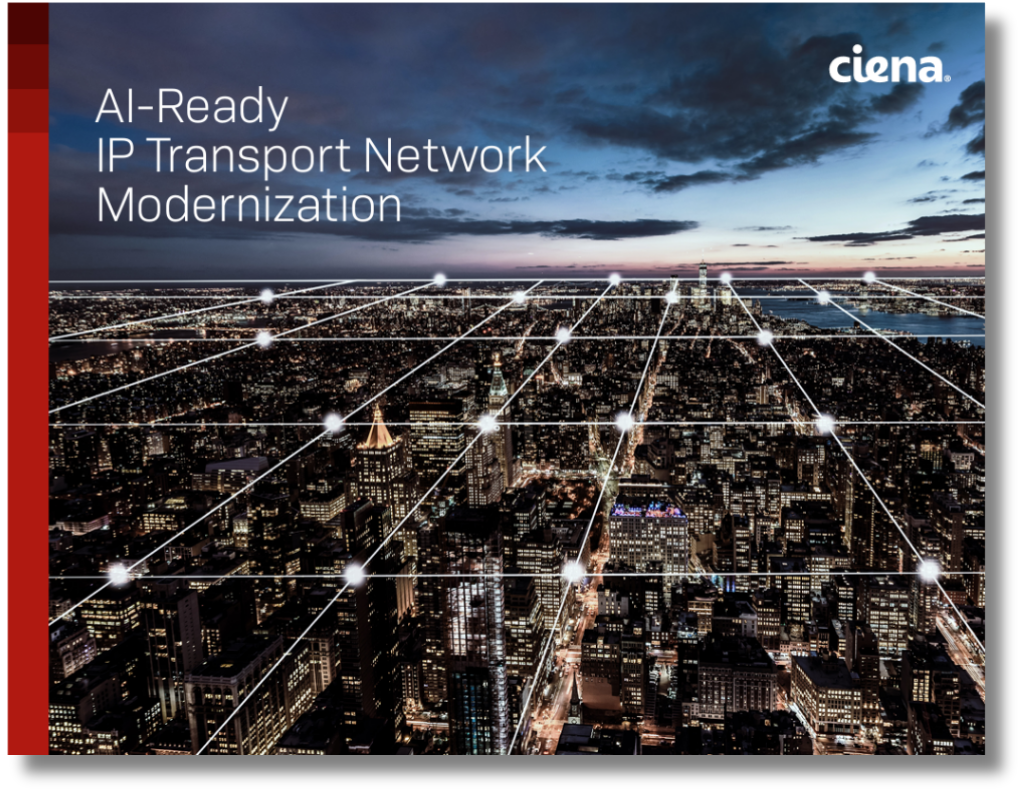
Explore our eBook on AI-Ready IP Transport Network Modernization for a deeper look at practical modernization paths, architecture options, and migration approaches that can help service providers build more scalable, service-aware IP networks for AI-driven workloads while protecting existing investments.