






Multi-rail photonics are unlocking a new era of optical network scale, allowing hundreds of fully filled fiber pairs to operate in parallel. Paulina Gomez explores how RLS Hyper-Rail builds on Ciena's proven RLS foundation to deliver up to 32x greater density and the operational capabilities needed to make multi-rail practical at hyperscale.
AI isn’t just driving more bandwidth—it’s changing the unit of scale for optical networks. For decades, optical networks scaled largely by adding wavelengths and fiber pairs incrementally. AI infrastructure changes that model. As hyperscalers distribute massive compute clusters across campuses, regions, and beyond, the photonic layer must be ready to light not just another wavelength or fiber pair—but hundreds of fully filled fiber pairs, or rails, in parallel.
That is a fundamentally different scaling challenge—one that Ciena’s RLS Hyper-Rail was designed for.
Multi-rail photonics provides a path to scaling AI connectivity, particularly across routes where intermediate line amplification (ILA) sites can quickly become constrained by space and power. But density and power efficiency are only part of the equation. At hyperscale, making hundreds of fiber pairs practical to deploy, operate, and maintain raises a new set of challenges:
- How do you deploy hundreds of fiber pairs without creating hundreds of new opportunities for error?
- How do you accelerate turn-up without multiplying complexity?
- And when something goes wrong, how do you quickly pinpoint the problem in infrastructure that is dramatically denser?
Building multi-rail on a proven RLS foundation
RLS Hyper-Rail is the next evolution of Ciena’s RLS, the industry standard in disaggregated optical line systems with the largest installed base. Co-designed with hyperscalers for AI connectivity at scale, it combines a new ultra-dense multi-rail architecture with the proven software, automation, instrumentation, operational capabilities, and deployment learnings already built into RLS.
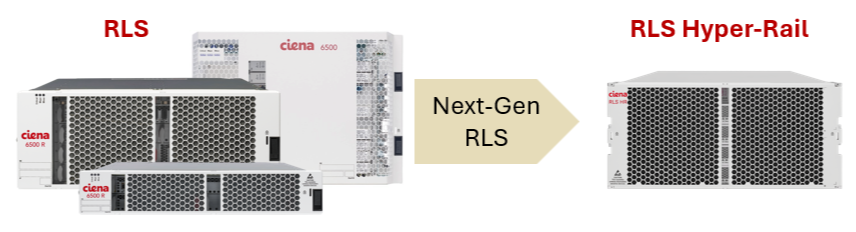
That foundation matters. RLS Hyper-Rail doesn’t start from zero. It applies the lessons Ciena has learned designing and operating photonic infrastructure at hyperscale to support a new order of scale. If you’re already running RLS, moving to multi-rail means advancing on a platform your teams already know, with the same software and operational model and less adoption risk.
So what does that RLS foundation actually deliver? Here are five ways RLS Hyper-Rail gives AI networks the scale they need without adding unnecessary operational complexity.
1. Dramatically more capacity per rack
As AI clusters scale, they’re becoming increasingly geographically distributed to take advantage of available power and real estate. At multi-region distances, ILA sites are unavoidable. Scale-across and AI backbone networks can require tens of petabits per second of capacity across hundreds of fiber pairs.
Traditional line system architectures weren’t designed for this reality. More fiber pairs mean significantly more amplification equipment, rack space, power, cooling, and supporting infrastructure.
RLS Hyper-Rail changes that equation. By integrating amplification, monitoring, and control into ultra-dense modules, it supports up to four fiber pairs per module and up to 128 fiber pairs per rack.
Compared with traditional approaches, RLS Hyper-Rail delivers up to 32x greater rack-level density, up to 75% power savings, and up to 85% less space. And that 32x matters: it reflects what can practically be powered in real-world ILA environments capped at 12 kW per rack—not a theoretical calculation of how many optics can physically fit in a rack.
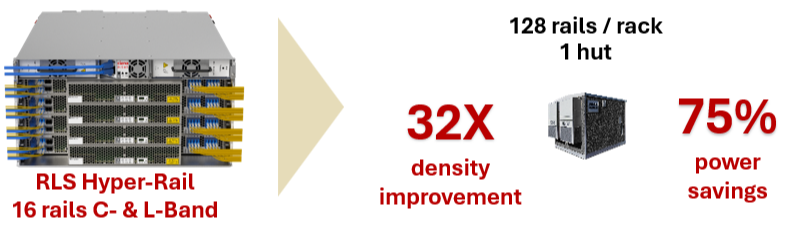
The goal isn’t to fit more optics into the same space. It’s to unlock significantly more capacity from the space and power you already have at these locations.
2. Fast, more consistent deployments at scale
Packing more fiber pairs into a rack solves the density problem. It doesn’t solve the operational one.
Imagine turning up hundreds of fiber pairs using processes designed for one. More connections, provisioning steps, and manual validation create more opportunities for inconsistency and error.
This is where starting with a proven operational RLS foundation pays off. RLS Hyper-Rail uses the same microservices-based software infrastructure and operational model as RLS, allowing operators to integrate RLS Hyper-Rail into existing back-office workflows through open APIs, model-driven configuration, and streaming telemetry.
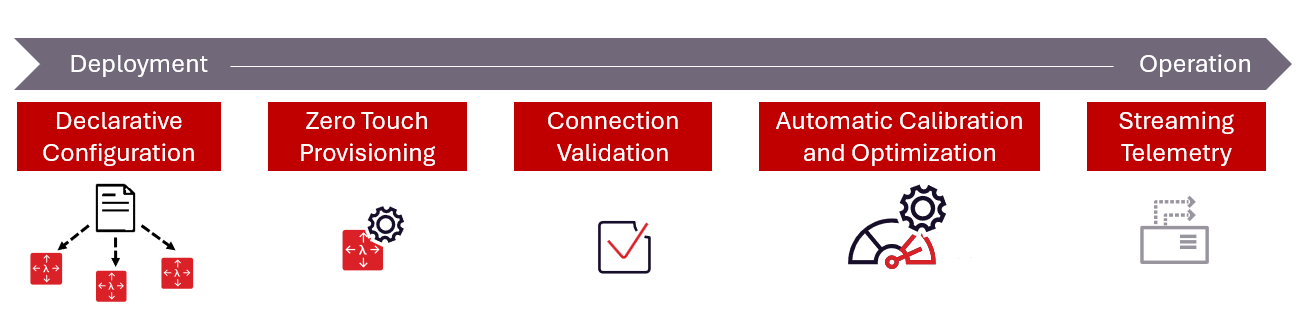
The result is a new multi-rail architecture that doesn’t require operators to adopt an entirely new way of managing the photonic layer.
Turn-up gets simpler too. RLS Hyper-Rail reduces the number of cards, ports, fibers, and provisioning steps required per rail. An automated workflow validates circuit packs, span connections, and fiber health before activation. Intuitive visual indicators provide technicians with instant on-site confirmation that connections are valid and the system is ready, while automated span calibration helps ensure each section is properly characterized.
The objective is simple: make deployment at scale as consistent and reliable for the hundredth connection as the first.
3. Visibility from turn-up to operations
When hundreds of fiber pairs are running through dramatically denser infrastructure, visibility can’t be an afterthought. RLS Hyper-Rail embeds advanced instrumentation directly into the system, giving operators real-time insight into span health, optical power, fiber characteristics, and potential faults throughout the network lifecycle.
Built-in capabilities—including high-resolution optical channel monitoring (OCM), bi-directional OTDR, and automatic fiber characterization—reduce dependence on external test equipment and manual processes. Rather than working from assumptions about fiber type or manually gathered data, automatic fiber characterization measures span length and loss to enable accurate link budgeting, even across mixed fiber types or unknown patch-panel losses.
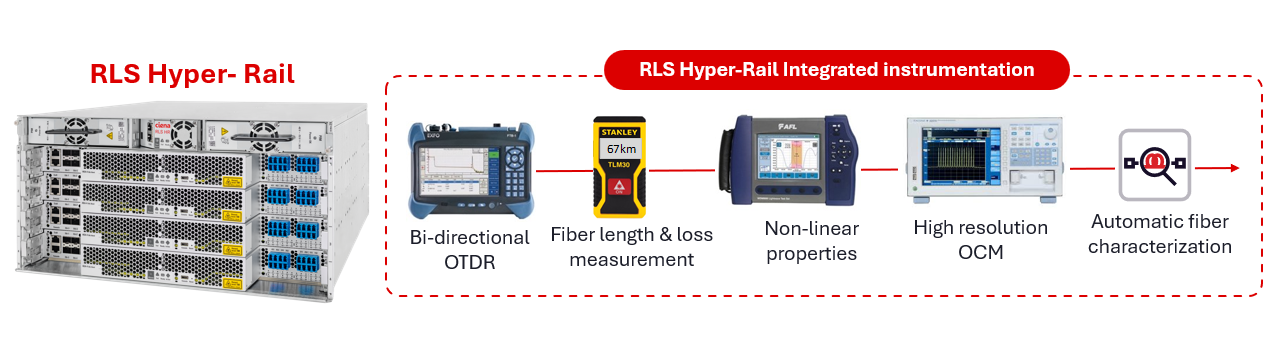
During deployment, these capabilities enable automated testing, span calibration, connection validation, and earlier identification of fiber issues. Once the network is operational, continuous streaming telemetry and built-in OTDR help operators quickly pinpoint and isolate problems while optimizing performance as the network scales.
4. More density without a bigger blast radius
Packing dramatically more capacity per rack raises the stakes for reliability. A single failure shouldn’t put multiple rails at risk, and serviceability needs to remain straightforward as system density increases.
That’s why multi-rail needs to be treated as a complete system, not simply more optical components packed into less space.


RLS Hyper-Rail draws on decades of photonic systems expertise and operational experience from extensive RLS deployments.
Built-in redundancy supports system availability and simplifies maintenance, while centralized management provides module status, power monitoring, firmware management, and secure configuration backup.
Just as importantly, each fiber pair operates independently, so a failure on one does not impact the others. This helps contain faults and protect the enormous capacity concentrated within each rack. Together, these design choices address not only how multi-rail systems perform, but how reliably they can be operated and maintained in real networks.
5. Built for the realities of the field
Greater density only helps if the system adapts to the realities you encounter in the field.
Span lengths, fiber types, amplification requirements, and power envelopes vary across the network. Some locations are modern facilities with ample power and deep racks. Others are legacy ILA huts where every watt and millimeter counts.
RLS Hyper-Rail was designed around that reality. It’s available in 300mm and 600mm variants to support environments ranging from legacy sites with only a few kilowatts per rack to newer facilities capable of supporting much higher rack densities. C&L-band EDFA and EDFA-Raman configurations allow operators to optimize deployments for their specific reach and performance requirements.
And the architecture isn’t limited to ILA sites. RLS Hyper-Rail can also be deployed at terminal locations, giving operators a solution that supports flexible deployments as multi-rail architectures expand across the network.
RLS Hyper-Rail: Making multi-rail practical for hyperscale AI connectivity
AI is redefining what optical infrastructure needs to deliver. As networks scale to light hundreds of fiber pairs in parallel, you need more than density—you need a solution that makes multi-rail practical to deploy and operate.
RLS Hyper-Rail is purpose-built for that shift, combining ultra-dense photonics with the automation, visibility, flexibility, systems expertise, and reliability needed to scale AI connectivity efficiently. And because it’s the next generation of RLS—not a fresh start—it gives you the capacity to scale on a proven foundation without making multi-rail harder to deploy, operate, or maintain.