






Managed Optical Fiber Network (MOFN) services are becoming an increasingly larger revenue opportunity for service providers, and the latest trends in MOFN are reshaping how networks are being deployed and managed. Kent Jordan explains how cutting-edge optical network innovations are enabling MOFN solutions to meet the growing connectivity demands of hyperscalers with greater efficiency and reliability.
In our industry today, there is a lot of talk about hyperscaler demand, with implications for our entire industry. For service providers, this is an opportunity to deliver tailored, high-capacity optical networking services that align with hyperscalers’ evolving needs. By offering the latest technology innovations as part of MOFN solutions, you can position yourself as a leader in the services market for hyperscalers and cloud providers. Hyperscalers are looking to collaborate to enhance their global network reach, and MOFN is an opportunity to help.
What is MOFN?
MOFN is a managed service where you build and operate a dedicated optical network for a hyperscaler or cloud provider. This network is tailored to the hyperscaler’s needs and offered back as a managed solution, enabling them to focus on scaling their services globally without the complexity of managing their own infrastructure.
For hyperscalers, MOFN is a faster path to market compared to acquiring dark fiber and building networks themselves. Leasing a network as a service allows hyperscalers to grow efficiently, especially in regions where licensing and regulatory hurdles make deploying their own networks impractical. Additionally, MOFN can help overcome challenges in areas where access to dark fiber is limited or unavailable.
The service provider deploys and operates these networks exclusively for a single customer, ensuring the solutions meet their specific requirements. Commercial terms may vary case by case, but the flexibility of MOFN enables hyperscalers to focus on their core business while service providers deliver the connectivity they need.
MOFN is a managed service where you build and operate a dedicated optical network for a hyperscaler or cloud provider. This network is tailored to the hyperscaler’s needs and offered back as a managed solution, enabling them to focus on scaling their services globally without the complexity of managing their own infrastructure.
For hyperscalers, MOFN is a faster path to market compared to acquiring dark fiber and building networks themselves. Leasing a network as a service allows hyperscalers to grow efficiently, especially in regions where licensing and regulatory hurdles make deploying their own networks impractical. Additionally, MOFN can help overcome challenges in areas where access to dark fiber is limited or unavailable.
The service provider deploys and operates these networks exclusively for a single customer, ensuring the solutions meet their specific requirements. Commercial terms may vary case by case, but the flexibility of MOFN enables hyperscalers to focus on their core business while service providers deliver the connectivity they need.
Why MOFN matters now
Hyperscalers are racing to introduce new AI services, driving an unprecedented need for rapid deployment of new data center connectivity and massive bandwidth. AI models are growing exponentially in size, requiring vast amounts of data to be processed and synchronized across interconnected data centers. This surge in demand is creating significant pressure to deploy scalable, reliable, and efficient optical networks—quickly.
As a service provider, MOFN gives you the opportunity to deliver the high-capacity network solutions hyperscalers need to keep pace with their aggressive timelines for AI innovation. The urgency to meet hyperscalers’ evolving needs has never been greater, and MOFN positions you as a trusted partner in enabling their global expansion.
Optical innovations are changing the architectures being deployed for MOFN services
As hyperscalers’ traffic demands have grown, highly flexible colorless, directionless, and contentionless (CDC) ROADM architectures that prioritize any-to-any wavelength routing have given way to simpler, scalable designs. Modern designs like colorless, direct attach (CDA) ROADM and transponder direct attach (TDA)—where the transponder directly connects to a ROADM port with no intermediate mux/demux or WDM filter—are being deployed more frequently. These architectures focus on efficiency, scalability, and cost-effectiveness, enabling you to deliver the high-capacity solutions hyperscalers require.
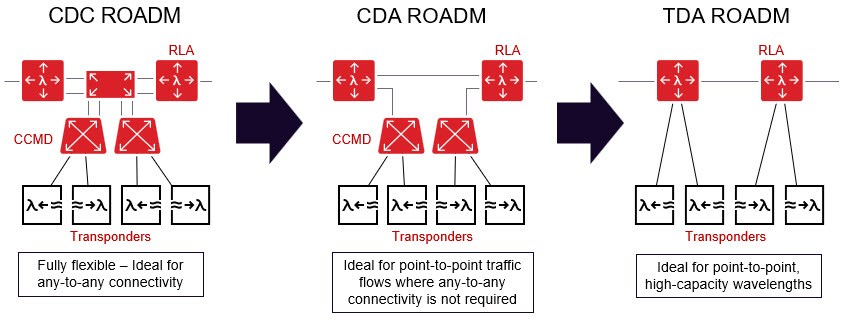
ROADM evolution to support high-capacity point-to-point connectivity
Coherent plugs are now being considered for MOFN deployments as an alternative to traditional transponder-based architectures in the metro. These compact, power-efficient transceivers offer flexible deployment options, reducing footprint and lowering ongoing energy costs, making it easier to scale metro connectivity.
Network resiliency has also become a critical requirement for hyperscalers, particularly in regions like India, where the frequency of fiber cuts is high. Downtime impacts AI training and cloud services, and hyperscalers are increasingly demanding robust optical protection. Nested optical-layer protection, multi-domain client protection, and protected ROADM designs are solution features that are available today to help you meet hyperscalers’ stringent reliability requirements.
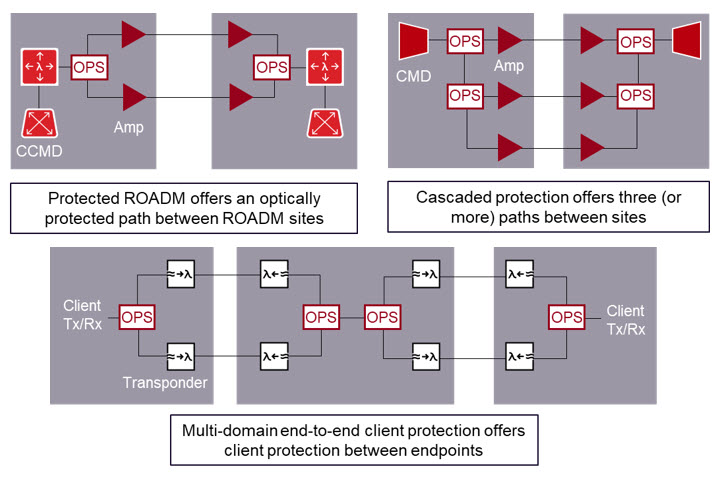
Multiple protection architectures to choose from depending upon your network resiliency requirements
For long-haul applications, C&L-band amplification continues to play an important role, and this proven technology is now moving into the metro, driven by increasing demand for short-distance, high-capacity DCI to support AI and data center connectivity. With C&L-band optimized photonics, you can deploy solutions that maximize fiber utilization while meeting hyperscalers’ growing need for scalable, reliable connectivity.
| Optical technology | Key innovation and features | Business Benefits |
|---|---|---|
| Coherent Transponders | Highest capacity and spectral efficiency (up to 1.6T) | Maximizes wavelength capacity to get the most value out of deployed fiber assets. |
| Coherent Plugs | High-capacity transmission (400G, 800G) with low-power and small footprint | Simplifies metro DCI scalability, reduces space, and lowers operational costs. |
| C&L-band Optimized Photonics | Simple C&L-band amplifiers and passive fixed-grid channel mux/demux optimized for plugs or transponders | Supports distributed GPU clusters with substantial capacity and minimal latency. |
| Optical Protection | Nested protection configurations (e.g., cascaded protection switching); multi-domain client OPS | Ensures network reliability, reduces downtime, meets hyperscaler SLAs. |
Optical networking innovations for modern MOFN deployments
These optical innovations are transforming how MOFN networks are designed, deployed, and scaled, empowering you to deliver tailored connectivity solutions that help hyperscalers and cloud providers build their AI infrastructure and expand their bandwidth capacity faster.
Solving MOFN visibility challenges with an end-to-end network view
As hyperscalers continue to adopt MOFN as part of their global network expansion efforts, they face challenges with fragmented network visibility across regions and service providers. Federated Navigator Network Control Suite™ (Navigator NCS) solves this problem by consolidating relevant network information into a unified, end-to-end view.
This solution gives hyperscalers visibility into their networks while you maintain control over your infrastructure. Federated Navigator NCS simplifies multi-network management and monitoring, ensuring compliance with regional regulations and hyperscaler privacy requirements. By streamlining network management, it allows you to operate MOFN efficiently while meeting hyperscaler expectations for transparency and reliability.
Federated Navigator NCS offers these benefits and uses:
- Consolidating fragmented networks: Hyperscalers can view their real-time end-to-end network performance across multiple regions to better plan their global capacity and connectivity needs.
- Ensuring privacy and control: You retain full control over your own network and the MOFN, exposing only relevant information to the hyperscaler while safeguarding sensitive data and your own business operations.
- Simplifying multi-network management: Federated Navigator NCS enables you to manage and troubleshoot issues across multiple MOFN, even if they are in different regions or being provided to different end customers.
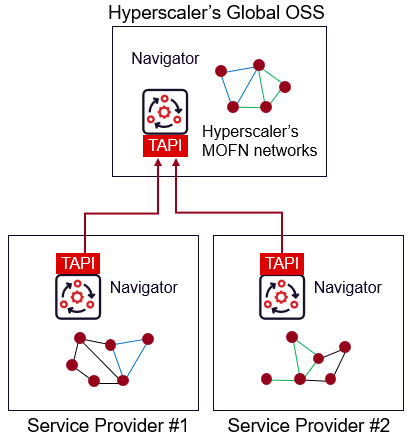 Federated Navigator NCS enables you to give hyperscalers visibility into their MOFN networks
By offering hyperscalers the ability to view their network in real-time, you can upsell value-added monitoring solutions to differentiate your services.
Spectrum services as an incremental step to MOFN
If you are looking for an easier transition to enter the MOFN market, spectrum services offer an accessible entry point. With spectrum services, you allocate portions of the optical spectrum to multiple customers on the same fiber. This allows you to transition to MOFN gradually while offering services across your existing lit fiber plant, delivering the flexible connectivity your hyperscale and cloud provider customers require without building dedicated optical networks for each of them.
To ensure reliable performance for spectrum services, the Shared Spectrum Monitor (SSM) module is available today to monitor each customer’s spectrum and protect against issues caused by provisioning errors or out-of-range power levels. By preventing interference with other customers’ wavelengths, the SSM helps ensure consistent network performance and allows you to guarantee your spectrum service SLAs.
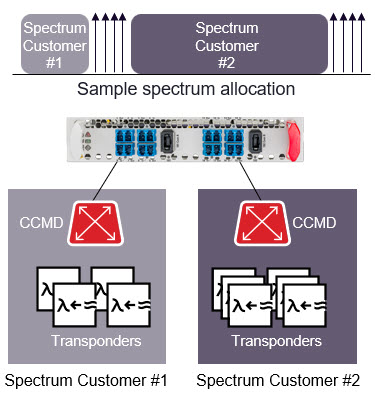
The SSM offers detailed power monitoring for up to 8 different spectrum customers
Looking ahead: Enabling hyperscaler success with MOFN innovations
Service providers like you are at the forefront of transforming global connectivity. High-capacity services are your specialty—MOFN is just an extension of that. It’s a game-changing opportunity for you to support the long-term growth of hyperscalers and cloud providers.
Recent advancements in optical technologies—such as 1.6T transponders, 800G coherent plugs, enhanced optical protection, and new photonic layer configurations—will help you be more competitive and win more MOFN opportunities. By equipping yourself with the latest optical network innovations, you are better positioned to capture market share, drive growth, and deliver value in this era of AI and cloud networking. Ready to explore what’s next for your optical network strategy? Let’s connect to discuss how these innovations can support your MOFN goals.