




Quantum-safe networking is quickly moving from research to real-world deployment as organizations prepare for the threat of quantum computers. Ciena’s Paulina Gomez sits down with Quantum Corridor’s Patrick Scully to discuss what quantum-safe communications means today and into the future.
Together with Quantum Corridor and Toshiba, we announced the successful completion of a trial of 1.6 Tb/s quantum-safe optical encryption on a live commercial network using both post-quantum cryptography (PQC) and quantum key distribution (QKD).
I sat down with Patrick Scully, Chief Product Officer at Quantum Corridor (and Ciena alum!), to explore what makes this achievement unique, why organizations should start preparing now, and how ecosystem collaboration is helping build the foundation for quantum-safe networking.
Paulina Gomez: Patrick, I can’t tell you how happy I am that our paths have crossed again, this time to discuss quantum-safe communications. This trial demonstrated 1.6 Tb/s quantum-safe optical encryption on a live commercial network. Why should this matter to network operators and enterprises preparing for quantum-readiness?
 Patrick Scully: This milestone is the first time a 1.6Tb/s channel is encrypted and secured with both PQC and QKD at the same time, and distributed over a live, real network. There have been other industry examples of encrypted channels being secured by QKD, as well as channels that are being encrypted with PQC, but this is the first time that both are combined to secure a 1.6Tb/s encrypted channel.
Globally, we’re seeing government mandates on quantum readiness. Whether it’s in the U.S. with the recent executive orders or in France, where the ANSSI cybersecurity agency says it will no longer certify anything that is not PQC-compliant, there is a strong push to deploy and migrate to quantum-safe networking applications and encryption solutions. Being able to deploy NIST-compliant PQC algorithms in an existing network and combine that with QKD adds a physical layer to the security element of the solution. This matters because it combines PQC’s mathematical approach with QKD’s quantum physics properties to create a stronger hybrid solution for securing critical in-flight data.
Paulina: I want to get into more details of the trial, but let’s first understand the bigger picture. What is the role that high-speed optical encryption plays in supporting a quantum-safe networking strategy?
Patrick: The high-speed optical encryption piece is a critical element. Combining a hybrid PQC and QKD quantum-safe approach with high-speed optical encryption allows us to serve almost any application, whether it's connecting AI clusters, data centers, or high-performance compute.
This translates to being able to meet the needs of any type of customer – from hyperscalers to financial organizations – by supporting connectivity at the optical speed that they need with an encryption solution that is fully transparent to the traffic. For Quantum Corridor it is essential to be able to offer the highest capacity network connectivity that is encrypted in a quantum-safe manner.
Paulina: One thing that really stood out to me about this trial was the collaboration behind it. This milestone brought together expertise from Quantum Corridor, Ciena, and Toshiba. Why is ecosystem collaboration important in moving these technologies into real-world deployments?
Patrick: Ecosystem collaboration is critical because quantum-safe networking depends on multiple capabilities working together. The value for end users is a faster, less disruptive path to quantum-safe connectivity. By securing traffic across PQC-enabled optical infrastructure, organizations can strengthen compliance and security without upending the applications and infrastructure they already rely on.
The ability to migrate to a NIST-compliant PQC environment allows enterprises and agencies to meet the legislative requirements for deploying quantum-safe solutions. Now, we can enable this with a simple software upgrade of our existing Ciena optical infrastructure, and the solution interworks with Toshiba’s QKD system to provide the physical layer security.
Paulina: Can you elaborate on the advantages of the Ciena and Toshiba solutions in this milestone?
Patrick: The collaboration with vendors like Ciena and Toshiba is critical for allowing us to be highly flexible and responsive to industry needs. Firstly, it allows us to seamlessly migrate our existing Ciena WaveLogic 5 Extreme-powered channel architecture to a PQC-compliant environment. Secondly, we can deploy industry-leading WaveLogic 6 Extreme 1.6 Tb/s channels onto our existing infrastructure to support secure high-speed connectivity. All of this is accomplished through a simple software upgrade without having to replace the infrastructure that we already have in place. And importantly, this is built with crypto agility, allowing us to adapt quickly to new standards, protocols, and PQC algorithms through software—without disruptive upgrades or costly rip-and-replace cycles.
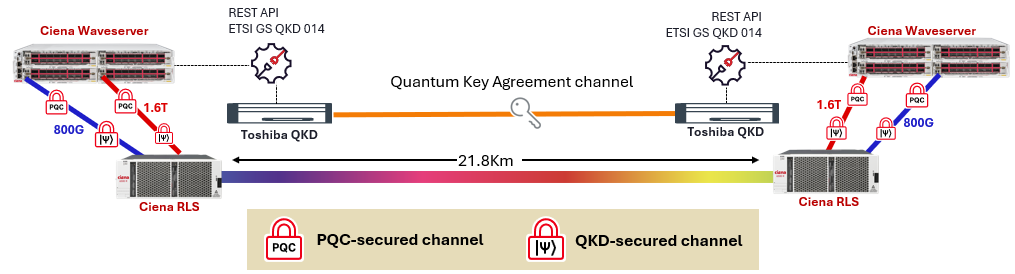
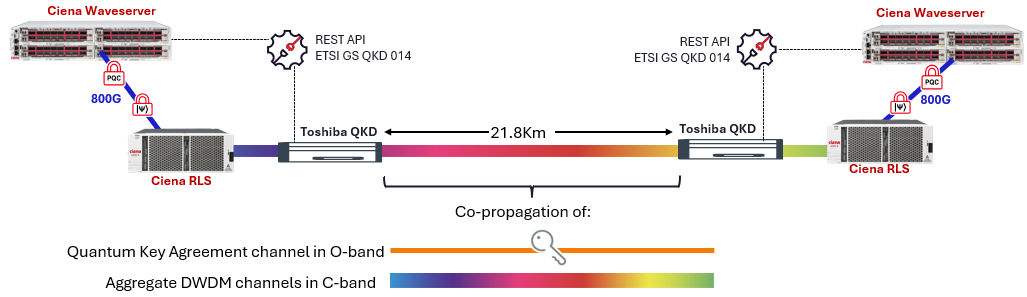
At the same time, the Toshiba QKD technology is also implemented in our network and interworks with Ciena’s Waveserver high-speed optical AES-256-GCM encryptors. Toshiba's QKD technology adds a physical layer of security by generating and distributing cryptographic keys based on the laws of quantum physics. During the trial we also validated Toshiba's photonic multiplexing capability with DWDM channels running over Ciena's Reconfigurable Line System (RLS), enabling QKD and classical data traffic to coexist over a single fiber pair. By enabling quantum and classical signals to coexist on the same fiber, this approach reduces fiber requirements, simplifies quantum-safe communications deployment, and lowers long-term network costs.
Paulina: The availability of Cryptographically Relevant Quantum Computers (CRQCs) is often talked about as a future threat. Why should organizations start preparing now?
Patrick: Even if quantum computers are not yet available to break today’s authentication and key exchange algorithms used to secure in-flight data, that date keeps moving closer as quantum computers are becoming increasingly powerful. Some companies are saying that this could be as soon as 2029, as Google recently published. The risk is not limited to some distant future point: data encrypted today may still be valuable when quantum capabilities mature, so enterprises and agencies need to migrate now to protect sensitive information before CRQCs become available.
Paulina: What do you see as the biggest challenges facing network operators and enterprises as they prepare for the threat of quantum computers. How does a quantum-safe networking approach help?
Patrick: Encryption systems have been in place for many years, and migrating to a quantum-safe application often means replacing some of the hardware that's already in place, as the existing hardware and/or firmware cannot be upgraded to support the PQC algorithms.
For enterprises and government agencies, this is a major challenge as they're looking to promptly migrate to a quantum-safe environment. If they need to replace thousands of routers across their infrastructure, this becomes a very complex activity over a short period of time. That is why enterprises haven't spent a ton of time on quantum-safe migration. They're waiting until they absolutely have to, because it can be extremely complex and costly.
Paulina: Quantum Corridor is a leader in quantum-safe networking and enabling your end-customers to quickly and securely migrate to this type of technology. What does this look like in practice?
Patrick: Quantum Corridor is building the kind of quantum-ready infrastructure that will help make next-generation secure communications possible. That means bringing together quantum and classical security technologies across our network, including commercially deployable QKD and PQC. We’re also exploring early trials in quantum-enhanced atomic clock synchronization and precision timing distribution, while continuing to expand what its quantum network can support.
Looking ahead, we’re contributing to foundational research in areas like quantum entanglement and distributed quantum networking, all with the goal of securely connecting quantum computers, sensors, applications, and users across geographically distributed infrastructure.