





September 1, 2026
By Farzam Toudeh-Fallah
R&D Director of Quantum Communications
In this technical deep dive, Farzam Toudeh-Fallah, R&D Director of Quantum Communications, discusses Ciena’s vision for developing large-scale quantum-optical networks capable of supporting applications such as quantum-secured communication, distributed quantum computing, and distributed quantum sensing regardless of the topology or distance.
Across the communications industry, there’s a growing acknowledgement that the adoption of quantum-based solutions will require communication networks that can support various applications regardless of the topology or distance. Beyond quantum-secured channels, this includes applications such as distributed quantum computing (inter-connecting quantum data centers at large scale) and distributed quantum sensing (interconnecting quantum sensors). Achieving this means that existing optical networks must be able to support both quantum and classical applications in the future.
To get there we need to overcome one of the major challenges in quantum communication: establishing long-distance quantum channels. This is what is driving much of the research at Ciena and across the global quantum community, and why we have published our vision for how large-scale quantum-optical networks could be architected in the future. In an earlier blog, we explained the broader industry context and our satellite-based approach in depth. Here, I focus on the terrestrial approach in our research towards establishing the future of quantum-optical networks and the fundamental requirements needed for real-word operational deployments.
Overcoming the long-distance quantum communication challenge
First, let me clarify that by long distance, I am referring to ultra-long haul networks that can stretch for thousands of kilometres, the best examples of which are the optical transcontinental links. Fiber is an expensive commodity and as a result, dedicating fibers to quantum channels is not a pragmatic approach. In practical deployments, establishing long-distance quantum-optical networks will be based on the coexistence mode of operation in which the optical DWDM classical channels and the quantum channels are multiplexed on the same fiber.
The main challenge in this approach is establishing long-distance quantum channels over today’s existing fiber infrastructure. All the degradation factors of the fibers deployed in operational networks must be considered in the performance analysis of the quantum channel established in an optical fiber. Loss, decoherence, Raman Scattering and other impairments in the propagation medium result in the degradation of the quantum channel. Importantly, the no-cloning principle in quantum mechanics prevents the copying of an unknown quantum state, which nullifies the notion of amplification in quantum communications.


To overcome this challenge, the research community is working towards developing a device called quantum repeater to extend the distance of a quantum channel.
A quantum repeater isn’t a new concept. In fact, it has been the subject of world-wide research for decades. This methodology is based on a unique phenomenon in quantum mechanics called entanglement, which is a non-local correlation between quantum particles regardless of their distance. In the future, once the quantum repeaters are transitioned from research labs to the real-world operation environments, they would be installed in ILA (In-Line Amplifier) sites, deployed in optical networks today on average every 80 to 100 km along the fiber routes to amplify the signals. Therefore, quantum repeaters must be able to cover at least distances up to 100 km spacing between them. In this model, the long-distance sites are connected via fiber optic links, in which DWDM optical data channels (C- and L- bands) and quantum channels (O-band) are multiplexed on the same fiber. Studies have shown that O-band loss on a fiber optic span in operational environments could exceed 42dB, therefore, quantum repeaters must be able to tolerate such massive quantum channel losses per span. Despite recent advances on this front, it is important to note that this technology is still far from the maturity level required for real-world deployments.
The essential building block for long-distance quantum communications
The fundamental building block in our vision towards establishing long distance quantum communications over an existing optical network is a device we define as the Quantum Optical Repeater System (QORS). Each QORS contains an optical element (ROADM, amplifier or switch) to establish optical DWDM classical channels and a quantum repeater to establish long-distance quantum channels as shown below.
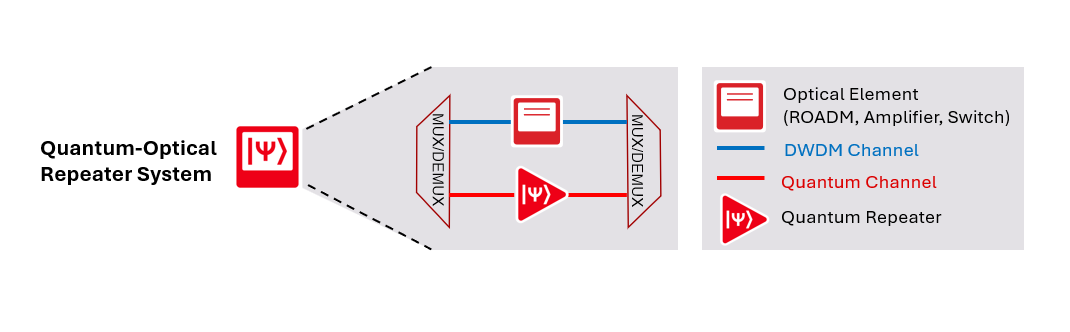
The QORS would be able to establish both classical optical DWDM and quantum channels on the network to operate together in a coexistence mode to enable large-scale quantum optical networks.
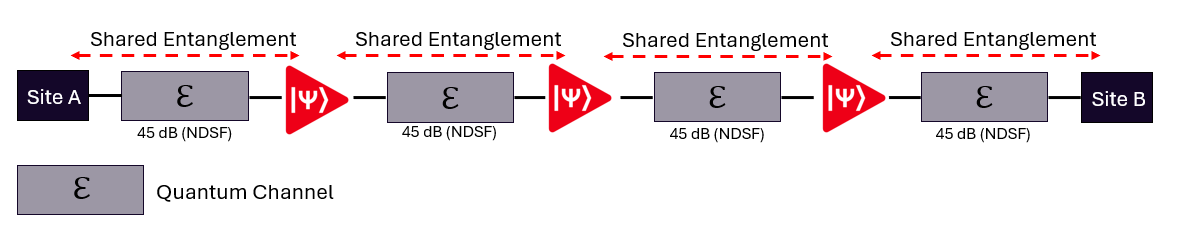
The quantum repeater in the QORS operates based on the well-known entanglement distribution methodology for establishing long-distance quantum channels. In this method, the long-distance link between the two communicating parties at Sites A and B is divided into spans of around 100 km in length and each span is connected to the next via a quantum repeater. Establishing a long-distance quantum communication channel starts with each quantum repeater establishing entanglement with its own neighbors. Then all quantum repeaters undergo a process known as entanglement swapping. At the end of this process, the two long-distance sites will be in entanglement with each other.
The quantum teleportation process
Once the long-distance entanglement via quantum repeaters is established, a process unique to quantum communication, known as quantum teleportation, will be used to transfer the quantum states from Site A to Site B. In this methodology, the quantum state that should be transferred between the two long-distance sites, disappears on one site and appears on the other via the quantum teleportation process that utilizes Quantum Processing Units (QPU) at each site and a classical communication channel between the two parties. In the case of establishing quantum-secured channels using QKD, once the entanglement between the two long-distance sites is established, entanglement-based QKD methodologies such as BBM92 can also be utilized. Please refer to Establishing Quantum-Secured Channels in Large-Scale Optical Networks for technical details.
Understanding the impact in a real long-distance optical network
The true value of this research comes from the learnings achieved when applying this vision to a real long-distance optical network – which is exactly what we are doing. In this on-going research study, a top-down approach is taken in which first a large-scale quantum-optical link based on the real-world parameters and set of requirements for a pragmatic quantum repeater is modelled on a simulation tool. The key differentiator in this research study in comparison to various academic studies is the set of requirements and data that we use for modelling a real-world environment. Specifically, link engineering data from a real-world 6000 km ultra long-haul optical link supported by Ciena devices connecting San Francisco to New York is utilized.
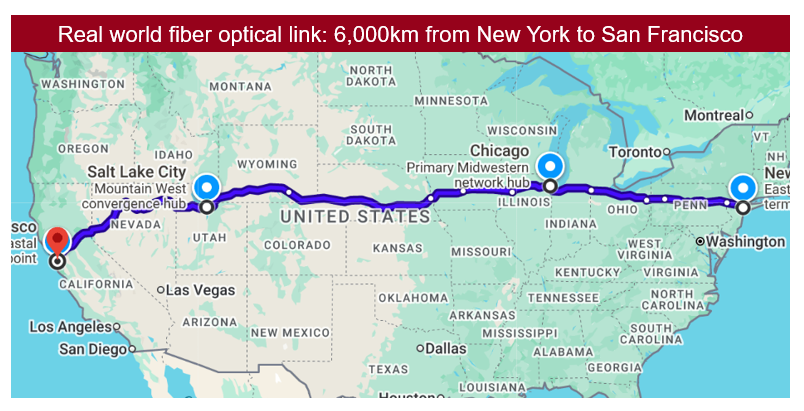 This approach in conducting analytical research at the network level is essential to address some fundamental questions for establishing long-distance quantum communication channels in the future. For example, getting closer to identifying the specific quantum repeater model that would meet the set of requirements for establishing such channels in the real-world operational environments as well as understanding the maximum tolerable loss and upper bound on the end-to-end entanglement generation rate are all fundamental towards achieving large-scale quantum-optical networks in the future.
What this means for the future
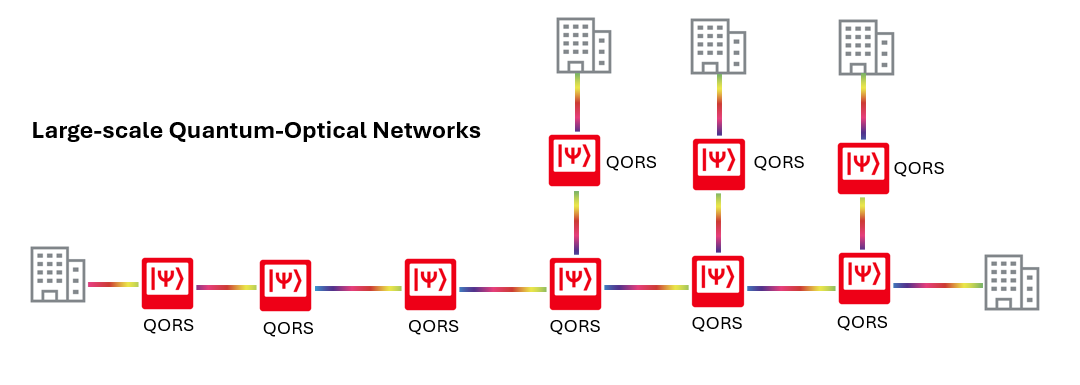
Large-scale quantum-optical networks will play a vital role in ensuring long-distance quantum-secured communication and the deployment of future applications including distributed quantum computing and distributed quantum sensing. Ciena is pioneering in this space by conducting the research that studies establishing long-distance quantum communication channels in real-world operational environments, to pave the way towards creating a blueprint for developing the required devices for establishing long-distance quantum communication links over existing optical fiber networks.
If you are interested in diving deeper and understanding how this vision could be adopted towards coexistence with today’s network infrastructures, we invite you to explore our technical paper and presentation on large-scale quantum-optical networks.