




8300 Router
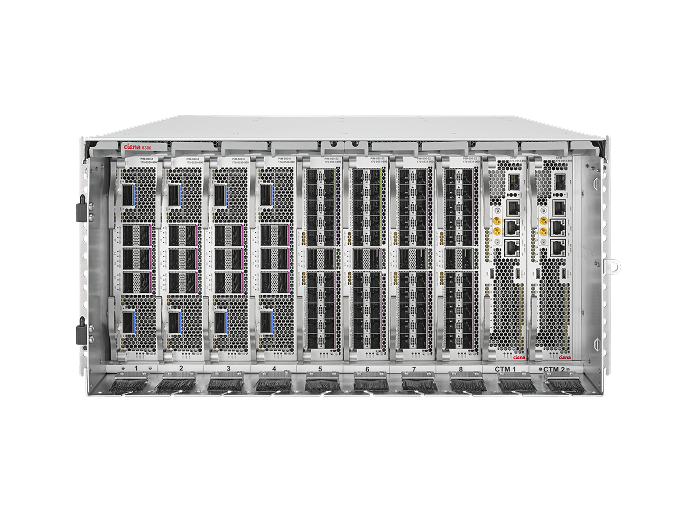
The 8300 Router features a clean-slate design for the next generation of distributed AI inference and IP services. Its modular chassis architecture provides redundancy across the control plane, data plane, cooling, and power modules to help maintain service continuity in demanding network environments.
Purpose-built for AI-driven traffic, the 8300 is engineered for routing and service scale. OAM offload through the control and timing module (CTM), combined with scalable telemetry, supports extensive service monitoring and measurement for more precise service assurance and strong SLA performance. The CTM also provides comprehensive system management and hardware readiness for advanced timing capabilities.
A single switch module delivers the router’s full 6.1 Tb/s switching capacity from day one, avoiding unnecessary fabric overbuild as demand increases. The eight-slot, 5 RU chassis features a shallow 600 mm depth and provides fine-grained interface flexibility from 1GbE to 400GbE, with a path to future 800GbE support. Integrated DWDM connectivity supports a broad range of coherent pluggable options across 100GbE to 400GbE ports.
Powered by Ciena’s Service-Aware Operating System (SAOS), the 8300 supports a broad range of IP and Ethernet transport, as well as Layer 2 (L2) and Layer 3 (L3) service capabilities. This versatility supports deployments across diverse metro aggregation and service edge applications.
Product overview
The 8300 is designed for resilient deployments and simplified serviceability, with key components accessible from the front and rear of the chassis.
Eight modular port interface modules (PIMs) and redundant CTMs are accessible from the front.
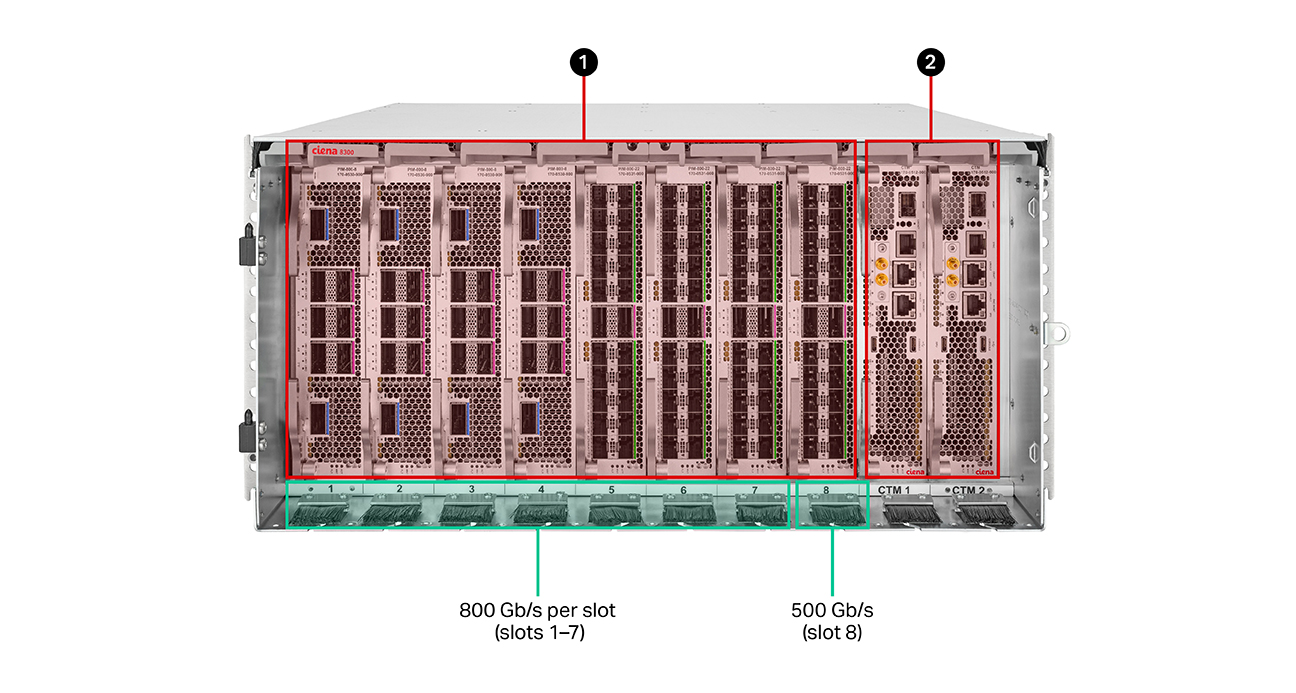
| 1. | Eight traffic PIM slots, with slots 1–7 supporting up to 800 Gb/s of switching capacity each and slot 8 supporting up to 500 Gb/s |
| 2. | CTM 1 and CTM 2 slots (1 + 1 configuration shown) |
The CTM runs Ciena’s SAOS, performs route processing, and distributes forwarding tables to the PIMs. It supports operations, administration, and maintenance (OAM) offload, timing and synchronization, and system management. The CTM also controls the operation of the fans, alarms, and power supplies. Its ports and external interfaces are shown below.
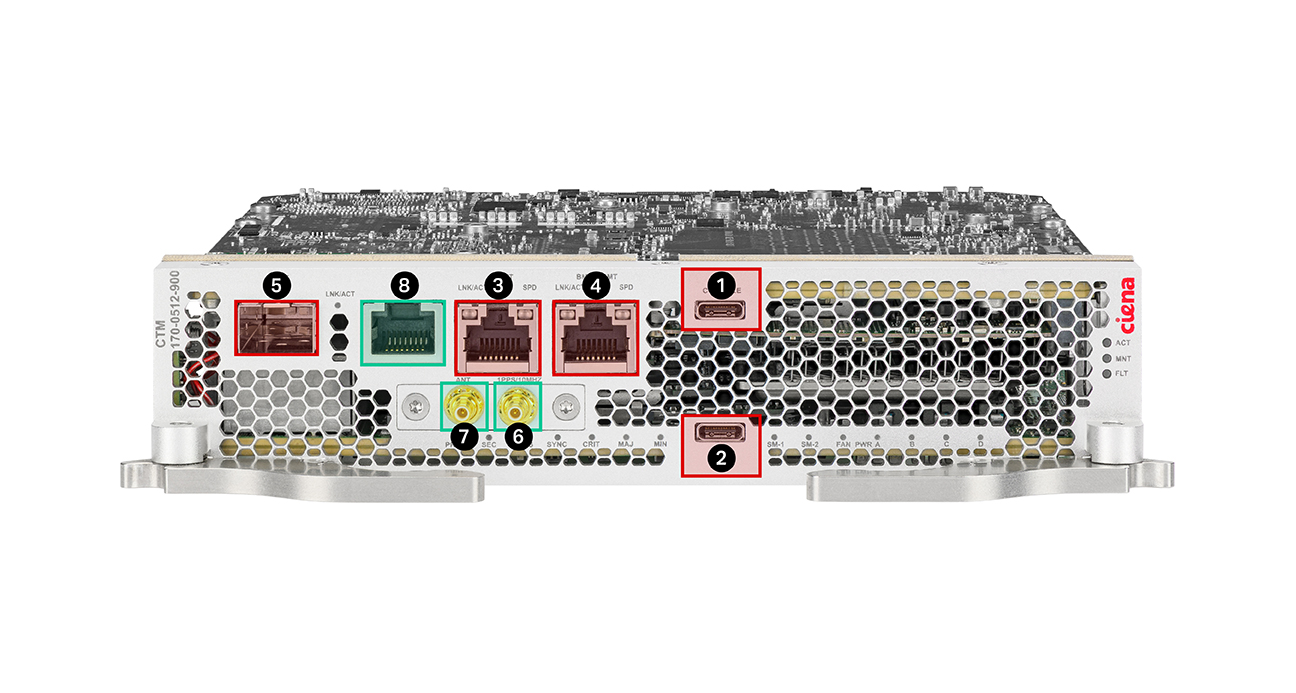
| Management ports |
|
| Timing and synchronization ports |
|
The 8300 offers a broad selection of PIMs with flexible speed and density options.
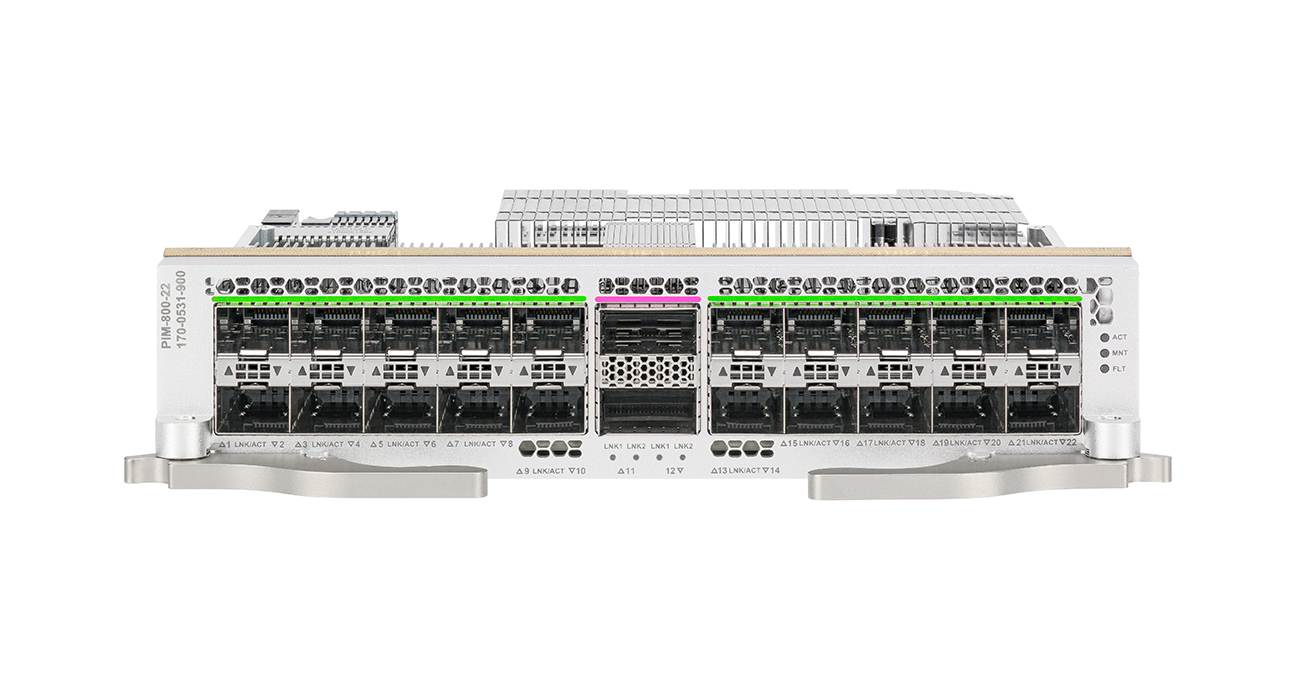
One PIM provides 20 x 1GbE/10GbE/25GbE SFP28 ports, shown in green in Figure 3, and 2 x 100GbE QSFP28 ports, shown in pink. It supports 10G DWDM on the SFP28 ports and standard 100G ZR, OpenROADM, and WaveLogic™ 5 Nano (WL5n) performance modes on the QSFP28 ports.
A second PIM provides eight ports: 6 x 100GbE QSFP28 ports, shown in pink in Figure 4, and 2 x 100GbE/200GbE/400GbE QSFP-DD ports, shown in blue. It supports standard 100G ZR and 400G ZR/ZR+ optics, 100G to 400G OpenROADM modes, and 100G to 400G WL5n performance modes.
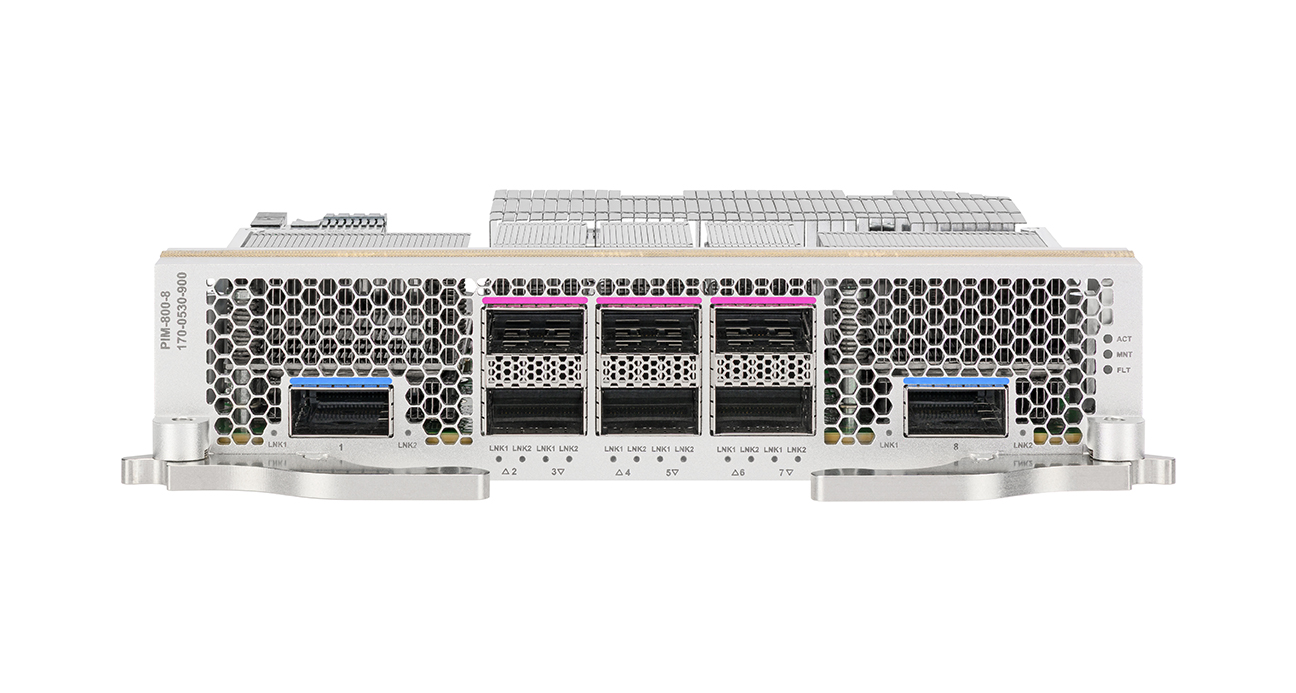
Refer to the technical specifications for maximum supported 1GbE, 10GbE, 25GbE, and 100GbE configurations, with and without breakout cables.
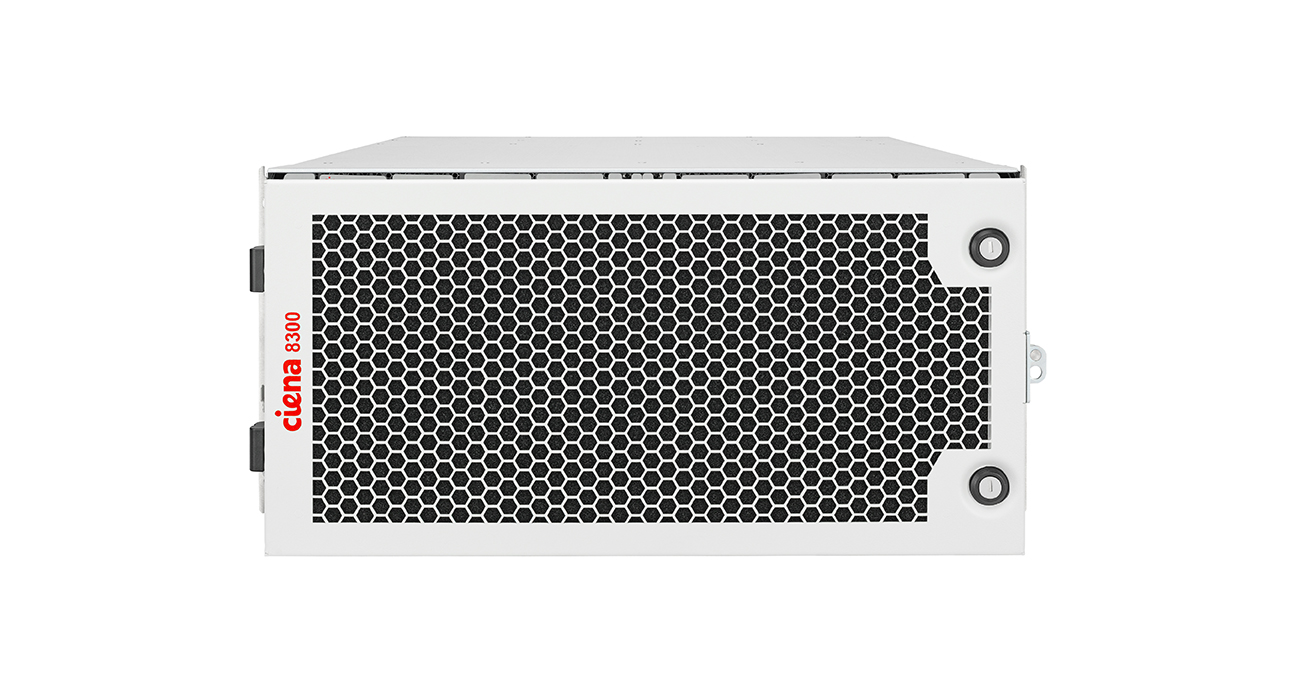
Figure 5 shows the chassis front view with the air filter door installed for added protection in Network Equipment-Building System (NEBS) Level 3 deployments.
Hot-swappable fans and power supplies are accessible from the rear of the chassis, as shown below.
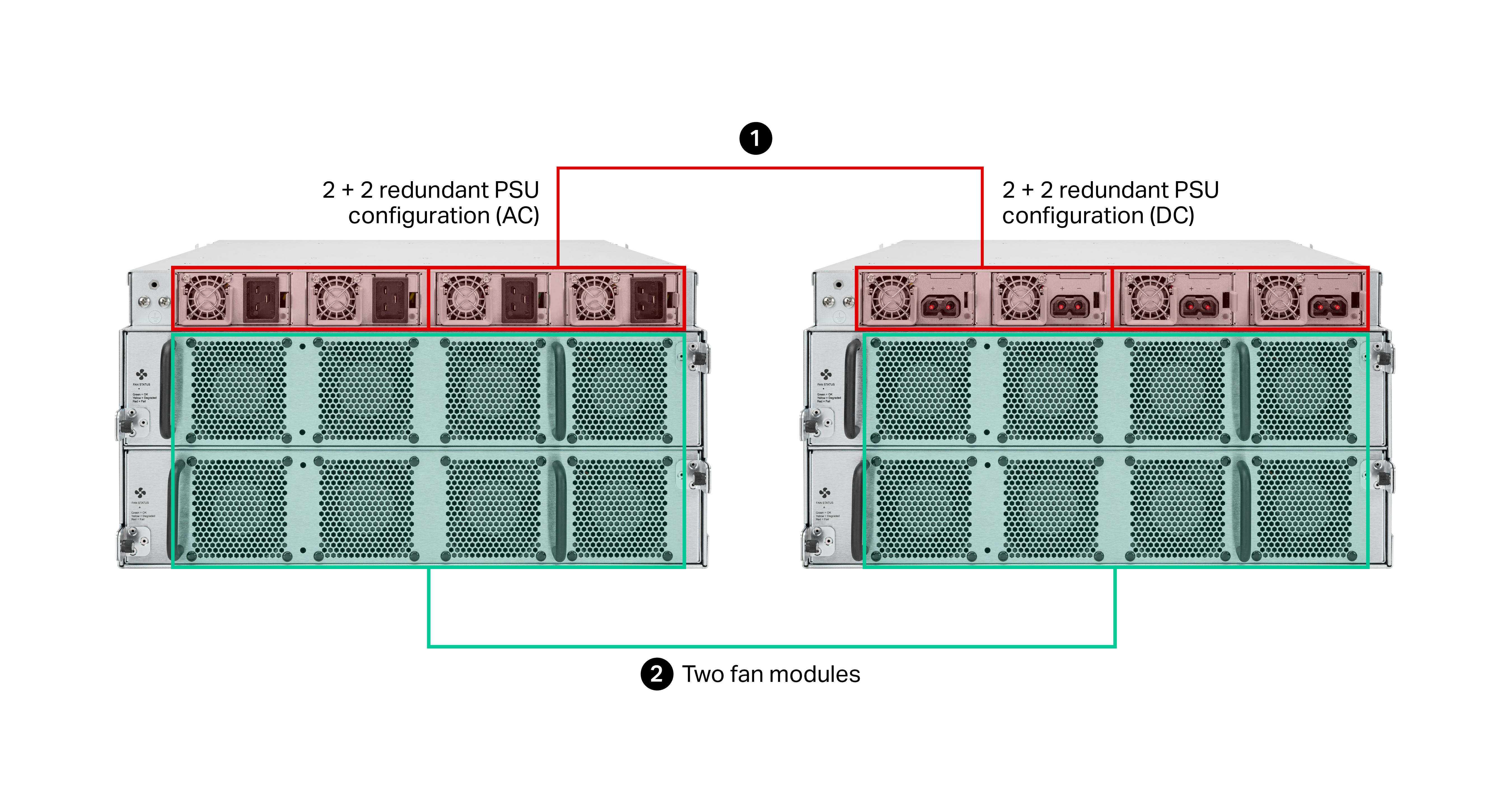
| 1. | AC and DC PSU options shown with 2 + 2 redundancy |
| 2. | Two fan modules with four fans per module in an N + 1 redundant configuration |
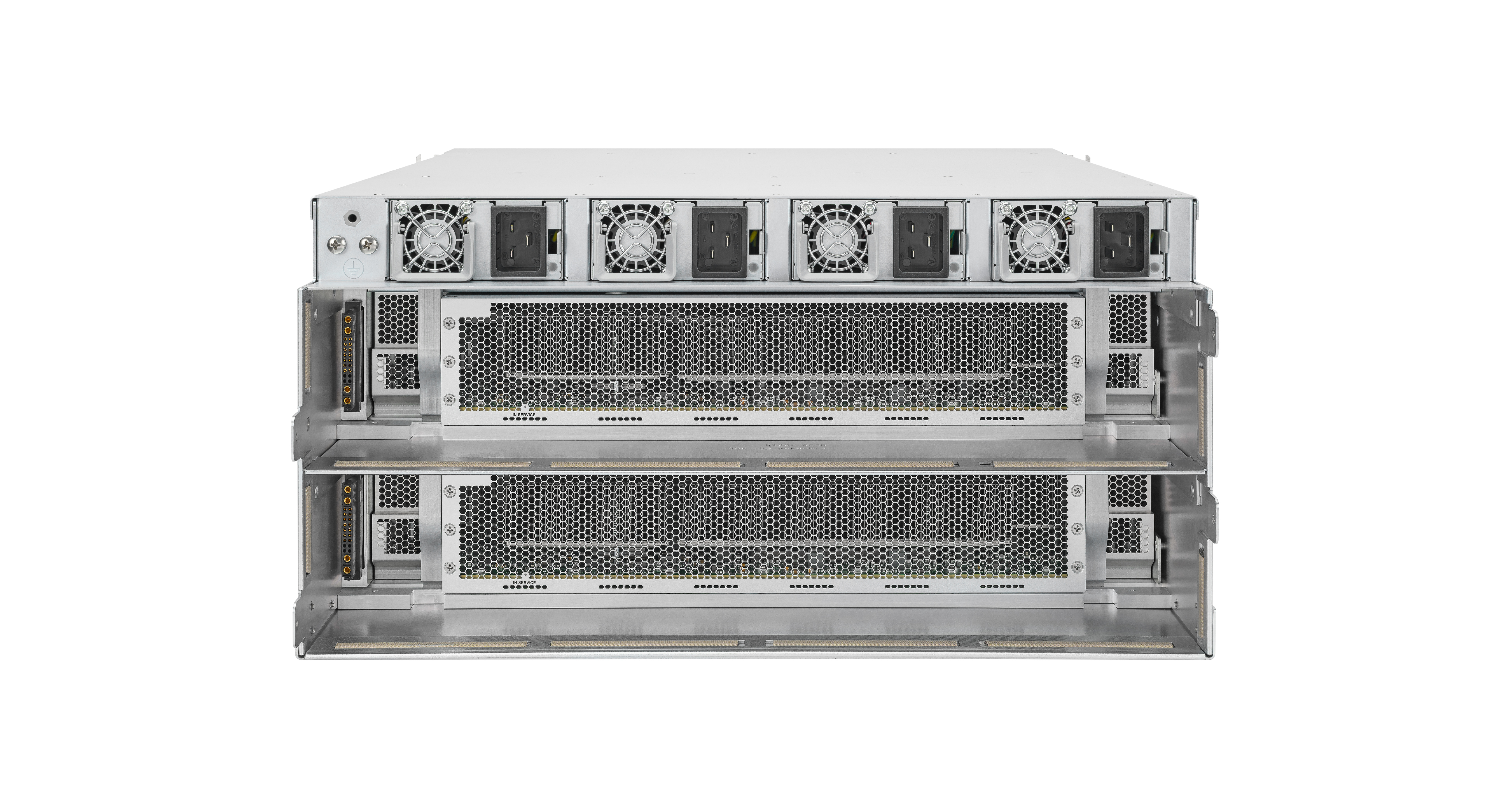
The 8300 delivers its full 6.1 Tb/s switching capacity and port density with a single switch module. The switch module hosts the forwarding engine and packet processing functions and is located horizontally behind the fan modules; it can be accessed once the fan modules are removed.
A resilient foundation by design
The 8300 provides built-in hardware redundancy without additional software licensing costs. The router supports 1 + 1 active-standby control-plane and data-plane configurations, two hot-swappable fan modules with N + 1 fan redundancy, and four AC or DC power modules in a 2 + 2 redundant configuration, as discussed above.
This hardware resiliency is complemented by software capabilities across the protocol stack. Examples include nonstop forwarding (NSF), which helps maintain traffic forwarding during a control-plane or software disruption, and graceful restart, which coordinates protocol adjacency behavior with neighboring routers as the routing state is relearned.
Comprehensive transport and service protocol support
Powered by Ciena’s SAOS, the 8300 supports IPv4 and IPv6 addressing, interior gateway protocols such as Intermediate System to Intermediate System (IS-IS), and a broad range of tunneling technologies, including Label Distribution Protocol (LDP), Resource Reservation Protocol (RSVP), and segment routing (SR)-MPLS.
The 8300 also supports a wide range of E-Line and E-LAN L2 services, as well as L3 services. These services can be delivered using EVPN or traditional L2 VPN and L3 VPN technologies.
Additional capabilities include Border Gateway Protocol Labeled Unicast (BGP-LU) and traffic engineering using RSVP-TE, SR-MPLS policies, and Flex-Algo. Together with comprehensive protection mechanisms, these capabilities support multi-domain, multi-area, and multi-layer network designs across a broad range of applications.
Rich OAM capabilities
The 8300 offers an extensive suite of software-based and hardware-assisted OAM capabilities.
Its Ethernet OAM features include ITU-T Y.1731 connectivity fault management (CFM) and performance measurements. An embedded, line-rate service activation test (SAT) engine supports RFC 2544 and ITU-T Y.1564 traffic generation and reflection at speeds up to 400 Gb/s. These capabilities help validate service performance and SLA compliance without relying on external test equipment.
Ethernet OAM can also be combined with Bidirectional Forwarding Detection (BFD) and other IP OAM mechanisms to support advanced use cases, including latency-aware traffic engineering.
Modern management and automation
The 8300 offers a broad range of management, automation, and provisioning options to support different operational needs.
You can use model-driven management through the Navigator Network Control Suite™ (Navigator NCS), a web-based interface through Node Essentials, or the command line interface (CLI). Node Essentials provides access to essential management functions and offers a simple option for users who prefer a graphical interface or do not have access to Navigator NCS.
The 8300 supports YANG-based data models and programmable interfaces, including NETCONF. It also supports streaming telemetry using the Google remote procedure call (gRPC) through the gRPC Network Management Interface (gNMI). These capabilities enable network automation, integration, and real-time monitoring use cases.
Technical specifications
| Specification | Description |
|---|---|
| Chassis dimensions |
Height: 5 RU, 221 mm (8.70 in.) Width: 443 mm (17.44 in.) Depth without air filter: 568 mm (22.36 in.) Depth with air filter: 600 mm (23.62 in.) |
| Chassis weight | 18 kg (39.68 lb.), chassis only |
| Switching capacity | 6.1 Tb/s |
| Switch module slots | Two rear-accessible slots located behind the fan modules |
| Switch module dimensions (H x W x D) | 81 mm x 419 mm x 206 mm (3.19 in. x 16.50 in. x 8.11 in.) |
| Switch module weight | 3 kg (6.61 lb.) |
| CTM slots | Two front-accessible slots, CTM 1 and CTM 2 |
| CTM dimensions (H x W x D) | 42 mm x 202 mm x 209 mm (1.65 in. x 7.95 in. x 8.23 in.) |
| CTM weight | 2 kg (4.41 lb.) |
| CTM management ports |
|
| CTM timing and synchronization ports |
|
| PIM slots | Eight front-facing slots, numbered 1–8 |
| PIM-800-8 interfaces |
|
| PIM-800-8 dimensions (H x W x D) | 42 mm x 202 mm x 209 mm (1.65 in. x 7.95 in. x 8.23 in.) |
| PIM-800-8 weight | 1.5 kg (3.31 lb.) |
| PIM-800-22 interfaces |
|
| PIM-800-22 dimensions (H x W x D) | 42 mm x 202 mm x 209 mm (1.65 in. x 7.95 in. x 8.23 in.) |
| PIM-800-22 weight | 1.5 kg (3.31 lb.) |
| Power supply options | AC or DC configurations |
| Power requirements |
|
| Cooling |
|
| Fan module dimensions (H x W x D) | 85 mm x 445 mm x 133 mm (3.35 in. x 17.52 in. x 5.24 in.) |
| Fan module weight | 2.5 kg (5.51 lb.) |
| Operating temperature | 0°C to 40°C (32°F to 104°F) |
| Storage temperature | –40°C to 70°C (–40°F to 158°F) |
| Relative humidity | 5% to 95%, noncondensing |
Maximum port density
| Ethernet speed | Port type | Maximum port density |
|---|---|---|
| 1GbE | SFP+ | 160 |
| 10GbE | SFP+ | 160 |
| 25GbE | SFP28 | 160 |
| 100GbE | QSFP28 |
58 without breakout cables 100 with breakout cables on 400GbE QSFP-DD ports |
| 200GbE | QSFP-DD | 14 |
| 400GbE | QSFP-DD | 14 |
Regulatory and standards compliance
| Specification | Description |
|---|---|
| Agency marks | NRTL |
| Electromagnetic compatibility (EMC) emissions and immunity |
CISPR 32 Class A EN 55032 Class A FCC Part 15 Class A ICES-003 Class A |
| Environmental | RoHS2 Directive 2011/65/EU and 2015/863 WEEE 2012/19/EU |
| Safety | CAN/CSA 22.2 No. 62368-1 EN 62368-1 IEC 62368-1 UL 62368-1 |
Software features
L2
-
Ethernet switching and interfaces
- Ethernet bridging and MAC learning
- Q-in-Q and customer virtual LAN (C-VLAN) bundling
- L2 Control Protocol (L2CP)
- Link aggregation group (LAG)
IP routing
-
IP addressing and interfaces
- IPv4 and IPv6
- IP unnumbered interfaces
- Multiple IP subnets on an interface
-
IS-IS
- IPv4 and IPv6
- Levels 1 and 2
- Single-topology, multi-topology, and multi-instance operation
-
BGP
- iBGP, eBGP, Multi-Protocol BGP (MP-BGP), and IPv6 BGP
- Inter-AS options A and C
- Inline route reflection
- BGP-LU
- BGP Prefix-Independent Convergence (PIC) edge
- BGP large communities
-
Routing policy and multipath
- Route map
- Interior Gateway Protocol (IGP) latency propagation
Services
-
EVPN
-
Point-to-point (virtual private wire service [VPWS])
- Single-homing and multi-homing support (all-active/port-active)
- IP route type 5
-
Point-to-point (virtual private wire service [VPWS])
-
Pseudowire (PW) options
- Flow awareness transport PW (FAT PW)
- Multi-segment PW (MS-PW)
-
L2VPN
-
Virtual private LAN service (VPLS)
- Static
- Signaled (LDP-based)
- Hierarchical VPLS (H-VPLS)
-
VPWS
- Static
- Signaled (LDP-based)
-
Virtual private LAN service (VPLS)
-
L3VPN
- Virtual routing and forwarding lite (VRF-lite)
- IPv6 VPN Provider Edge (6VPE)
- MP-BGP
Transport
-
MPLS-TP
- Static and LDP-signaled
-
SR-MPLS
- IS-IS
- Node, adjacency, prefix, and anycast segment identifiers (SIDs)
- Topology-independent loop-free alternative (TI-LFA) and microloop avoidance (Bashandy) for protection
- Flex-Algo and SR policy traffic engineering
- BGP-LU support
- ITU-T Y.1731
- Ping, traceroute, and SID statistics
-
Transport interworking and path selection
- MPLS-TP-to-SR interworking
-
RSVP-TE
- IS-IS
- Constrained shortest path first (CSPF), levels 1 and 2
- Traffic engineering affinities
- Link-, node-, and SRLG-aware fast reroute (FRR) protection
- Label switched path ping, traceroute, statistics, and counters
Breakout support
- 4 x 100GbE on 400GbE port
High availability
- NSF
- GR
Quality of service (QoS)
-
Ingress traffic classification and metering
- Ingress QoS metering
- Hierarchical ingress metering
- Classification based on IEEE 802.1p priority bits
- Classification based on differentiated services code point (DSCP) and MPLS traffic class markings
- Class of service (CoS) mapping
- Egress scheduling, queuing, and shaping
- Hierarchical egress QoS (HE-QoS)
-
Congestion management and traffic control
- Weighted random early detection (WRED)
OAM
-
Ethernet service OAM
- IEEE 802.1ag CFM
- ITU-T Y.1731 test traffic generation and reflection
-
Service activation testing
- Service activation test generation and reflection
- RFC 2544 testing at rates up to 400 Gb/s
- ITU-T Y.1564 testing at rates up to 400 Gb/s
-
BFD
- Single-hop and multi-hop BFD
- Micro-BFD
- Seamless BFD
-
Network Time Protocol (NTP)
- NTP Version 4 (NTPv4) server
- NTPv4 client
Security
-
Access control and protocol authentication
- IP access control lists
- BGP MD5 authentication
-
Secure administrative access and transport
- Secure Shell (SSH) v2 and SSHv3
- Secure Copy Protocol (SCP)
-
Software integrity and certificate management
- Software signature validation
- Restore of saved certificates through CLI or NETCONF
Manageability
-
Administrative access and user control
- Authentication, authorization, and accounting (AAA)
- TACACS+
- Remote Authentication Dial-in User Service (RADIUS)
- Local user management and authentication
- Role-based access control (RBAC)
- Local accounting
- Password aging and formatting
-
Management connectivity
- IPv4 and IPv6 management
- L2 and L3 in-band management
- Management VRF
- Domain name system (DNS)
-
Programmability and model-driven management
- NETCONF/YANG
- NETCONF access control
- Restore of saved configurations through CLI or NETCONF
-
gRPC/gNMI streaming telemetry
- gRPC dial-in telemetry
- gRPC dial-out telemetry
-
Discovery, monitoring, and event notification
- Link Layer Discovery Protocol (LLDP)
- Simple Network Management Protocol (SNMP) and SNMPv3
- Syslog
- External event notification and alarm generation
-
Traffic visibility
- Port mirroring
-
Lifecycle operations
- Reset to factory default (RTFD)
- Reset to User Configurations (RTUC) backup and restore
-
SDN and traffic engineering integration
- BGP-LS support for SR-MPLS
Ordering information
| Part number | Description |
|---|---|
| Common parts | |
| 170-8300-900 | 8300, BASE SYSTEM CHASSIS |
| 170-0512-900 | 8300, SECURE, CONTROL & TIMING MODULE, CTM |
| 170-0510-900 | 8300, FAN TRAY |
| 170-0526-900 | 8300, SWITCH MODULE ENHANCED, SM-6-P |
| Port interface modules | |
| 170-0530-900 | PIM-800-8, (2) X 400G/200G/100G QSFP-DD (6) X 100G QSFP28 LINE MODULE |
| 170-0531-900 | PIM-800-22, (20) X 1G/10G/25G SFP28 + (2) X 100GIGE QSFP28 LINE MODULE |
| Power supply | |
| 170-0372-900 | DC PLUGGABLE POWER SUPPLY -48V, 2.5KW, FOR USE WITH 814x/819x |
| 170-0373-900 | AC PLUGGABLE POWER SUPPLY, 240VAC, 2.5KW, FOR USE WITH 814x/819x |
| GNSS and console accessories | |
| 170-0329-900 | GNSS ANTENNA, ACTIVE, 5VDC POWER SUPPLY, TNC CONNECTOR |
| 170-0330-900 | GNSS CABLE, RG59, SMB TO TNC,1.8M/6FT,30UIN AU, GR3108 OSP CLASS 2 |
| 170-0331-900 | GNSS cable, RG59, SMB to BNC, 15.2M/50FT |
| 170-0353-900 | USB 2.0 MALE TO USB C MALE CABLE, 3M/10FT |
| 170-0366-900 | EIA561 RJ45F TO USB-C CONSOLE ADAPTER, 6 IN |
| Brackets, filters, and slot covers | |
| 170-0543-900 | 8300 RACK MOUNT BRACKETS, 23 IN. EIA |
| 170-0544-900 | 8300 RACK MOUNT BRACKETS, ETSI |
| 170-0545-900 | 8300 RACK MOUNT BRACKETS, 19 IN. EIA (MID-MOUNT) |
| 170-0546-900 | 8300 FRONT DOOR AIR FILTER |
| 170-0540-900 | CTM BLANK SLOT COVER |
| 170-0541-900 | LINE MODULE BLANK SLOT COVER |
| 170-0542-900 | POWER SUPPLY BLANK SLOT COVER |
| Required OS base system perpetual software licenses | |
| S75-LIC-8300EO-P | SAOS BASE OS, ETHERNET & OAM SOFTWARE LICENSE FOR 8300, PERPETUAL |
| Optional OS applications | |
| S75-LIC-8300MPLS-P | SAOS ROUTING AND MPLS SOFTWARE LICENSE FOR 8300, PERPETUAL PER PIM |
| S75-LIC-8300EVPN-P | SAOS EVPN SOFTWARE LICENSE FOR 8300, PERPETUAL |
| S75-LIC-8300SYNC-P | SAOS SYNCHRONIZATION SOFTWARE LICENSE FOR 8300, PERPETUAL |
| S75-LIC-8300SEC-P | SAOS SECURITY SOFTWARE LICENSE FOR 8300, PERPETUAL |
| S75-LIC-8300MACSEC-P | SAOS MACSEC SOFTWARE LICENSE FOR 8300, PERPETUAL |
| S75-LIC-31-63GBD200G | SAOS 31.5-60GBD 200G SOFTWARE LICENSE, PERPETUAL |
| S75-LIC-31GBD100G | SAOS 31.5GBD 100G SOFTWARE LICENSE, PERPETUAL |
| S75-LIC-60-70GBD400G | SAOS 60-70GBD 400G SOFTWARE LICENSE, PERPETUAL |