




3826 DCOM ONU
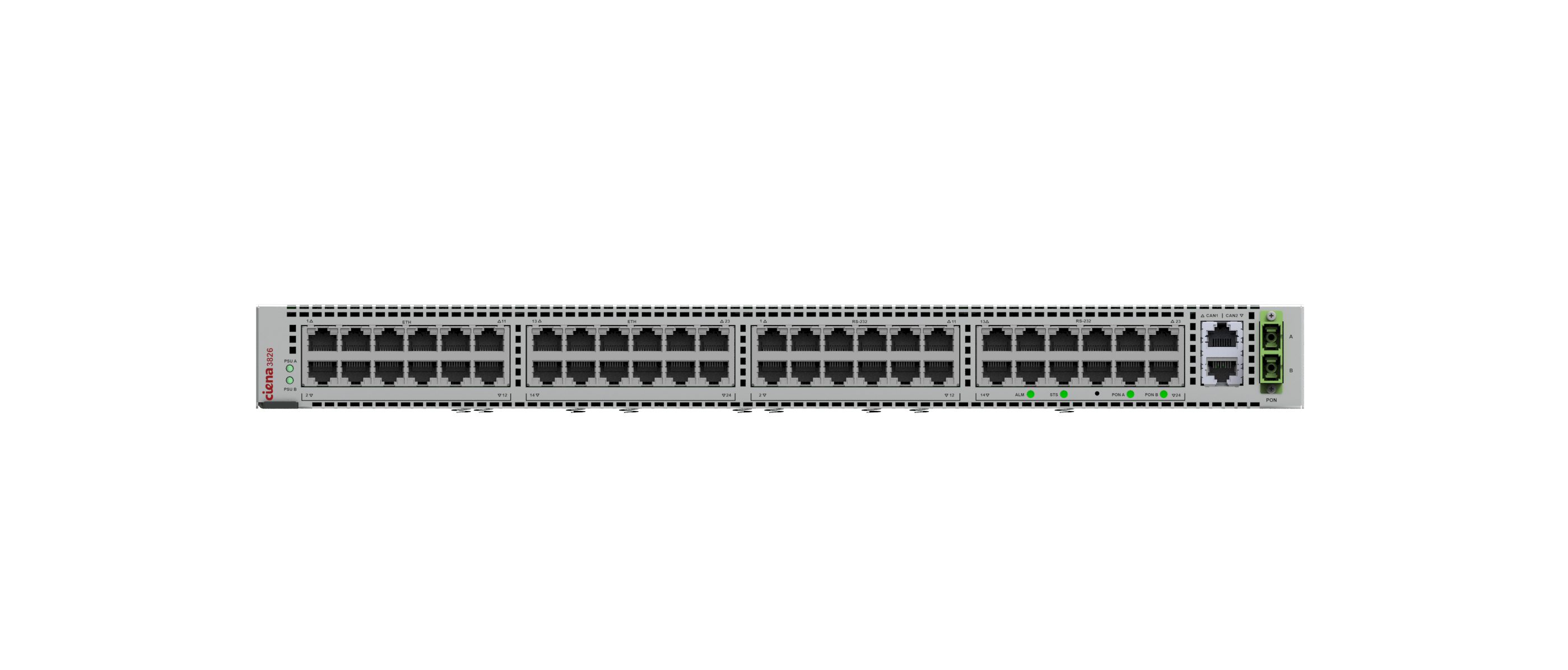
The rack-mounted 3826 DCOM optical network unit (ONU) helps hyperscalers, neoscalers, and enterprises significantly reduce the space, power, and cost to deploy an out-of-band (OOB) management network. As part of Ciena’s data center out-of-band management (DCOM) solution, it supports a modern fiber-based approach to designing, operating, and expanding data center management infrastructure.
The 3826 uses XGS-PON technology in an active-active configuration to transport management traffic over a passive optical network (PON). In a compact 1 RU form factor, it supports Ethernet, serial-console, and Controller Area Network (CAN) / CAN Flexible Data-Rate (CAN-FD)–based infrastructure management.
The ONU is fully managed by a containerized DCOM controller that runs on the router that hosts the Ciena DCOM OLT modules. Configuration, operational state, alarms, and performance statistics are centrally managed and reported through the ONU Management and Control Interface (OMCI). This centralized model simplifies provisioning, monitoring, software upgrades and downgrades, and security patch deployment by eliminating the need to manage the ONU as an independent network element.
In data center environments, the 3826 replaces traditional Ethernet switches and console servers, providing secure remote access to hosted network elements. It also supports CAN/CAN-FD–based infrastructure monitoring for real-time telemetry, power distribution visibility, and dense AI server environments.
Each 3826 provides 24 Ethernet management interfaces, 24 console module RS-232 serial interfaces, and two CAN/CAN-FD interfaces. This flexible architecture enables secure, reliable access to devices with Ethernet, serial, or CAN/CAN-FD management ports—even during in-band network congestion, failures, or security events.
The dual XGS-PON interfaces operate in an active-active configuration, providing up to 20 Gb/s of aggregated uplink capacity—twice the capacity of a single XGS-PON ONU. Full redundancy and automatic failover are supported for maximum network uptime.
As AI-driven data centers scale thousands of servers, GPUs, accelerators, and other high-performance devices, the 3826 helps reduce reliance on legacy OOB management switches, cabling, and rack space. This can lower costs, improve operational efficiency, and support more sustainable data center operations.
Features and benefits
- Dual XGS-PON ONUs, 24-port Ethernet switch, and 24-port console server in a compact 1 RU chassis reduce costs, complexity, and operational overhead
- Dual CAN-FD gateway ports enable management and control of CAN and CAN-FD devices
- Unified OMCI-based management simplifies device lifecycle operations
- Security-first design includes secure boot, software attestation, mutual authentication, and certificate-based SSH access
- Active-active dual XGS-PON interfaces provide simultaneous, resilient management paths
- Fanless design extends service life compared with fan-cooled alternatives
- Redundant DC power support increases availability
Product overview
A modern PON infrastructure for OOB management
As data centers scale, the point-to-point Ethernet aggregation required for legacy OOB management networks increases CAPEX, power and cooling requirements, and turn-up complexity.
A PON-based OOB management architecture replaces Ethernet aggregation switches and the associated Ethernet fiber transceivers with passive splitter devices. This point-to-multi-point design reduces cost, power consumption, rack space, and deployment complexity.
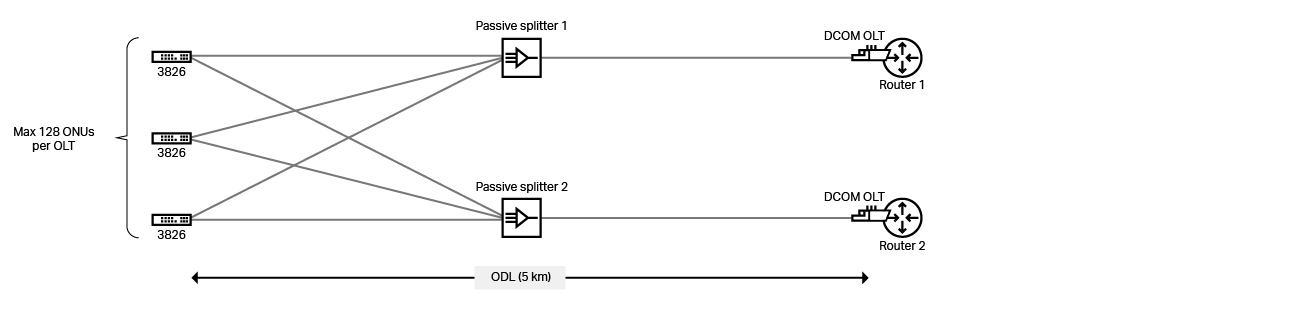
Within the DCOM solution, the 3826 operates over an XGS-PON optical distribution link (ODL) based on ITU-T G.9807.1, supporting symmetric 10 Gb/s point-to-multi-point connectivity with no active devices between the OLT and ONUs. The PON infrastructure supports up to 128 3826s over distances of up to 5 km, using single-fiber bidirectional transmission and redundant passive splitters.
OMCI
OMCI enables the OLT to remotely provision, configure, monitor, and manage the 3826.
It supports service provisioning, VLAN and QoS configuration, fault reporting, performance monitoring, and software updates.
For the DCOM solution, OMCI streamlines 3826 lifecycle management, supporting faster deployment and consistent operations across the PON-based OOB management infrastructure.
Sustainability
The 3826 supports more sustainable data center operations by reducing the space, cabling, and power and cooling requirements for traditional OOB management networks. It consolidates Ethernet, serial console, and CAN/CAN-FD management connectivity into a compact 1 RU platform.
A single 3826 can replace a 1 RU Ethernet aggregation switch and a 1 RU serial console server in each rack, reducing equipment and cabling across large deployments. By combining Ethernet switching, console server, CAN/CAN-FD ports, and ONU functions in a fanless design, the 3826 can lower power consumption and heat generation while improving airflow and reducing OOB management costs.
Applications
With the compact 3826, data center operators can deploy scalable OOB management over a fiber-based PON architecture optimized for two-post cabinet and telco racks.
- Hyperscaler data centers use the 3826 to scale OOB management across large cloud and AI infrastructure inside the data center. By consolidating Ethernet, console server, and CAN/CAN-FD functionality into a single 1 RU platform, the 3826 reduces rack space, cabling, and power and cooling requirements.
- Neoscaler data centers use the 3826 to support high-density AI, cloud, edge, and colocation environments. Its optical OOB architecture aggregates multiple ONUs over PON infrastructure through a single fiber and Ciena XGS-PON uOLT, reducing reliance on point-to-point Ethernet aggregation.
- Enterprise data centers use the 3826 to modernize distributed OOB management with a secure, efficient, and scalable optical architecture that reduces reliance on rack-mounted aggregation switches and legacy copper cabling.
Security
The 3826 incorporates a layered security architecture to protect device integrity, OOB network access, and sensitive credentials. Secure boot with a hardware root of trust, measured boot, signed firmware validation, and anti-rollback protection helps ensure the device runs trusted software. TPM/PCR-based attestation verifies the ONU software state before service activation, helping establish device integrity before network operation.
The 3826 also supports mutual authentication between the OLT and ONU to prevent unauthorized devices from joining the network, along with certificate- or key-based SSH authentication for secure console access. Cryptographic storage protects certificates, keys, and passwords from unauthorized access or tampering.
Technical specifications
Ports and interfaces
| 3826 DCOM ONU |
|---|
| 48 VDC |
| 24 x 10M/100M/1,000M RJ-45 Ethernet UNI |
| 24 x RS-232 RJ-45 serial console |
| 2 x ITU-T G.9807.1 compliant XGS-PON, SC/APC connector, SMF |
| 2 x CAN/CAN-FD |
| 1 x USB 2.0 Type-C host |
| Fanless |
| Front LEDs |
Transmitter optical characteristics
| Parameter | Symbol | Min | Type | Max | Unit | Condition |
|---|---|---|---|---|---|---|
| Laser type | - | DFB | - | - | ||
| Maximum reach | - | >= 5 | km | Vcc, Tc | ||
| Nominal line rate | BWTX | - | 9.95328 | - | Gb/s | Vcc, Tc, XGS mode |
| Operating wavelength | λc | 1260 | 1270 | 1280 | nm | Vcc, Tc |
| Spectral width | Δλc | - | - | 1 | nm | Vcc, Tc |
| Average launch power | Po | 4.0 | - | 9.0 | dBm | Vcc, Tc |
| Extinction ratio | ER | 6.0 | - | - | dB | Vcc, Tc |
| Side-mode suppression ratio | SMSR | 30 | - | - | dB | Vcc, Tc |
Receiver optical characteristics
| Parameter | Symbol | Min | Type | Max | Unit | Condition |
|---|---|---|---|---|---|---|
| Receiver type | - | APD/TIA | - | - | ||
| Nominal line rate | BWRX | 9.95328 | Gb/s | Vcc, Tc, XGS mode | ||
| Operating wavelength | λc | 1575 | 1577 | 1580 | nm | Vcc, Tc |
| Overload threshold | PD | - | - | -8 | dBm | Vcc, Tc |
| Sensitivity | PSEN | - | -28 | dBm | Vcc, Tc, (9.95328 Gb/s, λc = 1577 nm, NRZ, ER = 8.2 dB, BER ≤ 10-3, PRBS = 231-1) |
Regulatory compliance
| Parameter | Standard | Performance |
|---|---|---|
| Agency marks | CE (Europe) UKCA (UK) NRTL (NA) RCM (Australia and New Zealand) VCCI (Japan) | Compatible with standards |
| Emissions and immunity | CISPR 32 Class A CISPR 35 EN 55032 Class A BS EN 55032 Class A AS/NZS CISPR 32 Class A VCCI CISPR 32 Class A EN 55035 BS EN 55035 ETSI EN 300 386 BS EN 300 386 FCC Part 15 Sub-part B Class A ICES-003 Class A | Compatible with standards |
| Environmental | RoHS Directive 2011/65/EU and 2015/863 WEEE 2012/19/EU | Compatible with standards |
| Laser eye safety | FDA 21 CFR Subchapter J IEC 60825-1 EN 60825-1 | Compatible with Class 1 laser product requirements |
| Electrical safety | CAN/CSA C22.2 No. 62368-1 IEC 62368-1 EN 62368-1 BS EN 62368-1 UL 62368-1 AS/NZS 62368.1 | Compatible with standards |
Physical dimensions
| Product | H x W x D (mm/in) |
Weight (gm/lb.) |
Power consumption (W) Typical/maximum |
Operating temperature |
|---|---|---|---|---|
| 3826 DCOM ONU | 44 x 441 x 255 / 1.73 x 17.36 x 10.04 | 3,600/7.94 | 37/45 | 0°C to +40°C; 5% to 85% RH, noncondensing |
Ethernet features
| Ethernet | Management |
|---|---|
| IEEE 802.3 | OMCI for XGS-PON |
| IEEE 802.3u | OMCI for XGS-PON |
| IEEE 802.3ab | OMCI for XGS-PON |
| IEEE 802.1D MAC bridges | OMCI for XGS-PON |
| IEEE 802.1Q VLANs including 802.1p priority | OMCI for XGS-PON |
| IEEE 802.1ad provider bridging (Q-in-Q) VLAN | OMCI for XGS-PON |
| VLAN classification and manipulation | OMCI for XGS-PON |
| Push/pop/swap VLAN | OMCI for XGS-PON |
Ordering information
| Part number | Description |
|---|---|
| 170-3826-900 | 3826, 1RU ACTIVE-ACTIVE DCOM ONU, DUAL DC POWER, 24 GE + 24 SERIAL + 2 CAN |