






Ciena and Blue Planet leaders unpack the operational and financial outcomes driving the shift to AI-driven autonomy.
 Why are communication service providers (CSPs) increasingly focused on transitioning their operations to an AI-driven autonomous network? I recently spoke with Jason Phipps, Senior Vice President, Global Customer Engagement at Ciena, and Joe Cumello, Senior Vice President and General Manager of Blue Planet, a division of Ciena, to get their unique insights as to what they're hearing from Ciena's global customer base about why they are turning to autonomous networks and what it could mean for you.
Kacie: I know you both talk to CSPs customers every day. And while AI is driving massive investment in industry infrastructure, the concept of an autonomous network is also driving digital transformation discussions. Why is there so much urgency now, and how are these concepts connected?
Joe Cumello: We’ve seen major industry investment inflection points throughout history, and AI is clearly driving one of the largest today. For CSPs, customers are linking AI, data management, and autonomy into the concept of an autonomous network. But this isn’t about technology for technology's sake. It’s actually more about financial outcomes and the P&L.
Because CSP revenue growth has slowed, an attractive area to drive financial performance is to use AI and autonomous operations to massively drive down costs. From process engineering to application consolidation to AI-optimized workforces, some large CSPs believe that they can reduce costs by $100Ms. The result: an invigorated look at next-gen technologies to reduce operational costs and drive benefits to the bottom line.
Kacie: Jason, what pressures are rising to the top in your customer conversations?
Jason Phipps: Building on Joe’s point, network traffic—especially AI-driven traffic—is accelerating rapidly, and it’s fundamentally changing the economics of telco service opportunities, which drives two connection points to an autonomous network. The first is in the area of new service creation. CSPs are reexamining their networking strategies to scale to meet hyperscalers' demands. Meeting this demand in regional, long-haul, and submarine networks presents an interesting growth opportunity.
At the same time, these customers can’t afford to operate next-gen high-bandwidth services the way they’ve operated in the past. They need new, simpler operating models that can handle increasing network complexity without driving up costs—and that’s exactly where autonomous networking is coming up time and again with customers.
Kacie: What does that mean day-to-day for CSPs?
Joe: The benefits customers are looking for are both strategic and pragmatic. Strategically, they want to reimagine how they operate and break the predominant model that has driven up costs and complexity for the last 30 years. Pragmatically, this will reduce costs, as I mentioned previously, shorten service lead times, and reduce the time it takes to launch new services or identify and resolve issues.
Jason: Another thing we often hear is that engineers aren’t getting to be engineers anymore. They’re stuck reacting to issues, chasing alarms, and working around manual processes instead of building new capabilities or services for the business. Autonomous networking helps flip that equation—freeing skilled teams to focus on innovation rather than process management and firefighting.
Kacie: TM Forum has defined a framework for autonomous networks. Why has that framework mattered in customer conversations?
Joe: As autonomous networking has gained momentum, our industry needed a common way to describe what autonomy looks like in practice and how to measure that over time. That’s where TM Forum’s Autonomous Network framework comes in. It provides a shared model for how networks evolve, from largely manual operations to more autonomous, AI-driven ones.
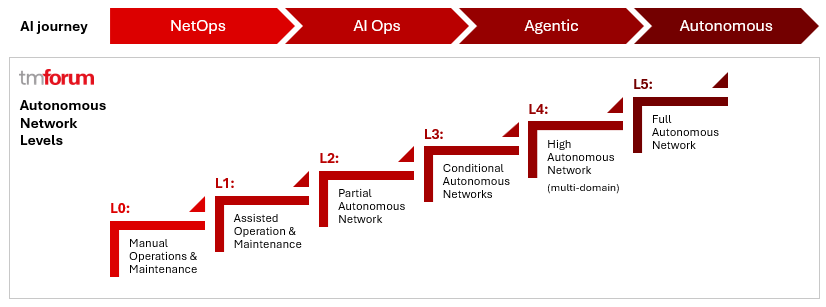 TM Forum defines six Autonomous Network Levels, from Level 0—where operations are almost entirely manual—to Level 5—where operations are completely autonomous. Each level describes not just automation but also what is required to support it, like the maturity of data, analytics, AI, and closed-loop operations. And because not every CSP aims for full autonomy, the framework helps them decide what their next step should be based on where they are today.
Kacie: If the industry has this framework, does that mean there is a simple one-size-fits-all approach to autonomy?
Jason: I wish it was that simple. I think it helps to level-set what we really mean by autonomous networks. At Ciena and Blue Planet, it means enabling networks to self-configure, self-optimize, and self-heal based on intent or a desired business outcome.
It’s about giving CSPs the flexibility to define the level of control they’re comfortable with as they adapt to customer needs and work to improve the overall customer experience.
Joe: And it's also important to be clear about what autonomous networking is not. This isn’t something you turn on overnight, and it’s not about removing humans from the equation. This is a human-led journey, guided by experience and judgment. Every customer has a different starting point and a different goal. This is where we can really step in and help.
Kacie: What is Ciena and Blue Planet’s vision for autonomous networking to help with these challenges you both have highlighted?
Joe: The good news is that Ciena and Blue Planet have helped customers navigate transformations like this before. Our Adaptive Network vision, which we introduced to the industry nearly eight years ago, laid the groundwork with programmable infrastructure, real-time analytics and intelligent software control and automation, and professional services expertise.
Our vision for autonomous networking builds on that foundation and takes it further.
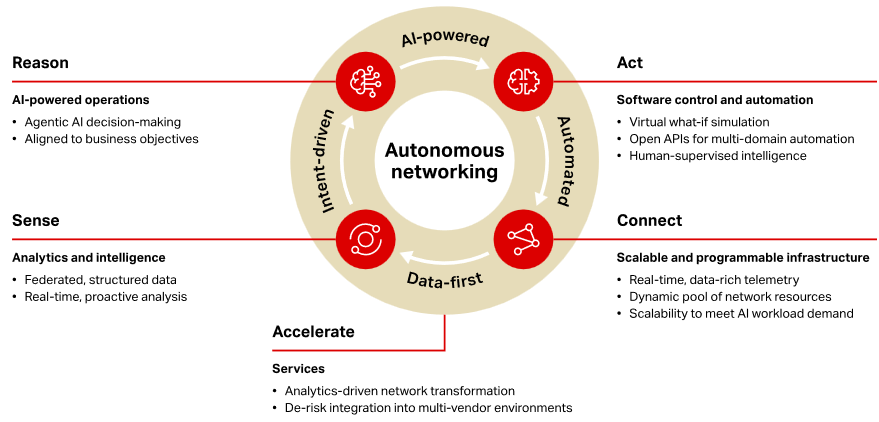 Ciena’s vision for autonomous networking begins by connecting highly instrumented infrastructure that delivers rich, real-time telemetry. That data is then federated and structured across layers and domains, so that AI can be used to accurately sense or understand what’s happening and what’s likely to happen next. Agentic AI then applies reasoning to this information—applying intent and business objectives to make optimal operating decisions. Finally, the network acts by executing those decisions automatically. Underpinning this approach are Ciena and Blue Planet’s professional services that can help CSPs accelerate their journey to more autonomous networks based on their unique business needs and objectives.
Jason: This is where the collaboration between Ciena, Blue Planet, and our leadership in high-speed connectivity really matters. Not only does Ciena deliver the industry’s most scalable network solutions, but they are also the most intelligent. Our programmable infrastructure provides deep telemetry, and when combined with our advanced multi-layer network control, it gives CSPs the real-time visibility they need to understand what’s happening in their networks—and how demand is changing—across layers and domains.
Joe: And when you combine that level of infrastructure intelligence with Blue Planet’s multi-vendor cloud-native OSS, which enables rich network inventory data, advanced analytics, and agentic automation across planning, activation, and assurance, you get true closed-loop, data-driven operations.
That real-time insight is what makes autonomy possible. Without it, AI is flying blind. With it, CSPs can move from reactive operations to proactive, intent-driven autonomous operations.
Kacie: Data comes up repeatedly as a gating factor for autonomy. Why is it so critical?
Joe: As most know, the network generates a tremendous amount of data, and what AI is getting much better at doing today is providing insight from that data to the decision makers who need it. As I’m so fond of saying, “You can’t AI what you can’t see.” Blue Planet has been directly involved with CSPs globally in organizing and cleaning their network and services data through large Inventory, Orchestration, and Assurance programs. From clean data, you can drive accurate AI-powered insights and actions where AI agents can identify issues, understand service impacts, predict future problems, and execute optimizations to deliver better customer experiences at a much lower cost.
Kacie: To make this real, customers always ask for examples. Can you give an example of autonomous networking in action?
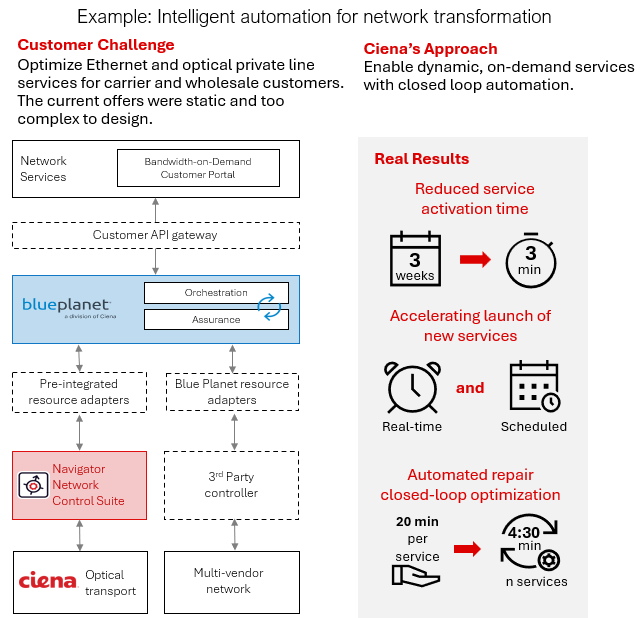
Joe: One example that I often point to is a CSP customer that wanted to become the leading wholesale fiber provider in its region, but manual OSS processes were holding them back. By modernizing service design, activation, and assurance with Blue Planet’s OSS and Ciena’s programmable infrastructure, they eliminated manual workflows and enabled true self-service provisioning.
The impact was dramatic: activation times dropped from weeks to minutes, and closed-loop optimization cut restoration times to under five minutes for critical services.
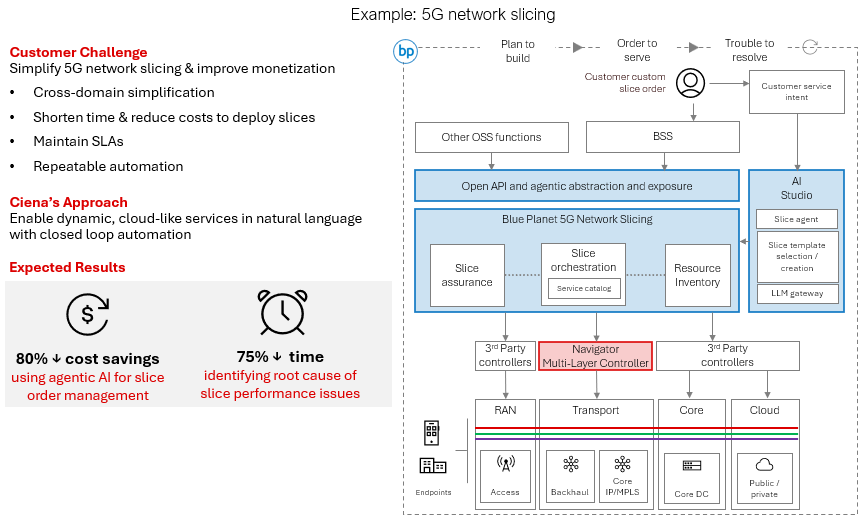
Jason: Another example I use is the addition of agentic AI to 5G network slicing, where autonomy spans multiple domains rather than just one. In a proof-of-concept we conducted with a European customer, this approach projected significant cost savings and faster issue resolution, turning 5G slicing into a repeatable, profitable service.
Kacie: If you had to sum it up, why are Ciena and Blue Planet the right partners for those embarking on the autonomous networking journey?
Jason: Autonomous networking is no longer optional—but it’s definitely not something you install over a weekend. It’s a real transformation. And after working with Joe for years, I can tell you we’ve both seen what works… and what absolutely doesn’t.
What makes Ciena and Blue Planet different is that we bring the full picture. World-class programmable network infrastructure with AI-ready OSS and multi-layer control. This rich expertise across the network and the OSS layers enables our customers to merge these worlds together in a more cohesive and impactful way.
Joe: I’m glad you didn’t say it's because “we finish each other’s sentences.”
Jason: I thought about it.
Joe: The reality is that autonomy only works when the infrastructure and the operational systems are aligned. And we’ve built that alignment in from the start. We take an open standards-based approach, giving our customers flexibility in where they start, how fast they move, and who they partner with.
And everything is built on data. By helping customers access clean, federated data across network domains, we help them unlock smarter automation, faster decision-making, and ultimately help them differentiate customer experiences.
Ultimately, this isn’t about a product pitch. It’s about partnership. We’re helping customers evolve their business — operationally and financially — in a way that’s practical and sustainable.