






As demand for international bandwidth intensifies, operators need more agile and cost-efficient ways to scale capacity. Learn how TAFS delivers a flexible, open-access submarine network to the Americas, designed to support diverse business and service requirements.
As demand for AI, cloud, and digital services accelerates, the Americas face a critical inflection point: existing international infrastructure is struggling to keep pace with bandwidth growth, while connectivity gaps persist across Latin America and the Caribbean. The next generation of submarine networks will need to be more open, scalable, and resilient to meet this demand. This is where Trans Americas Fiber System (TAFS) is aiming to redefine what connectivity across the region looks like.
Learn about the latest TAFS digital platform advances and ways the operator delivers a flexible, open-access submarine network to the Americas, designed to support diverse business and service requirements.
Who is Trans Americas Fiber System (TAFS)?
TAFS was created with a clear vision to renew connectivity across the Americas, reduce the digital divide, and promote digital inclusion through equitable access to high-speed connectivity. To address this vision, TAFS is deploying and managing a sustainable, high-capacity, and open-access digital infrastructure throughout the Americas. By leveraging collaborative partnerships with local governments, non-profit organizations, and private sector entities to ensure affordable, reliable, and accessible internet access for all communities. This makes TAFS an infrastructure platform built for long-term impact, enabling resilience, scalability, and inclusive digital growth throughout the Americas.
The Latin American submarine cable market
According to TeleGeography, used international bandwidth in Latin America grew at a rate of 27% in 2025 with signs of the growth rate increasing into 2026 and beyond based on current projections, as shown in Figure 1. Undersea capacity deployed by different types of submarine network operators in the region has almost tripled since 2021, reaching an aggregate of over 425 Tb/s in 2025.
Latin America remains heavily tied to the U.S., with international bandwidth connected to the U.S. and Canada accounting for 80% of the region’s total capacity. Meanwhile, international bandwidth connecting Latin American countries to one another slightly increased from 17% in 2021 to 19% in 2025. All in all, a healthy region for submarine network capacity and connectivity for submarine cable operators of all kinds.
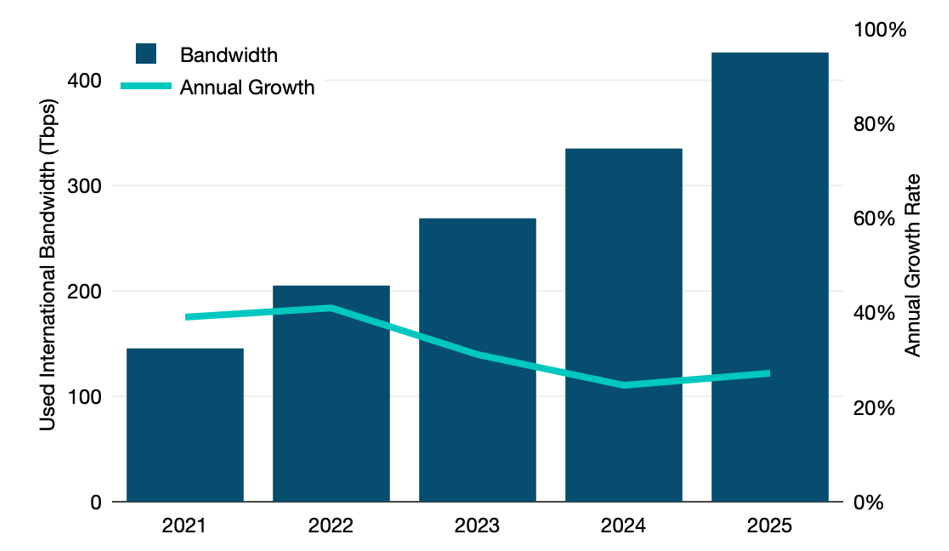 Figure 1: Used International Bandwidth in Latin America (TeleGeography)
The TAFS submarine cable system
As demand for digital infrastructure accelerates across the Americas, TAFS is building a neutral, open-access submarine cable system, which will connect the U.S. to Mexico, Central America, Colombia, and the Caribbean with scalable, low-latency undersea capacity.
Its flagship project, TAM-1, is positioned as the first neutral and most scalable fiber system built in decades to directly interconnect Central America and the Caribbean to the U.S., with plans to extend into other major markets in the region.
After announcing in October 2025 that the first phase of TAM-1 was successfully deployed, TAFS is expanding its digital infrastructure across the Americas. The project will deliver the first new undersea cable route in decades connecting key markets in Colombia, Panama, Costa Rica, Puerto Rico, and St. Croix directly to the United States.
Telcos, enterprises, and cloud providers with presence in this region can leverage TAFS flexible business model to purchase, scale, and manage international undersea bandwidth where legacy systems may be providing limited agility.
The value proposition of TAFS is rooted in openness, resiliency, and commercial flexibility. TAM-1 subsea cable is designed to deliver more than 650 Tb/s of total system capacity over 24 southbound fiber pairs and 12 northbound fiber pairs spanning roughly 7,200 kilometers. By providing a cross-Caribbean route, the system addresses connectivity challenges faced by national Caribbean carriers and governments. It introduces a diverse and redundant path for north-south traffic, which is crucial for maintaining reliable internet services. TAM-1 southern route will be Ready for Service (RFS) this month, followed by the northern route in 3Q2026.
The TAM-1 submarine cable system architecture, shown in Figure 2, is designed and built to support the growth associated with AI, cloud, 5G, edge computing, streaming, and enterprise services, which together increase pressure on international infrastructure in the Latin America region.
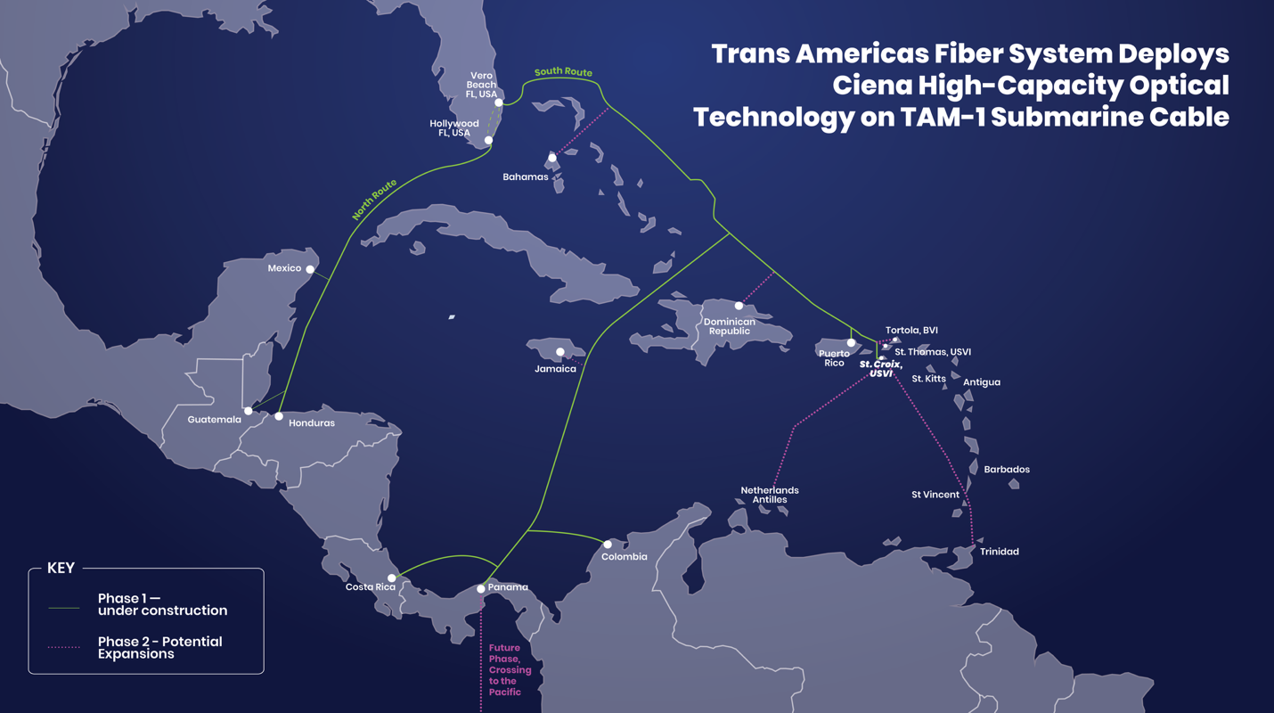
Figure 2: The TAM-1 submarine cable system
Flexibility by leveraging the Open Cable business model
TAM-1 leverages the Open Cable business model, where the wet plant purchase decision is decoupled from Submarine Line Terminal Equipment (SLTE). This allows TAFS to use the latest SLTE as it comes to market, offering ongoing improved scalability with a lower cost and power per bit. This also allows them to leverage its open architecture to offer spectrum sharing and fluid scalability so customers on the TAM-1 cable can quickly expand capacity and connectivity as demand grows.
Ciena plays a central role in enabling this Open Cable business model. TAFS selected Ciena’s GeoMesh Extreme submarine network solution, powered by our latest WaveLogic 6 Extreme modems, along with Ciena’s Reconfigurable Line System to light segments of the overall TAM-1 submarine cable system.
Ciena’s GeoMesh Extreme provides TAFS with service flexibility ranging from 100 Gb/s increments to full fiber pairs, including options such as spectrum sharing for virtual fiber pairs and Managed Optical Fiber Networks (MOFN). This broadens their portfolio to serve the diverse needs of their customers.
TAFS value proposition
This flexible architecture is relevant for buyers of undersea capacity in the region. For example, one network operator may require wholesale managed wavelength services, another may want a virtual fiber pair using spectrum sharing, while a cloud service provider needs readily expandable large-scale capacity, all on the same submarine cable network.
TAM-1 is designed to support all these diverse requirements through its open submarine network architecture with high-capacity optical technology creating a flexible platform to serve a wide range of customer requirements.
More broadly, this reflects an ongoing transformation in the submarine cable industry—from traditional static infrastructure to more programmable, service-oriented platforms. As demand patterns become more dynamic, operators increasingly require infrastructure that can scale and evolve alongside them.