



May 4, 2026
By Nicole Anderson
Vice President, Global Communications & Branding
Reaching 25 years as CEO is rare—especially in the technology industry. For Gary Smith, President and CEO of Ciena, the milestone is less about tenure and more about reinvention. In a conversation with Nicole Anderson, Smith reflects on the evolution of the internet, the rise of AI, and what it takes to lead through decades of change.
From building the internet to powering global infrastructure
Nicole Anderson: Twenty-five years as CEO is an extraordinary milestone. As you reach this moment, how are you thinking about the journey so far?
Gary Smith: First off, I can’t believe it’s been 25 years.
It feels like we’ve reinvented the company multiple times along the way, which has been both motivating and challenging.
I’ve been very fortunate to have had a front-row seat to the first coming of the internet—“build it and they will come”—and for a while, they didn’t. Now, watching the evolution into the AI age and the global connectivity that’s happened over the last 25 years—it’s been incredible.
I feel very fortunate to have shared that journey with a great set of people at Ciena and across the broader ecosystem. But it’s gone very quickly. It really has.
Nicole: You mentioned having a front-row seat to the evolution of the internet. What shifts stand out most to you?
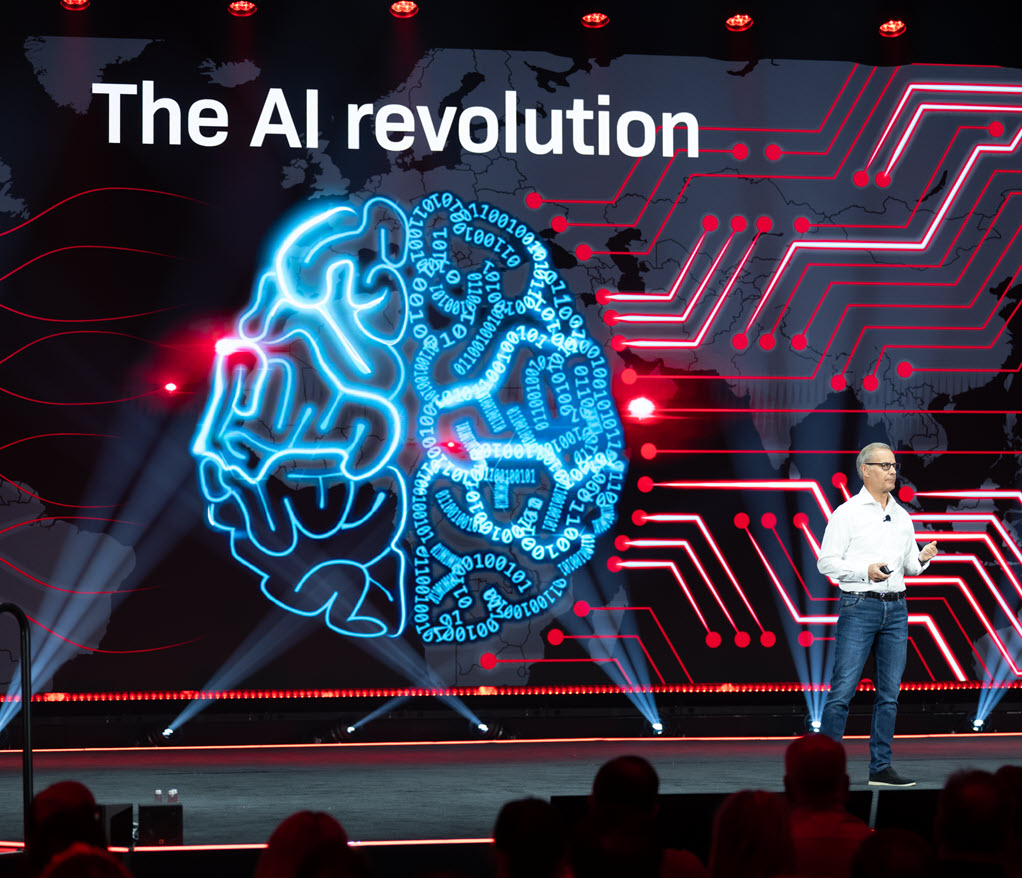
 Gary: At the beginning, the company was focused on enabling basic phone and data connectivity and enabling its scaling, which ultimately became the internet and the infrastructure for the information age globally, including submarine cables.
Today, the value of high-speed fiber connectivity is fully recognized worldwide. On top of that, you now have AI, which is, in many ways, the killer app for all that optical infrastructure. You can’t operationalize AI without the network.
So, we’ve gone from basic phone connectivity to being a fundamental underpinning of global infrastructure.
Nicole: That evolution was obviously a massive inflection point for Ciena. How did it shape the competitive landscape, and how did it inform Ciena’s strategy?
Gary: Our strategy evolved, but it didn’t fundamentally change. We entered an industry dominated by legacy generalists—companies like Lucent, Nokia, Alcatel, Nortel, and Marconi.
Ciena was part of a new breed focused on a single technology and being best of breed. Over time, the industry shifted in that direction. We focused on being the best in optical high-speed connectivity and eventually reached scale and critical mass.
Today, there are very few generalists left because the market is so competitive in each technology—you have to specialize.
Nicole: How have perceptions of Ciena changed over time?
Gary: We were always seen as having the best technology, but we lacked global scale, track record, and relationships.
What’s changed is that we’ve moved from being a pure technology leader to a true market leader—with global scale, strong customer engagement, and consistent financial performance.
We’re a much more mature company now, with clear market leadership in a high-growth space.
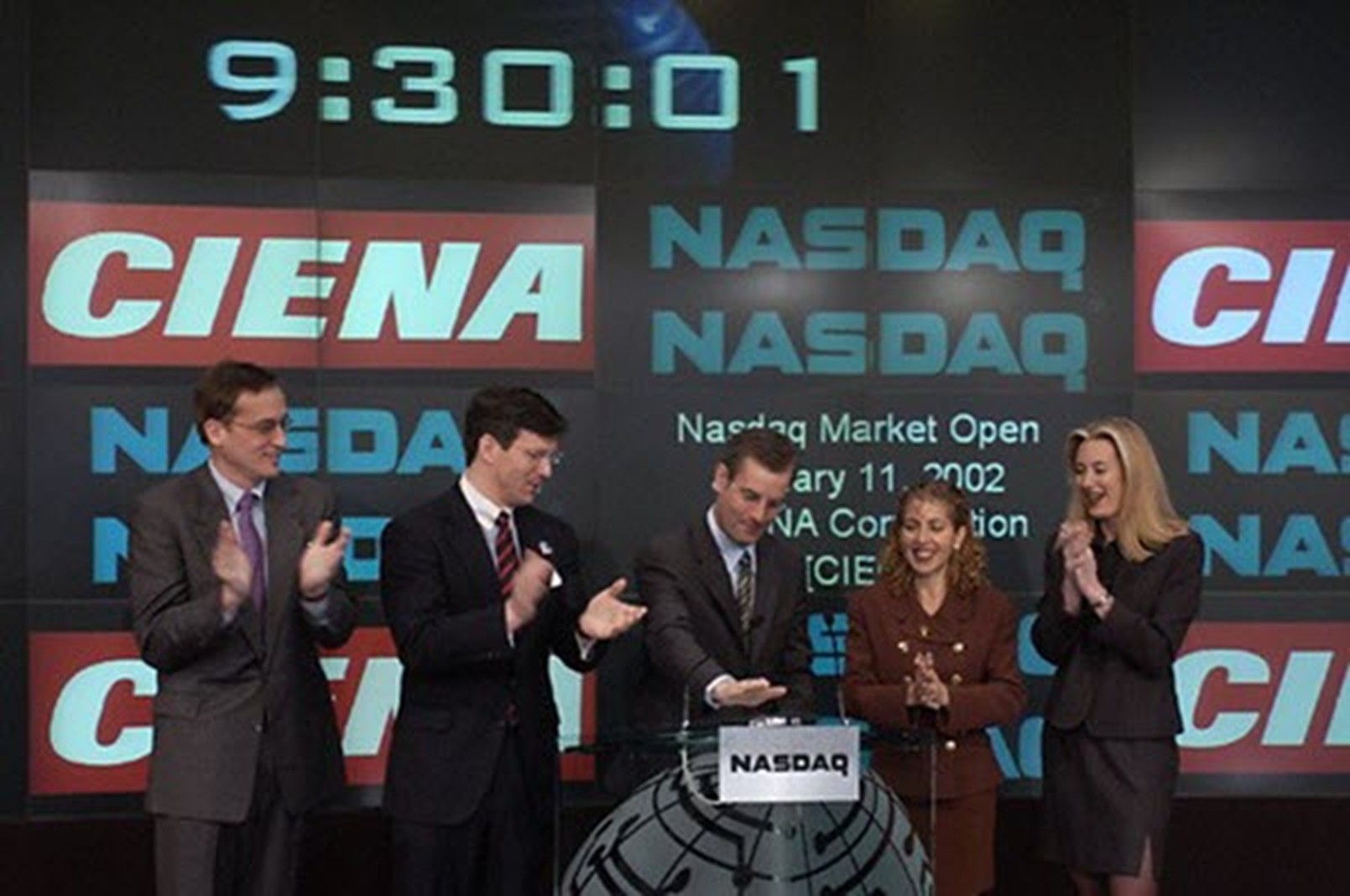
Gary and team rang the opening bell at the NASDAQ stock exchange on January 11, 2002
Why the AI era is really about the network
Nicole: If the last 25 years were about building the internet, what are the next 10 about?
Gary: The next decade is about building the infrastructure to support global AI adoption. It’s really about the network—and specifically optical technology.
It’s still early—the impact of AI is just beginning to emerge from the data center. We’re going to see the “opticalization” of the data center. As speeds increase, electrical limits are being reached, and the shift to optical is inevitable.
This is a decade of AI networking.
Nicole: Do you think the industry is underestimating any of this?
Gary: Yes—the network piece has been underestimated.
So far, the focus has been on language models, GPUs, power, and data centers. Now people are realizing the network is the critical enabler.
Scaling AI requires massive investment across the entire ecosystem—from fiber to components. The scale required is in my view an order of magnitude beyond where we are today.
Nicole: In the context of your 25 years, does AI feel like the second coming of the internet?
Gary: It feels like the killer app layered on top of it.
This is a massive inflection point—not just for the industry, but for global society. The speed of adoption is by the nature of the technology far faster than previous industrial revolutions, and society will need to adapt rapidly.
Leading through 25 years of change
Nicole: What do people tend to misunderstand about staying an effective leader over time?
Gary: As the company grows, leadership has to grow with it. Each phase brings a different set of challenges.
We went from a massive IPO in the late ’90s, to survival mode in 2001 when no one was buying anything, to rebuilding the business, and now to being an AI infrastructure company.
Each phase requires different skills. You must constantly evolve, stay flexible, and figure out the right approach for the moment.
The one constant is the need for change and always playing for the long-term—making decisions you believe are right for the future, even if you have to adjust along the way.
You won’t get everything right. Sometimes speed matters more than perfection. But you have to be resilient, tenacious, and confident in your convictions.
Nicole: What mindset is required to lead through that level of transformation?
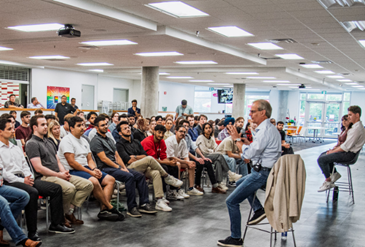 Gary: It comes down to people and the team you build.
You need curiosity and a willingness to learn and adapt. The strategy itself may not change often, but it’s refined over time through experience.
You also have to be agile to address new opportunities and threats. The only constant over the last 25 years has been change. You have to embrace it and get ahead of it.
It’s about balancing conviction with curiosity—staying focused while always learning.
Nicole: Ciena has completed many acquisitions under your leadership. What have you learned about leading through M&A?
Gary: We’ve done a lot of M&A alongside organic development, and much of it has accelerated our growth.
But ultimately, it’s about people. You’re not just acquiring technology—you’re acquiring the people behind it.
Cultural fit is critical. That’s what determines whether you truly realize the value of the acquisition. And in our case, that’s been a big part of why our M&A has been successful.
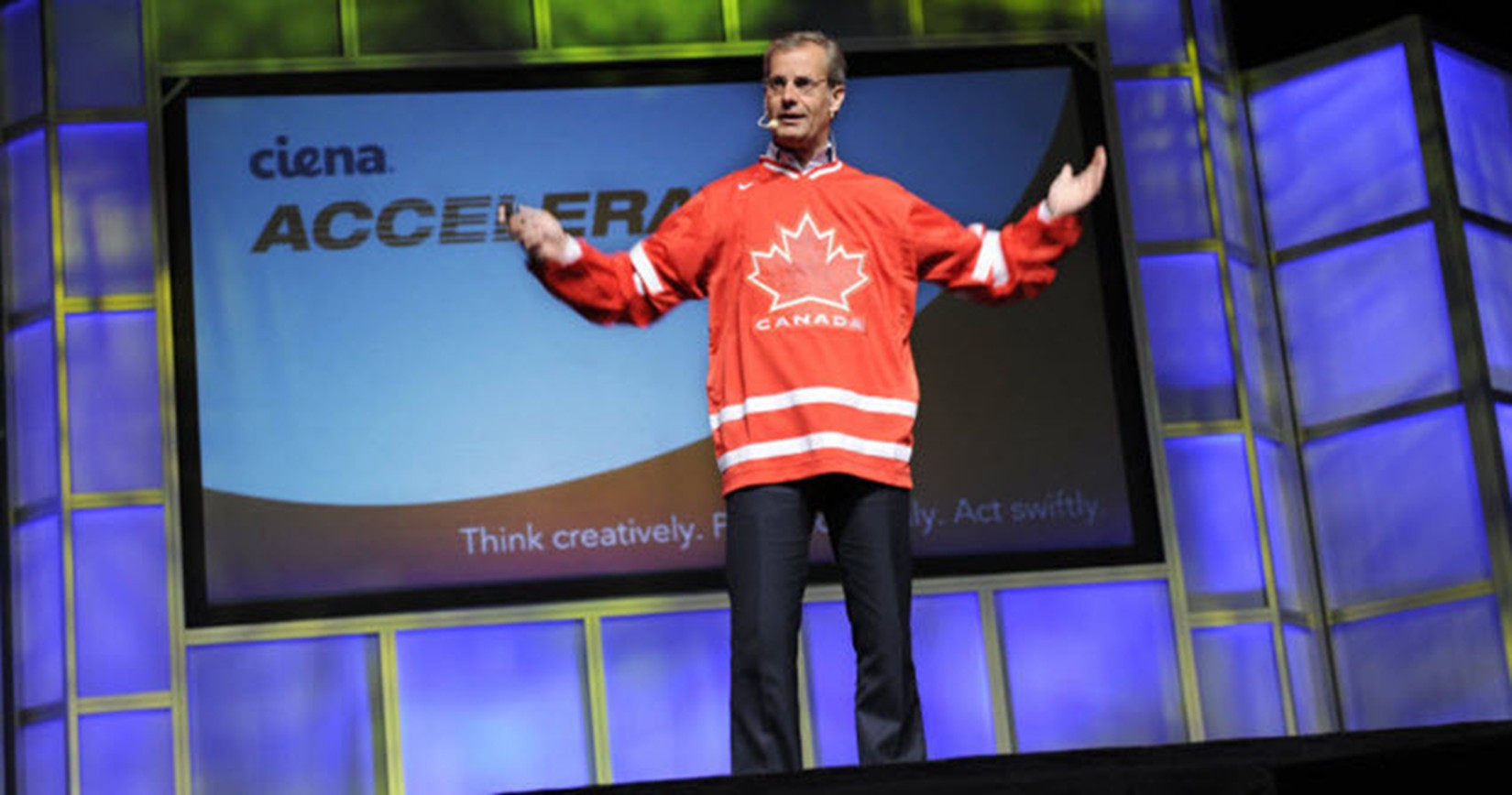
Gary welcomed the Nortel Ottawa team to Ciena at the 2010 event celebrating the Nortel optical acquisition
Nicole: You’ve always maintained a balance between your professional and personal life. How do you do that today?
Gary: You have to carve out time for yourself—it makes you a better leader.
I stay disciplined with physical fitness—running, lifting, CrossFit-style training—even when I travel.
And mentally, photography is important for me. It gives me space to think and reset. I often come back with new ideas.
This is a marathon, not a sprint. If you want to perform at a high level over time, you have to take care of your physical and mental well-being.
Nicole: After 25 years, what continues to drive you?
Gary: If you can’t be excited about what’s happening in this industry now, you’re probably never going to be.
This is the biggest opportunity the industry has ever had. Optical networking has come of age, and we’re right at the center of it.
What motivates me is positioning the company for the long-term—investing now for where we’ll be in three to five years—and seeing both the business and our people grow.