




Neoscalers are quickly emerging as a distinct and fast-growing segment of AI-native infrastructure providers, with unique network needs. They are building advanced optical networks to help maximize opportunities from AI traffic, distributed compute, accelerated automation, and increasingly high-volume inference workloads.
These AI workloads are rarely limited by geographical boundaries. With neoscalers scaling rapidly to capture AI demand, the focus is often on pursuing lean, partnership-driven operational models across the globe, particularly in geographically multifaceted markets like Australia.
This is where local service providers such as Telstra play a critical role, giving neoscalers access to high-capacity network infrastructure so they can move at speed without having to build or operate complex connectivity from the ground up.
“Unlike traditional enterprise customers, neoscalers operate highly dynamic environments where performance, latency, and rapid scalability are non-negotiable. AI workloads are driving exponential increases in inter-data center traffic, with capacity demands scaling to multiple terabits per route and requiring seamless, low-latency connectivity between compute clusters,” said Sandy Cameron, Australia, Infrastructure AI Executive, Telstra Digital Infrastructure.
Speed and Scale as Competitive Advantage
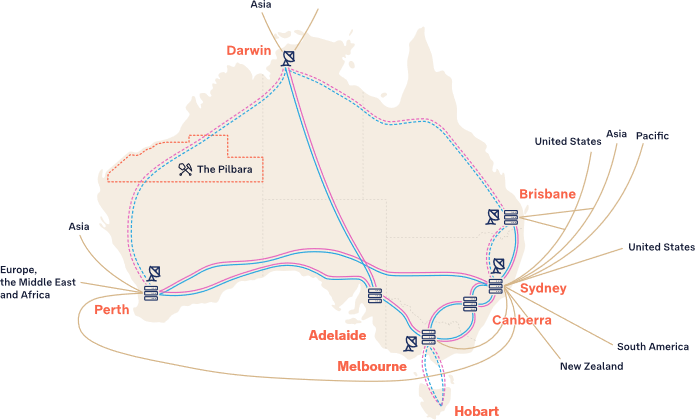
To meet these requirements, Australia’s leading telecommunications company, Telstra, is moving beyond fixed provisioning models and delivering infrastructure that scales in lockstep with demand. This includes targeted investments in fibre infrastructure and optical network upgrades to support high-capacity, long-haul connectivity between key data center hubs.
Telstra is working closely with Ciena to deliver scalable, high-performance connectivity through its Aura network. By leveraging Ciena’s advanced optical innovations, Telstra can efficiently expand network capacity to support the bandwidth-intensive demands of neoscaler environments. This capability allows Telstra to align network delivery timelines with data center construction and GPU deployment schedules, a key capability in securing neoscaler workloads.
For hyperscalers and neoscalers alike, speed to market is as critical as scale. Infrastructure must be deployed in parallel across compute, power, and connectivity domains, with minimal tolerance for delay. Telstra’s ability to deliver flexible, scalable capacity, combined with latency-sensitive connectivity capabilities and extensive geographic reach, positions it as a trusted provider for this new generation of AI infrastructure operators.
As demand accelerates over the next few years, driven by rising data center distribution and increased east-west traffic between facilities, this combination of scale, consistency, and operational execution supports Telstra’s ability to meet the evolving needs of AI infrastructure operators.
“Telstra is establishing itself as a notable option for neoscalers by removing key barriers to scale—from constrained capacity and long infrastructure lead times to the complexity of deploying high-performance networks across Australia’s vast geography,” said Cameron. “By combining our extensive fibre footprint, local delivery expertise, and investments in next-generation optical innovation with Ciena, we enable neoscalers to accelerate time to market and scale AI infrastructure with confidence.”
Telstra’s Aura network leverages Ciena's 6500 powered by WaveLogic 6 Extreme (WL6e). To learn more about how Telstra is collaborating with Ciena, you can refer to the following press release or podcast.