




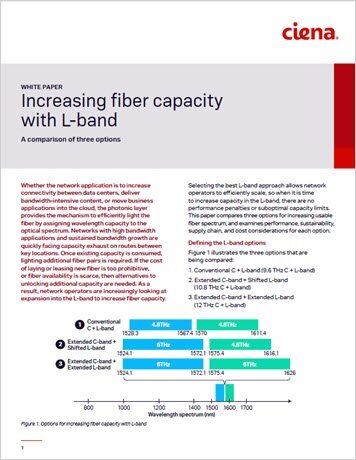
Whether the network application is to increase connectivity between data centers, deliver bandwidth-intensive content, or move business applications into the cloud, the photonic layer provides the mechanism to efficiently light the fiber by assigning wavelength capacity to the optical spectrum. Networks with high bandwidth applications and sustained bandwidth growth are quickly facing capacity exhaust on routes between key locations. Once existing capacity is consumed, lighting additional fiber pairs is required. If the cost of laying or leasing new fiber is too prohibitive, or fiber availability is scarce, then alternatives to unlocking additional capacity are needed. As a result, network operators are increasingly looking at expansion into the L-band to increase fiber capacity.
White Paper
Increasing Fiber Capacity with L-band: A comparison of three options
Related
View more insightsWhite Papers
AI Inferencing and the Evolution of On-Demand Optical Networks analyst report
Explore Omdia 2026 survey findings on how AI inferencing is driving demand for high-bandwidth optical services and on-demand connectivity.
DownloadBlog
When speed meets physics of data center connectivity
What happens when the data center connectivity technologies we rely on today start running up against the limits of physics? Brodie Gage explores how rising interconnect speeds are shifting the boundaries between copper and optical—and opening the
Read