


Are You Ready for the DOCSIS Impact on Fiber?
Data Over Cable Service Interface specification (DOCSIS) is the international standard developed by CableLabs used to provide internet access over the cable system. Introduced way back in 1998, the standard has evolved over time, with ever-increasing data rates.
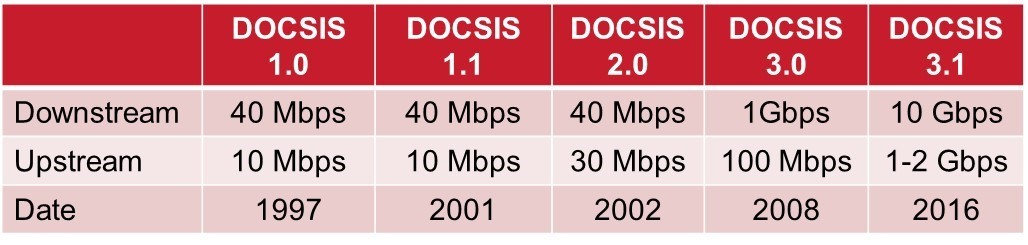 The latest version, DOCSIS 3.1, allows up to 10Gbps downstream and 1Gbps upstream, which to-date had only been possible with a fiber optic connection, and can, with few infrastructural changes, be easily deployed over existing infrastructure. It should be mentioned that to meet these speeds, DOCSIS 3.1 must be supported on both ends of the connection. This game changer gives cable operators the ability to prolong the lifespans of their existing Hybrid Fiber Coax (HFC) investments, keep up with rival fiber optic Internet Service Providers (ISPs), and not have to change out the ‘last mile’ of their existing deployments.
DOCSIS 3.1 enables things like Ultra-High Definition (UHD) or 4K broadcast, faster WiFi access speeds, and with Active Queue Management (AQM), delay can be reduced for time-sensitive applications, such as online gaming. Given the insatiable appetite subscribers are showing for bandwidth consumption for things like Over-the-Top (OTT) and other applications, DOCSIS 3.1 will only further exacerbate the packet-bandwidth conundrum. We live in interesting times.
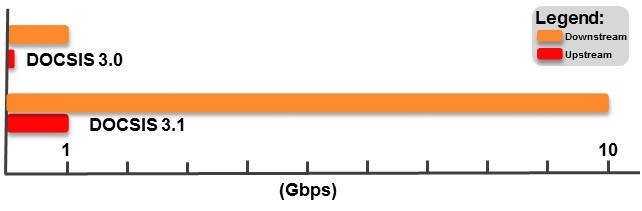
With such an improvement over DOCSIS 3.0, DOCSIS 3.1 will become commonplace in homes and businesses alike, as vendors expect to ship millions of DOCSIS 3.1 cable modems in the next few years - even Walmart is getting into the game!
There are over 40 million DOCSIS cable modems already deployed worldwide, and up to 80% of those units are expected to migrate to DOCSIS 3.1, not to mention additional growth in the next few years. Doing the rough math, this translates to a theoretical load of 32 terabits per second on the network! Only one medium can economically deliver those kind of capacity numbers – fiber.
As a shared medium, coaxial cable is about to get very crowded.
As a limited shared medium, coaxial cable has delivered DOCSIS 3.0 services for almost a decade. However, over those years, average customer broadband bandwidth rates were in the 10s and 100s of megabits, not gigabits. This meant cable operators really didn’t have to change much of their fiber distribution networks.
However, with bandwidth rates soaring, without change, pretty much every broadband customer, and remember there are millions, will experience severe negative impact to their quality of experience. For cable operators to secure their packet-bandwidth futures, significant changes to the cable access and distribution network are required to re-sod cable MSO brownfields.
It follows then that the knock-on effect of all this extra bandwidth on the cable infrastructure cannot be ignored. For the cable operator, fiber technology enabling unprecedented density, capacity, and scalability will be needed to drive down energy and transport costs.
Ciena’s modular packet-optical architecture approach, along with coherent optical technology, allows cable operators to maximize capacity at any distance, seamlessly upgrading to higher speeds, up to and including 400Gbps. By driving optical fiber deeper, cable operators can improve performance and reliability, increase capacity, reduce the high cost of coaxial cable, and provide faster download and upload speeds – not bad at all!
Just wait until Virtual Reality (VR) and Augmented Reality (AR) take hold and significant packet-centric bandwidth is needed in the upstream. If you’re thinking DOCSIS is the answer, you’re right, as a full-duplex version allowing 10Gbps down and 10Gbps upstream is already being planned - effectively doing the same to the upstream.
With Ciena. your need-for-speed can be satiated.