




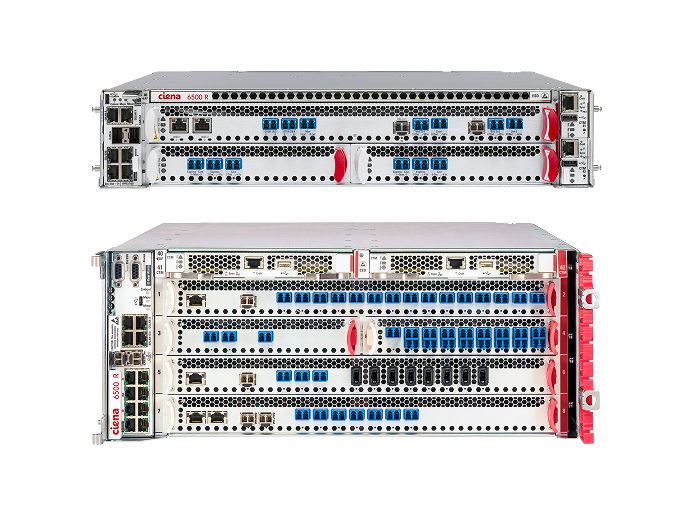
RLS, a reconfigurable line system, empowers network operators to efficiently address the highest-capacity networking requirements in today’s metro, long-haul, and data center interconnect (DCI) networks.
This open and programmable photonic networking platform, built for simplified deployment and streamlined operations, is optimized for space-constrained, multi-vendor environments. Compact, modular transport devices have emerged to solve footprint challenges in networks requiring massive capacity scalability. However, footprint and scalability challenges also exist within the photonic layer, driving the need to minimize footprint while scaling for capacity growth. As hyperscale data center networks light thousands of fiber pairs over the coming years, line system technologies cannot scale efficiently within a minimal footprint without the introduction of compact solutions for the photonic line.
RLS was designed to address the evolving density and footprint requirements of the photonic layer while integrating tools and capabilities that simplify installation, turn-up, and ongoing management. It provides operators with flexible deployment options for their photonic line systems, whether integrated or disaggregated. Highly programmable, the platform features open APIs that enable integration with existing management and back-office systems. RLS improves service velocity through significant operational savings while providing the scale that operators need to increase their competitive edge and elevate the end-customer experience.
Features and benefits
- Efficiently scales to meet the highest-capacity network requirements with an optimized, ultra-dense design
- Reduces footprint by as much as 70% compared with traditional chassis-based systems through its modular, compact form factor
- Simplifies deployment and operations with ZTP, network auto-discovery, and full network visibility for easier troubleshooting
- Enables openness and programmability with a comprehensive suite of open APIs and a microservices-based software architecture
- Doubles fiber capacity with an optimized C&L-band architecture
- Accelerates wavelength turn-up and improves service availability with an intelligent L0 control plane
Product overview
Ultra-dense design for optimal photonic line system scale and efficiency
RLS addresses scalability needs with an ultra-dense design optimized for both capacity and efficiency. Supporting deployments at both large and small sites, it accommodates a range of applications, from simple mux/demux configurations for DCI and colorless direct attach to colorless transponder direct attach and fully flexible colorless-directionless-contentionless (CDC) photonic architectures.
The platform delivers exceptional scale for both metro and long-haul applications, supporting C-band and C&L-band 12-port and 32-port ROADM configurations with up to 768 C&L-band CDC add/drop channels for a 16-degree node.
RLS also supports Raman amplification for longer, higher-loss spans. With flexible-grid channel spacing, operators can deploy frequent technology updates—including next-generation high-baud coherent modem technologies—to achieve higher line rates, longer-distance transmission, and improved spectral efficiency.
With its integrated C&L-band architecture, RLS doubles available fiber capacity for fiber-constrained networks. Optimized for both C- and L-band performance, it provides a photonic layer foundation capable of delivering over 60 Tb/s of capacity on a single fiber pair, without the operational complexity, uncertainty around L-band performance, or service disruptions often associated with historical L-band network upgrades.
Increasing fiber capacity with the L-band is as simple as lighting the C-band, helping operators double the capacity without impacting existing C-band traffic.
Simple to deploy and operate
RLS was designed for operational simplicity and rapid deployment, with integrated instrumentation that enables fast turn-up and efficient channel activation. To ease line-system deployments, RLS includes a comprehensive set of instrumentation features to streamline installation, turn-up, and troubleshooting. Zero-touch provisioning (ZTP) automates commissioning, while photonic connection validation helps quickly identify manual fibering errors or dirty fiber connections.
The platform provides full network visibility and simplified troubleshooting with channel monitoring and an integrated bidirectional optical time domain reflectometer (OTDR). In the event of fiber cuts, RLS pinpoints fiber fault locations to speed up technician deployment for fiber repairs and reduce network downtime. Integrated channelized amplified spontaneous emission (ASE) fully loads the system from day one, maintaining optimal system performance throughout the network lifecycle and enabling faster wavelength activation and restoration during fault conditions.
The intelligent Layer 0 (L0) control plane further automates network functions to simplify operations, accelerate service creation, and improve resiliency with photonic layer restoration.
Advanced programmability and openness
RLS provides advanced programmability and openness for the photonic layer through a comprehensive suite of open APIs, model-driven configuration, streaming telemetry, and open, microservices-based software architecture. Its open APIs enable seamless integration with existing operational tools and back-office systems, so operators can efficiently scale their networks to meet the largest bandwidth requirements with minimal footprint. The platform provides flexible deployment models, supporting fully integrated or disaggregated photonic line configurations.
With its simplified deployment, flexible configuration options, and programmable open APIs, RLS helps operators efficiently scale their networks to meet growing bandwidth demands while accelerating service activation and strengthening their competitive advantage.
Technical specifications
Physical dimensions
| Shelf | Rack height | Dimensions (mm), H x W x D | Dimensions (in.), H x W x D |
|---|---|---|---|
| R2 4-slot shelf | 2 RU | 88 x 440 x 580 | 3.5 x 17.33 x 22.83 |
| R4 8-slot shelf | 4 RU | 177 x 440 x 580 | 6.97 x 17.33 x 22.83 |
| R2-300 2-slot shelf | 2 RU | 88 x 482 x 288 | 3.47 x 18.98 x 11.34 |
| R6-300 7-slot shelf | 6 RU | 286 x 482 x 288 | 10.47 x 18.98 x 11.34 |
| R8-300 8-slot shelf | 7.5 RU | 330 x 440 x 281 | 12 x 17.3 x 11.1 |
Weight (chassis only)
| Shelf | Weight |
|---|---|
| R2 4-slot shelf | 8.8 kg (19.4 lb.) |
| R4 8-slot shelf | 11.8 kg (26 lb.) |
| R2-300 2-slot shelf | 4.3 kg (9.4 lb.) |
| R6-300 7-slot shelf | 8.9 kg (19.7 lb.) |
| R8-300 8-slot shelf | 11.9 kg (26.2 lb.) |
Photonic modules
- ROADM with line amplifier (RLA) 32 x 1 C-band module: Double-width, single-height module integrating twin 1 x 32 flexible-grid wavelength selective switch (WSS), dual-line erbium-doped fiber amplifier (EDFA), bidirectional OTDR, integrated ASE, optical channel monitoring, and optical service channel (OSC) for high-port-count ROADM applications
- RLA 32 x 1 C&L-band module: Double-width, single-height module integrating twin 1 x 32 flexible-grid WSS, EDFAs, bidirectional OTDR, integrated channelized C-band and bulk L-band ASE, optical channel monitoring, and OSC for C&L-band ROADM applications
- L-band ROADM upgrade (LRU) 32 x 1 module: Double-width, single-height module integrating 1 x 32 flexible-grid WSS, EDFA, channelized L-band ASE, and optical channel monitoring for C&L-band ROADM applications
- Integrated C&L-band RLA (iC&L-band RLA) 32 x 1 module: Double-width, single-height module with twin 1 x 32 iC&L-band flexible-grid WSS, EDFAs, bidirectional OTDR, integrated channelized C&L-band ASE, optical channel monitoring, and OSC, providing a single-card solution for improved density with C&L-band ROADM applications
- iC&L-band RLA 64 x 1 module: Double-width, double-height module with twin iC&L-band flexible-grid WSS, EDFAs, bidirectional OTDR, integrated channelized ASE, optical channel monitoring, and OSC, providing a single-card solution for iC&L-band ROADM applications with 64 ports for full C&L-band add/drop with transponder direct attach
- RLA 12 x 1 C-band module: Double-width, single-height module integrating twin 1 x 12 flexible-grid WSS, dual-line EDFA, bidirectional OTDR, integrated ASE, optical channel monitoring, and OSC for ROADM applications
- RLA 12 x 1 C&L-band module: Double-width, single-height module integrating twin 1 x 12 flexible-grid WSS, EDFAs, bidirectional OTDR, integrated channelized C-band and bulk L-band ASE, optical channel monitoring, and OSC for C&L-band ROADM applications
- LRU 12 x 1 module: Double-width, single-height module integrating 1 x 12 flexible-grid WSS, EDFA, channelized L-band ASE, and optical channel monitoring for C&L-band ROADM applications
- 300 mm RLA 12 x 1 C-band module: Three-slot module integrating twin 1 x 12 flexible-grid WSS, EDFAs, bidirectional OTDR, integrated ASE, optical channel monitoring, and OSC for ROADM applications at locations optimized for 300 mm footprint
- 300 mm RLA 12 x 1 C&L-band module: Three-slot module integrating twin 1 x 12 flexible-grid WSS, EDFAs, bidirectional OTDR, integrated channelized C-band and bulk L-band ASE, optical channel monitoring, and OSC for C&L-band ROADM applications at locations optimized for 300 mm footprint
- 300 mm RLA 9 x 1 C-band module: Two-slot module integrating twin 1 x 9 flexible-grid WSS, EDFAs, OTDR, integrated ASE, optical channel monitoring, and OSC for ROADM applications at locations optimized for 300 mm footprint
- C-band 32 x 1 WSS module: Double-width, single-height module integrating twin 1 x 32 flexible-grid WSS and C-band ASE for submarine line terminal equipment (SLTE) applications
- Dual line amplifier (DLA) C-band module: RLS double-width, single-height module and 300 mm chassis two-slot module integrating bidirectional C-band EDFA line amplifiers, OSC, and bidirectional OTDR for line-amplification applications
- DLA C&L-band module: RLS double-width, single-height module and 300 mm chassis three-slot module integrating bidirectional C&L-band EDFA line amplifiers, OSC, and bidirectional OTDR for C&L-band line-amplification applications
- DLA with monitoring (DLM) C-band module: Double-width, single-height module integrating bidirectional EDFA line amplifier, OSC, bidirectional OTDR, and channel-monitoring capabilities
- DLA with equalization (DLE) C-band module: RLS double-width, single-height module, and 300 mm chassis two-slot module integrating bidirectional C-band EDFAs, dynamic gain equalizer, optical channel monitoring, and OSC
- DLE C&L-band module: RLS double-width, single-height module, and 300 mm chassis three-slot module integrating bidirectional C&L-band EDFA line amplifiers, dynamic gain equalizer, optical channel monitoring, and OSC
- Terminal line amplifier with monitoring (TLM) C-band module: Single-width, single-height module integrating bidirectional C-band EDFAs, optical channel monitoring, and OSC
- TLM C&L-band module: Double-width, single-height module integrating bidirectional C&L-band EDFAs, optical channel monitoring, bidirectional OTDR, and OSC
- Single-line Raman amplifier (SRA) C-band module: RLS single-width, single-height module and 300 mm chassis single-slot module providing Raman amplification for the C-band
- SRA C&L-band module: RLS single-width, single-height module and 300 mm chassis two-slot module providing Raman amplification for C- and L-bands
- Trunk protection switch (TPS, TPS2): Single-width, single-height module for trunk-protection applications
- TPS 1 x 2 C&L-band: Single-width, single-height module for trunk protection applications in C&L-band networks
- Colorless channel mux/demux (CCMD) 8 x 24 C-band module: Single-width, double-height module with twin contentionless WSS for interconnecting C-band add/drop channels to any of the 8 degrees for CDC-ROADM applications
- CCMD 8 x 24 L-band module: Single-width, double-height module with twin contentionless WSS for interconnecting L-band add/drop channels to any of the 8 degrees for CDC-ROADM applications
- CCMD 16 x 24 C-band module: Single-width, double-height module with twin contentionless WSS for interconnecting C-band add/drop channels to any of the 16 degrees for CDC-ROADM applications
- CCMD 16 x 24 L-band module: Single-width, double-height module with twin contentionless WSS for interconnecting L-band add/drop channels to any of the 16 degrees for CDC-ROADM applications
- CCMD 16-channel (CCMD16) C-band module: Single-width, single-height module for colorless muxing/demuxing of up to 16 C-band wavelengths onto a single common port for colorless direct attach (CDA) applications
- CCMD16 L-band module: Single-width, single-height module for colorless muxing/demuxing of up to 16 L-band wavelengths onto a single common port for CDA applications
- 300 mm CCMD16 C-band module: Single-slot module for colorless muxing/demuxing of up to 16 C-band wavelengths onto a single common port for CDA applications at locations optimized for 300 mm footprint
- 24-channel mux/demux (CMD24): 1 RU 200 GHz, C-band channel mux/demux for add/drop of up to 24 channels; optimized to support higher baud coherent interfaces, including WaveLogic™ 6 Extreme
- 32-channel mux/demux (CMD32): 1 RU 150 GHz, C-band channel mux/demux for add/drop of up to 32 channels; optimized for use with 800ZR (150 GHz) or 400ZR (75 GHz, when deployed with CMD32 Type 2) signals
- 32-channel mux/demux Type 2 module (CMD32 Type 2): 1 RU 150 GHz C-band channel mux/demux (offset by 75 GHz compared with CMD32) for add/drop of up to 32 channels; optimized for use with 400ZR signals
- 48-channel mux/demux (CMD48): 2 RU 100 GHz, C-band channel mux/demux for add/drop of up to 48 channels
- 64-channel mux/demux (CMD64): 2 RU 75 GHz, C-band channel mux/demux for add/drop of up to 64 channels, including support for coherent pluggables
- CMD44 C&L-band: 1 RU 212.5 GHz, C&L-band channel mux/demux for add/drop of C&L-band wavelengths, optimized for high-baud signals, including WL6e
- CMD64 C&L-band: 2 RU 150 GHz, C&L-band channel mux/demux for add/drop of C&L-band wavelengths, optimized for use with 800ZR signals
- Compact fiber interconnect module (CFIM1, CFIM2, CFIM3): CFIM1 interconnects up to 4 degrees via multi-fiber push-on (MPO) cables; CFIM2 uses MPO cables to interconnect a group of 4 degrees to another group of 4 degrees or to the add/drop interconnections between RLAs and CCMDs; CFIM3 interconnects RLAs and CCMD16s via MPO cables for CDA configurations using RLA 32x1
- Fiber interconnect module (FIM) type 4A: 1 RU module used to interconnect RLA 32 x 1 modules and CCMD 8 x 24 modules in C-band or C&L-band CDC ROADM applications
- Shared spectrum monitor (SSM) C-band module: Single-width, single-height module with optical channel monitoring for use in submarine networking applications to enable spectrum sharing for multiple customers on a single fiber pair
Common equipment
- Redundant, field-replaceable power supplies
- Redundant, field-replaceable fan units
- Redundant control and timing module
Power options
- AC or DC power
- Operational AC input voltage range: 100 VAC to 240 VAC
- Operational DC input voltage range: -40 VDC to -75 VDC, +40 VDC to +60 VDC
Environmental characteristics
- Normal operating temperature: 5°C to 40°C (41°F to 104°F)
- Normal operating humidity: 5% to 85% RH
- Operational altitude: -60 m to 1,800 m at 40°C (-197 ft. to 5,906 ft.) and from 1,800 m to 4,000 m at 30°C (5,906 ft. to 13,123 ft.)
- Earthquake/seismic: Zone 4
Security
- TACACS+, SSHv2, SFTPv3/SFTPv4, SCP, TLS, RADIUS, secure erase
Management
- CLI, Nodal Web UI, SNMP, Navigator Network Control Suite®
- API: NETCONF, REST, gRPC, WebSocket, declarative configuration, streaming telemetry
- OpenConfig data models
- ZTP
- Service and photonic layer interworking (SPLI) with 6500 and Waveserver® families
- Intelligent L0 control plane